In concerts on February 6, 7 and 8 in Virginia, DC and Maryland, The Thirteen will perform the Liturgy of St. John Chrysostom, Op. 31 by Sergei Rachmaninoff.
The Liturgy of St. John Chrysostom holds a place of prominence in Orthodox worship analogous to the Mass Ordinary in Roman Catholicism, and like the Mass, this Liturgy has been set to music by generations of composers; Rachmaninoff had a particular reverence for Pyotr Ilyich Tchaikovsky’s setting from 1878.
He composed his setting of the Liturgy in 1910, five years before writing a work perhaps more familiar to us, his All-Night Vigil, Op. 37 (often called “the Vespers”). A 1988 public television documentary, aired on KQED in San Jose (back when it was KTEH), sheds some light on the fascinating history of this piece.
I had an opportunity to talk with two of the artists who will be bringing us these concerts by The Thirteen.
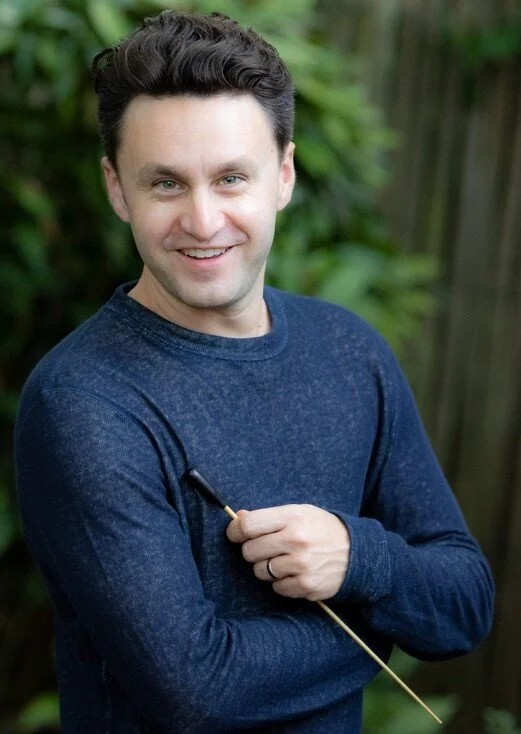
- Artistic Director Matthew Robertson will conduct the performances, and you can listen to some of my conversation with him below and on WETA Virtuoso throughout the week.
- Soprano Fotina Naumenko sang in The Thirteen’s performance of the All-Night Vigil in 2023, and she is also a vocal coach with expertise in Old Slavonic (the liturgical language of many Eastern Orthodox rites, including Russian Orthodox); she coached The Thirteen in those concerts, and she’ll be singing with and coaching The Thirteen once again in Rachmaninoff’s Liturgy of St. John Chrysostom. You can hear my interview with her below and on WETA Virtuoso throughout the week.
I’ve had the pleasure of interviewing Matthew Robertson before (as has my colleague James Jacobs), and he has been a guest blogger on Classical Score in the past, sharing with our WETA Classical audience some of his thoughts on Monteverdi and Palestrina. We’re delighted to share his perspective on Rachmaninoff’s Liturgy of St. John Chrysostom.
In 1985, Norman Scribner collaborated with the great Russian cellist, conductor, and Music Director of the National Symphony Orchestra, Mstislav Rostropovich, in a recording of Rachmaninoff’s All-Night Vigil. This recording was among the first Western recordings of this masterpiece. A contemporary reader must pause to appreciate how monumental an undertaking this was in 1985: The Iron Curtain was still largely intact, making a recording like this not only politically fraught but also musically difficult. Not only was the sheet music for the work not readily available in the west—in similar cases Slava famously resorted to smuggling musical materials out of the USSR—but the extraordinary demands that Rachmaninoff placed on the bass singers drove Norman to place an ad in The Washington Post with an image of a low B-flat note accompanied by the plea, ‘If you can sing this note, come sing with us!’ (In our performances, Rachmaninoff’s characteristic writing for low basses will be expertly handled by Eric Alatorre and Glenn Miller.)
While my interaction with Rachmaninoff’s vocal music likely began in utero (my dad sang with Norman, and this recording and I were released at around the same time), my first memorable interaction with it was when, to my parents’ surprise, I used the CD booklet as a canvas for “Masterpiece in Crayon, age 3.” That recording formed part of the backdrop of my childhood, and Rachmaninoff’s sonorities worked their way deep into my musical imagination. When I was a teenager, Norman became one of my earliest conducting teachers, and, later, an advocate for The Thirteen, serving on our Artistic Advisory Board until his death. Approaching Rachmaninoff this year feels especially tender as I remember both Norman and my dad, who passed last year.
Rachmaninoff’s Liturgy of St. John Chrysostom stands as the culmination of the sound world that the composer preserved in the Vigil and as an elegy to the long 19th century. Fundamentally, the Liturgy grapples with the question of how to respond to a world sliding toward crisis. Composed in 1910, it emerged at a moment when many Enlightenment ideals—faith in rational progress, moral self-cultivation, and the slow refinement of the human spirit—were beginning to erode, even as the clouds of the Great War and the Russian Revolution gathered on the horizon, shaping the atmosphere of the age before they broke. The once-solid cornerstone of rational thought was quicksand in the face of impending brutality. Rachmaninoff’s contemporaries responded by remaking music altogether: Stravinsky’s Rite of Spring embraced the mechanical and the macabre; Mahler’s late symphonies confronted the brutality of the modern age by juxtaposing it with great beauty; Strauss pushed tonal gravity to its limits; Schönberg broke them. Rachmaninoff, in the Liturgy (and, later, his Vigil), chose a different path. Turning from this modernist rupture, he instead wrote music that reached backward. His music was unapologetically Romantic, rooted in chant, and oriented toward spiritual and communal unity (Church Slavonic, the language of the Liturgy, the lingua franca of many Eastern Orthodox Churches as Latin is to Western Christianity).
To modern Western ears, the Liturgy can feel unfamiliar. Its reliance on chant, its generous slowing of time, its fullness of sound, and its abiding in a world of mystery all mark it as a work apart. In this we hear not escapism, but a composer affirming formation over fragmentation, rootedness over rupture, at a moment when the familiar structures of 19th century Russia and Europe began to wash away. Ironically, it was precisely the breadth and expressive richness that Rachmaninoff brought to the Liturgy—deeply motivated by his symphonic and operatic style—that led the Holy Synod of the Russian Orthodox Church to effectively prohibit its performance. As a result, the work slipped from public view in Russia for much of the twentieth century, surviving in archives yet not in churches or concert halls. It would not again see prominent performance in Rachmaninoff’s home country until close to the fall of the USSR; it then followed a path to the West that mirrored the Vigil.
Preparing these performances has allowed me to delight in a return to the sound world of my childhood. I hope you will find equal pleasure in entering a musical space of quiet formation where time seems to stop.
PBS PASSPORT
Stream tens of thousands of hours of your PBS and local favorites with WETA+ and PBS Passport whenever and wherever you want. Catch up on a single episode or binge-watch full seasons before they air on TV.