The guest author of this blog, conductor Matthew Robertson is Artistic Director of the D.C.-based professional choir and orchestra, The Thirteen. The Thirteen performs “On That Distant Day” October 17-19, 2025, featuring works by Palestrina, Duruflé, Martin, and Robinson. More information can be found at TheThirteenChoir.org. See below for an interview with Matthew Robertson to learn more about The Thirteen and the upcoming program.
Five hundred years ago, Giovanni Pierluigi was born in the Lazio hill village of Palestrina, which is, today, about a 70-minute drive east-south-east of the Vatican (under best traffic conditions). Following the death of his mother, eleven-year-old Palestrina moved to Rome, the city in which he would spend the lion’s share of his career. Palestrina’s career, as was common for the age, encompassed a period of significant disease and change in what is now modern Italy. Indeed, over the course of his life, the composer buried his wife, brother, and two sons of the plague, and had his position as a papal chorister revoked in 1555 at the vicissitudes of a Papal edict. Otherwise, Palestrina’s career followed an established pattern, beginning with his training at the Basilica of Santa Maria Maggiore through his appointment as maestro di cappella at St. Peter’s itself. And yet, Palestrina —the composer who was once defined by the town of his birth that is now defined by him—would go on to have an outsized impact on musical history. Palestrina’s body lies in the Basilica of St. Peter’s, in a coffin with a lead plate bearing the words “Praenestinus Musicae Princep”—“Prince of Music.” While he attained fame during his lifetime, his reputation grew substantially after his death. Palestrina is now viewed as the originator of the compositional style known varyingly as the “prima prattica” or as “counterpoint in the style of Palestrina.” Given his influence on generations of composers, from Bach to Bruckner, his role can hardly be overstated.
The critical composition in Palestrina’s enduring prominence is his Missa Papae Marcelli. As legend holds, in 1562—the same year as this mass may have been composed—the Council of Trent’s final sessions convened, with delegates expressing disapproval of masses based on tunes from secular drinking songs (among other less polite topics) and/or compositions that obscured sacred texts with overwrought polyphony. As the story goes, the Council was poised to enjoin against polyphony in the church altogether and it was only upon hearing this mass, dedicated to a pope with a 22-day pontificate who, on the 8th day of his reign in 1555, instructed the Sistine Chapel’s choristers to sing intelligibly, that the delegates to the Council changed course, persuaded that polyphony and clarity of text were not mutually exclusive in the proper compositional hands. While the historical record challenges this narrative, this legend had, within a generation of Palestrina’s death, enshrined his reputation as the Father of Church Music, and this mass as the work that saved it from an ignominious end.
Palestrina’s Missa forms one of the pillars for The Thirteen’s upcoming concerts, On that Distant Day, performed October 17-19 in Alexandria, VA, Washington, D.C., and Bethesda, MD. These concerts also include Maurice Duruflé’s beloved Requiem featuring organist Eric Plutz, the North American Premiere of a Canata by mid-20th Century Swiss composer Frank Martin, and a performance of Kyrie by native Washingtonian Diedre Robinson.
Palestrina, Duruflé, and Martin all share the distinction of living in interesting times: Palestrina lived through the disease, cultural upheavals, and doctrinal constraints of the Counter-Reformation, while Duruflé and Martin would both live through two World Wars, the latter of which inspired their compositions performed today. All three composers display a conscious turn to beginnings or first principles, including an influence of musical nationalism: Duruflé with the inclusion of Gregorian-like chant in his compositions, Martin with a focus on themes from his native Switzerland (le 1er août—the First of August—is the Swiss equivalent of the Fourth of July), and Palestrina (whatever the actual role he played in ‘saving’ polyphonic church music), with his focus on the clarity of the mass text and its perfect setting in imitative counterpoint and as the progenitor of home-grown church music in 16th century Italy. And all three compositions featured today exemplify the concept of triumph through adversity, per aspera ad astra.
But this is where the similarities between these compositions end, and the differences begin to emerge. Duruflé’s Requiem is searching and tender, Martin’s Cantate nostalgic and celebratory, and Palestrina’s Missa refined and ethereal in its formal perfection. We begin this program with Diedre Robinson’s demanding Kyrie, yet another take on this repeated refrain.
It is my hope that, taken together, these works provide different lenses through which to view these common themes; that today’s concert provides a fitting opening to our fourteenth season, Kaleidoscope, which celebrates our broad approach to programming as a foundational aspect of our identity; and that this concert is as meaningful to experience as it has been to program and rehearse.
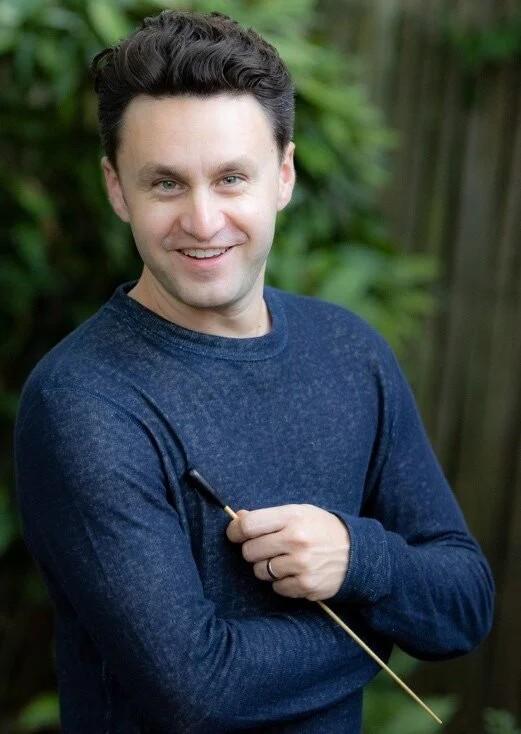
American conductor Matthew Robertson (b. 1986) is the founder and driving force of the professional choir and orchestra The Thirteen, which he has led in more than two hundred concerts, two dozen concert tours, nine commercial recordings, and numerous world premieres. Noted for boundary-defying performances that “transfigure the listener” (The Washington Post), for his “incisive tempos and dramatic pacing” (Washington Classical Review) and “flowing lines and dramatic climaxes”(Fanfare Magazine, UK), Robertson’s boundless artistic vision has led to acclaimed performances of a vast and varied repertoire, often featuring inspired use of staging and multimedia and to The Thirteen’s winning the Most Creative Programming Award from the Greater Washington Area Choral Music Awards.
Recognized as a leader in the field, Robertson advances the frontier of vocal music performance, reimagining music from the entirety of the classical music canon. Equally at home in well-loved classics and contemporary works, Robertson tackles works by Renaissance and Baroque masters and contemporary composers with equal skill. For example, Robertson’s curation of Monteverdi’s end-of-life magnum opus Selva morale resulted in concerts in The Lost Vespers series, while his performance of contemporary composer David Lang’s the little match girl passion was praised by Anne Midgette of The Washington Post: “In contrast to the Tallis Scholars’ slightly dry sound, The Thirteen sings with striking color and richness.” Robertson’s passion for reinterpreting masterpieces has led to staged performances of J.S. Bach’s St. John Passion and Johannes Brahms’ Requiem, and the use of projected images in Kile Smith’s The Consolation of Apollo, Scott Ordway’s The Outer Edge of Youth, and the Washington, D.C. premiere of Talbot’s Path of Miracles.
Drawing on his deep commitment to addressing important issues of our time, Robertson’s programming frequently tackles the topics of ecology and systemic racism. His concerts Sing Willow (2020), From Tree to Shining Tree (2019), and Ordway’s Outer Edge of Youth (2022) addressed the existential threat of climate change. His staged 2021 performance of J.S. Bach’s St. John Passion addressed the theme of systemic racism and was called “an indictment of injustice” (The Washington Post). He frequently commissions underrepresented voices, including composers Juhi Bansal, Melissa Dunphy, Lori Laitman, Hilary Purrington, Trevor Weston, and Jonathan Woody. In 2019 he created The Thirteen’s Vocal Fellows Program, an initiative for young singers from underrepresented demographics that debuted in 2021.
Committed to fostering the next generation of musicians and music lovers, Robertson has led educational residencies at more than twenty colleges and universities, including Yale University and The University of Maryland – College Park, where he led a staged performance of Johannes Brahms’ Requiem. He has also directed educational outreach for young people throughout the Washington, D.C. region, including with the LGBTQ+ teen choir, GenOUT.
Robertson’s growing discography with The Thirteen of nine commercially released albums, including the recently released Monteverdi: Vespers of 1610 with Dark Horse Consort and the Children’s Chorus of Washington and The Outer Edge of Youth, of which Gramophone wrote “…Robertson’s pacing is faultless, and he shows how silences and breaths are as important in this music as the notes themselves." He enjoys a fruitful relationship with Acis Records: Truth & Fable received four stars from Choir & Organ and Fanfare when it was released in September 2019, and recently released Monteverdi: The ‘Lost’ Vespers with them in 2024.
Robertson also serves as Director of Music at Bradley Hills Church in Bethesda, MD. Leading the Bradley Hills Choir and Orchestra of the Hills, Robertson has performed much of J.S. Bach’s oeuvre, the requiems of Brahms, Duruflé, Fauré, and Mozart, Arvo Pärt’s Passio, Buxtehude’s Jesu membra nostri, Carissimi’s Jephte, and many other masterworks. Robertson is a Trustee of the Denyce Graves Foundation and has also served on the Board of the DC area chapter of the American Choral Director’s Association and on the faculty of Oberlin’s Baroque Performance Institute. Robertson holds a M.M. in conducting from Westminster Choir College in Princeton, NJ, where he studied with Andrew Megill and Joe Miller, and was the Robert P. Fountain scholar at Oberlin Conservatory where he studied with Bridget Reischl and Robert Spano. A native Washingtonian, Robertson’s early musical formation included studies with Norman Scribner and J. Reilly Lewis.
PBS PASSPORT
Stream tens of thousands of hours of your PBS and local favorites with WETA+ and PBS Passport whenever and wherever you want. Catch up on a single episode or binge-watch full seasons before they air on TV.