Join Evan Keely for the special program Black Voices in Classical on WETA Virtuoso. On Tuesday, February 10 at 2pm, the program presents the music of Howard University alumnus Adolphus Hailstork (b. 1941). Wednesday, February 11 at 2pm, we will explore music by Chicago native Margaret Bonds (1913–1972).
It’s been not quite half a dozen years since I joined the crew at WETA Classical. I came to it at that peculiar phase of life in which one is too old to be “young” but too young to be “old” — nel mezzo del cammin di nostra vita, as Dante put it, though his fourteenth-century mathematical equivalent thereof was quite different from ours. Suffice it to say two things: being part of the WETA Classical team has been the greatest joy of my professional life, and starting a new career path in mid-life necessitates no small degree of humility. Admittedly, the humility-inducing circumstances and the aforementioned abundance of joy are in no way unrelated, but perhaps that’s another blog post.
Humility and joy are also what’s needed for someone like myself to be called upon to share something with our audience about the incomparable contributions that Black artists have made to the world of classical music. After much discussion with my colleagues, we decided I would focus on just two artists for Black History Month 2026. Both are composers, and both American: Margaret Bonds and Adolphus Hailstork.
In both instances I was able to draw upon some of my conversations with John Banther, host and producer of Classical Breakdown, the WETA Classical podcast. It’s been my privilege and my pleasure to be John’s guest on the pod many times. In an episode recommending six works by living Black composers, one piece I lifted up was An American Port of Call by Adolphus Hailstork. More recently, we devoted an entire episode of the show to this composer.
I’ve really enjoyed getting more acquainted with the exciting, imaginative, skillfully-wrought works of this composer, whose oeuvre includes symphonies, concertos, organ music, choral pieces and chamber music. I also was quite moved hearing one of his pieces live a few years ago.
It gratifies me immensely that this superb composer’s works are being performed and recorded. Deciding which of his pieces I wanted to share on the WETA Virtuoso program was daunting, though it was wonderful to wade deeply into his immense talent in that process.
Margaret Bonds was quite a different experience altogether. Born in Chicago in 1913, she died in Los Angeles in 1972. Although she achieved a great many things in her lifetime, following her death her compositions were not as well remembered. Many that had been published went out of print; scores of her work have been less readily available. Selecting recordings of her work for a radio program was therefore a very different challenge, as there are far fewer than her genius deserves. It is only in recent years that the work of this superb composer has been enjoying something of a revival.
John Banther and I had a conversation about a Christmas cantata she composed in 1954, Ballad of the Brown King, one of her many collaborations with her good friend Langston Hughes, who wrote its text. We recognize our indebtedness to Dr. Malcolm J. Merriweather, who conducted a performance that may be the only commercially-available recording of this work (an album that has also been featured on Choral Showcase with Bill Bukowski — where I first heard it).
But what I really wanted to do was further explore her 1964 orchestral work Montgomery Variations. Felicitously, a new recording of this masterpiece just came out last summer, nominated for a Grammy award (who won?).
I dare say few will be surprised that a classical radio host and producer such as myself listens to a lot of music. Those of us in this happy lot give ear to countless recordings and delight in many live concerts. I am continuously in awe at the great music, brilliantly performed, that I’ve been able to experience, in person or digitally.
And then, once in a great while, there comes that experience that changes you. You’re not who you were after hearing it and experiencing it; you can’t go back to life just as you lived it before.
That was my experience with plumbing more deeply into Mongtomery Variations for this WETA Virtuoso program.
I’m grateful to Hildegard Publishing Company for producing a study score, fastidiously edited by John Michael Cooper. This immensely enhanced my understanding and appreciation of this brilliant, devastating work.
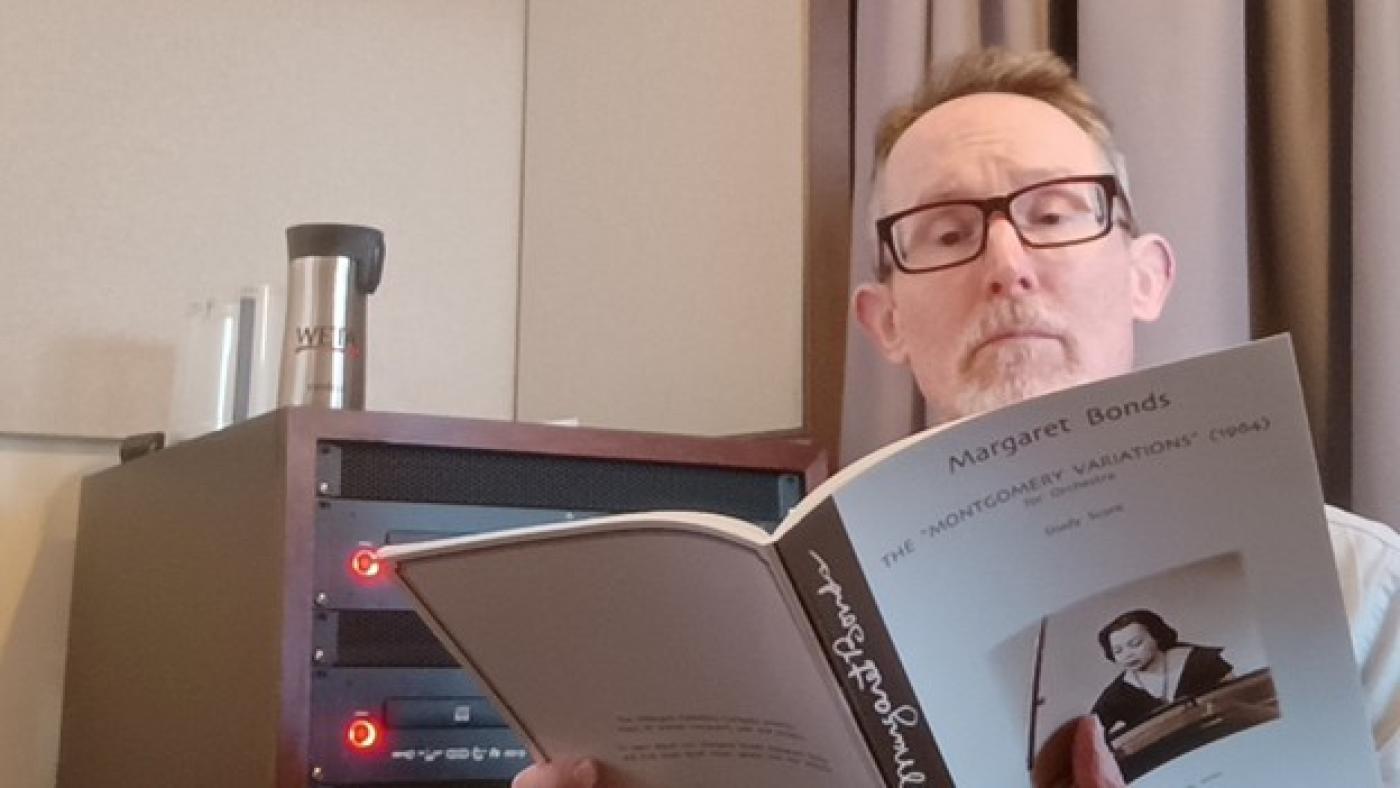
The final movement is entitled “Benediction”. But the entire work is a blessing — a shocking, revitalizing, heartbreaking, healing revelation about a chapter of American history, but also about the eternal now, about the future of humanity and the great moral struggle for greater freedom, greater dignity, greater lovingkindness for all of us as we strive and weep and rejoice under the sun, under the stars.
Please join me on WETA Virtuoso on Tuesday, February 10 at 2pm, for a program on the life and music of Adolphus Hailstork, and on Wednesday, February 11 at 2pm, for a program on the life and music of Margaret Bonds.
PBS PASSPORT
Stream tens of thousands of hours of your PBS and local favorites with WETA+ and PBS Passport whenever and wherever you want. Catch up on a single episode or binge-watch full seasons before they air on TV.