This article is the final installment in a series of my conversations with Washington, D.C.-based opera scholar, Saul Lilienstein, about the Verdi operas scheduled for broadcast this season on WETA Classical’s Opera Matinee Saturday afternoon feature. It’s been a delight to get Mr. Lilienstein’s insights into opera, many of which he has shared throughout the Washington, D.C. community through his involvement with professional arts organizations, universities and The Smithsonian. This conversation includes references to comments Mr. Lilienstein previously presented in his lecture series for Washington National Opera.
Here, we discuss Verdi’s Il trovatore, presented by the Metropolitan Opera on May 3, 2025 at 1:00 pm (ET) and broadcast on WETA Classical’s Opera Matinee. Further information is available at WETAClassical.org. Thank you, Mr. Lilienstein.
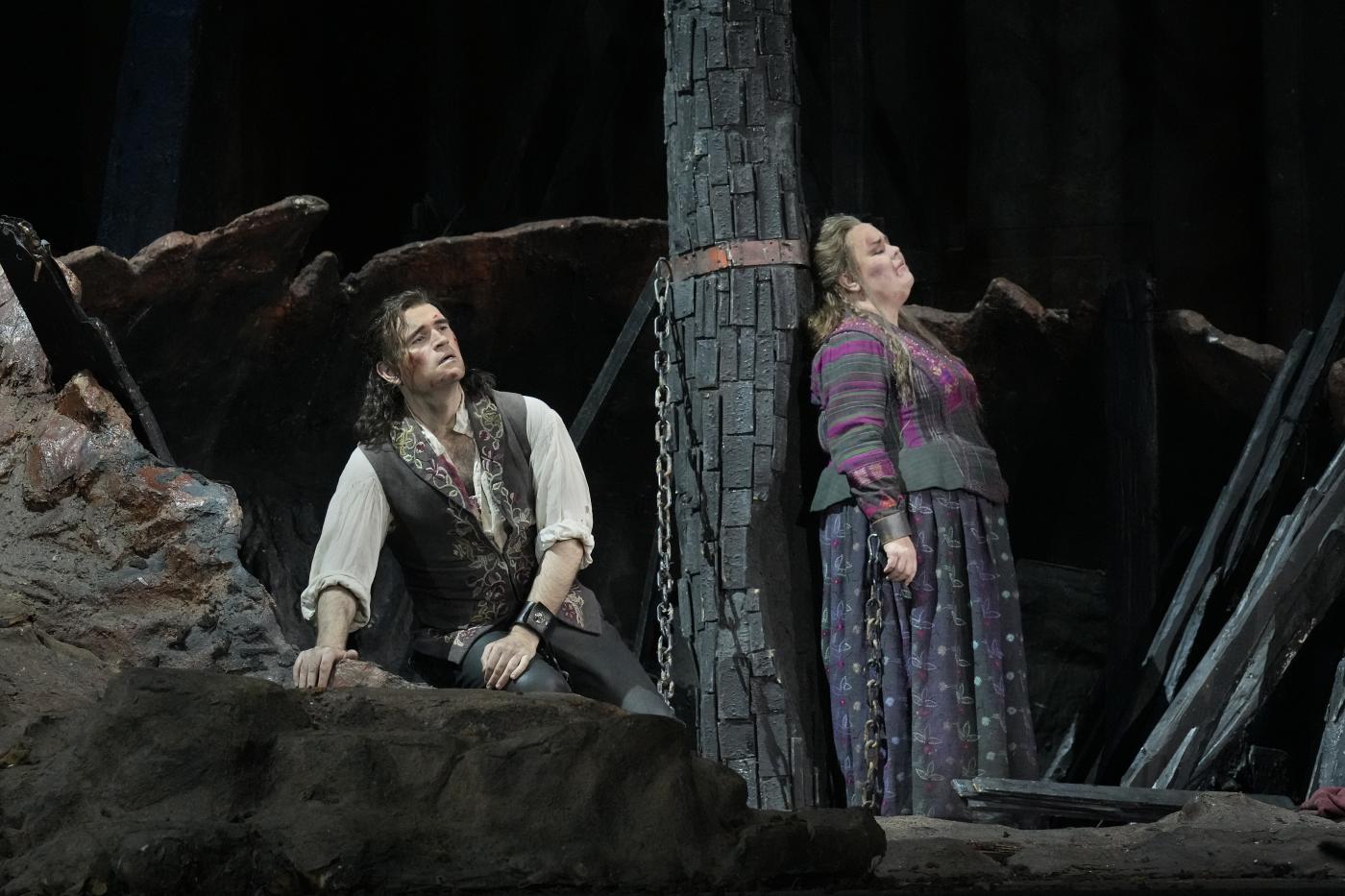
Linda Carducci: The underlying story of Il trovatore (The Troubadour) strikes modern audiences as convoluted and unrealistic but undeniably dramatic with swapped babies, knights locked in bitter hatred, murder, and insanity driven by death and passion. It takes place in 15th century Spain, during a civil war between the provinces of Aragon and Biscay. Two men – a love-crazed young nobleman, the Conte di Luna, and a mysterious troubadour and army officer named Manrico – compete for the love of the same woman, Leonora. But the backdrop of this love triangle is vital to the story: Years earlier, a mysterious woman was accused of cursing di Luna’s infant brother. When the infant becomes ill and disappears, the woman is condemned as a witch and burned at the stake. Her daughter, Azucena (who has a prominent role in this opera) witnesses her mother’s funeral pyre while holding both her own infant son and the di Luna infant. Traumatized, she mistakenly throws her own son into that fire while holding on to the di Luna child -- who is really the infant Manrico. Azucena raises the child as her own. Meeting as adults, di Luna and Manrico don’t know that they are brothers and become bitter enemies as they fight for Leonora’s affections. In a dramatic finale, Azucena reveals Manrico’s true identity after he is executed by di Luna, her mother’s death avenged. High drama, but maybe not as strange a scenario as we might think.
Saul Lilienstein: Verdi didn’t think the story was strange; he thought it was possible based on events in his own life. The small village in Northern Italy where he was born in 1813 and raised was within the borders of the French Empire and under occupation by the French Napoleonic army. In his youth, these armies would go through Northern Italian villages and kill women and children indiscriminately. Verdi’s village was greatly affected. He survived infancy when his mother hid him in a barn to protect him from the marauders. What if he had whimpered while in his mother’s arms? His story would have had a different outcome. He survived past infancy by a stroke of luck, and he knew that. He believed in destiny. So the grim realities of his childhood and the mad fatalism of the story of Il trovatore were not so far apart in Verdi's mind.
The basis of the opera was a popular 19th century play, El Trovador, by Antonio García Gutiérrez that takes place in 15th century Spain during the terror of the Spanish Inquisition. The play was written in the style of Victor Hugo – high Romanticism. The play and Verdi’s adaptation included true elements of life in the 15th and 19th centuries.
LC: Il trovatore was composed during a significant period of Verdi’s artistic development, one of three Verdi masterpieces that included Rigoletto and La traviata. The three were written between the brief period of less than three years -- 1851 to 1853. An astonishing feat.
SL: It’s hard to think of many opera composers who accomplished that. Some of Verdi’s most original and loved music are contained in these three operas; they’re full of sensuous arias and robust, spirited choruses. Each is enduring and important to the opera repertoire.
LC: As we’ve discussed in previous blogs (available for search on Classical Score), Verdi used significant innovations in Rigoletto and La traviata, yet he returned to a more traditional style of composition and structure for Il trovatore. Why?
SL: Innovation and progression in any endeavor, including art, don’t always move in a straightforward path. Medicine, for example, continually improves and gets more refined and focused toward healing a particular disease, but it does so in a gradual manner. And look at Beethoven: his symphonies are progressively innovative but not in a linear way. After his innovative and large Third Symphony (Eroica), for example, he gave us a traditional Fourth Symphony. After his powerful Fifth Symphony, full of fate and fury, he followed up with a peaceful Sixth Symphony (Pastoral). We see that pattern with other composers, including Verdi.
Also, Verdi was dependent upon what the librettists gave him. The shape of every opera is formed and dictated by the structure and length of its lines, and the rhyme scheme provided by librettists. Verdi often said he could do nothing without the words first, although he would give his librettists a general structure of the music so they could fit the words within. In the case of Il trovatore, his highly-regarded librettist, Salvadore Cammarano, gave him a very traditional libretto. Cammarano was older than Verdi and had previously written the libretto for Donizetti’s Lucia di Lammermoor. Verdi wasn't particularly happy with early drafts of Cammarano’s libretto, but Cammarano died before he could revise it. This was an inhibiting situation. But out of respect for Cammarano, Verdi kept the libretto as written and didn’t make any adjustments.
True, Il trovatore is structurally rigid compared to Rigoletto and La traviata, but a solid, formal design – like a box -- is not an impediment because it requires and inspires an extra dose of creativity to devise something artistic within a defined structure. Look at all of the great work by the Viennese Classicists who composed within a standard sonata form. Verdi welcomed the structure of a box not only for the challenge of creativity but also because an explosion within a box is much more intense than one in open air.
LC: The music in Il trovatore is highly-charged, full of wonderful melodies that Verdi produced in abundance, with a range of styles from tender to dramatic. It’s scored for a large orchestra that includes harp and a wide array of percussion. It also includes the famous Anvil Chorus. Like Rigoletto, it’s tight and moves at a rapid pace.
SL: Has there ever been anyone more straightforward than Verdi? Has there ever been a work that from the beginning so clearly proclaimed itself grim, gripping, dark, powerful, unforgettable? There’s a constant forward motion starting with the prelude, one of the briefest openers he ever wrote. Right at the start, Ferrando, a captain of di Luna’s guard, commands his troupes to “Wake up” while di Luna watches for Leonora. It’s an aggressive insistence followed by attention-gripping horns. It’s almost as if Verdi is telling his audience, “Wake up! Pay attention!” This unrelenting pace, this insistence, which is quicker than anything he wrote up to Falstaff, is part of the tinta of this opera, referring to the tempo of the music, how rapidly the drama proceeds, how the orchestration is used to propel the narrative in a constant forward motion that drives the work.

Leonora, the naïve young woman pursued by di Luna and Manrico, has sweet moments but her true spotlight is in the finale Act; with sorrow and anguish, she prays for Manrico’s safety and sacrifices herself to di Luna in return for Manrico’s freedom.
Verdi portrays the men with forceful and direct music as they vie for sexual supremacy. Di Luna, a baritone, has strong music befitting a young love-crazed man determined to win Leonora and destroy Manrico. Di Luna delivers a sincere, impassioned expression of love for Leonora that starts sweetly but builds to a strain within the high baritone range to portray a heightened a sense of urgency and anxiety. Verdi used a similar device with Rigoletto, who strains vocally as he feels destructive elements unfold. Manrico, like many tenors, is focused on impassioned expressions of love when he isn’t physically fighting di Luna – although we hear his evolution in the final scenes.
The famous Anvil Chorus, another example of Verdi’s talent for melodies, opens Act 2. A group of Romani gather at night to craft their tools. They remark on the darkness of the night, punctuated by loud clangs as their hammers strike anvils. It’s the second part of the Anvil Chorus that contains the primary melody, a stylistic device that Verdi used elsewhere in the opera.
LC: Azucena’s constant presence drives this tragic narrative. Is she a supporting character or might we consider her the main character? Here is a multi-dimensional person; her life has been marked by tragedy, suffering, love and sacrifice. We might draw parallels between Azucena and Amneris, a supporting character in Verdi’s Aida, who is really the most interesting character in that opera because she suffers and evolves more than others.
SL: Yes, in fact, Azucena’s role is vital in transforming the narrative beyond a love triangle. She is one of the most troubled and tormented characters in all opera. She lives with the trauma of witnessing her mother’s death at the stake and the horror of mistakenly casting her son – her own flesh and blood -- into that fire. Yet she cares for Manrico as her own and she suffers with him as they await execution. And it is Azucena who closes the opera in dramatic fashion with a shocking exclamation.
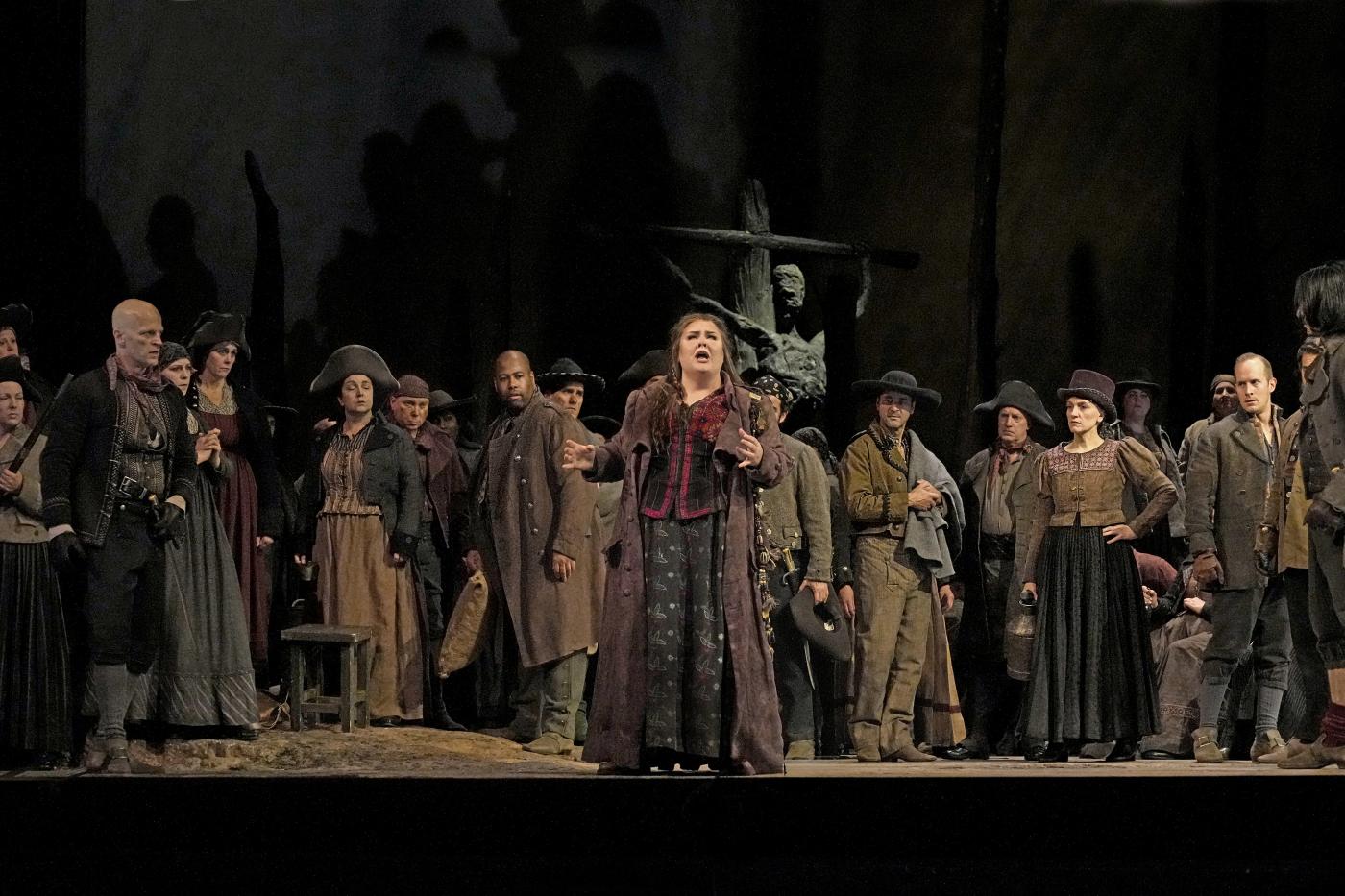
LC: I imagine that Verdi enjoyed creating music for this complex character.
SL: Verdi had never before given a major role to a dramatic mezzo-soprano. Maybe he associated Azucena with his own mother, who had just recently died, because the essence of Azucena is maternal, fiercely loyal to her child, even though that child, Manrico, is not her own. Verdi portrays her with dark shades and a roughness of instrumentation associated with a troubled spirit. After Ferrando’s opening call to awaken, Azucena takes center stage to tell us the backstory – a burning fire, a frenzied crowd, her mother dragged to a funeral pyre, flames leaping to the sky, her terror in approaching the fire while her mother calls out to her, “Avenge me!”, her confusion as she casts her own son into the pyre, and her kidnapping the di Luna child, Manrico. A traumatic tale that the orchestra supports with tight rhythms and accents, sparse instrumentation and strings in short phrases. Dramatic orchestral writing to portray terror and pathos.
LC: The final Act brings all of these elements together with passion and emotion. Leonora tries to save Manrico from execution by making the ultimate sacrifice, while we witness the poignant affection between mother and son -- Azucena and Manrico -- in the dungeon as they await execution. I’m reminded of the final duet in Verdi’s Aida in which Aida and Radamès are entombed together. Verdi’s music perfectly supports this tableau.
SL: It’s here where we experience Verdi in his greatness as a human being. He’s filled with compassion for his characters even from the very beginning, but we hear it in fullness in this final Act. Leonora prays that breezes carry her love to the imprisoned Manrico -- “D'amor sull'ali rosee” (On the rosy wings of love). Here again, Verdi saves something special for the second phrase of that aria that propels us to the next moment: the celebrated Miserere from the chorus with Leonora’s voice soaring above, accompanied by orchestral rhythms, tolling bells and chanting monks that signal the horror of impending death. Leonora hears haunting, sorrowful cries of farewell from Manrico in the dungeon. Manrico has evolved from a generic tenor to a man filled with compassion for his suffering mother, Azucena. In a moving duet, Manrico tries to comfort Azucena, and she relates her calming dream of returning to their peaceful homeland in the mountains, far away from this turmoil. These are wonderful characterizations; her weariness, his comforting tones. Throughout this scene are simple melodies, not full arias and seemingly not composed but rather, natural human utterances.
Verdi continuously evolves the music as the opera drives toward its powerful finale. Di Luna’s army closes in on Manrico and Azucena. Leonora offers herself to di Luna in exchange for his granting Manrico’s release. Di Luna agrees, and she secretly swallows poison as a sacrifice for this dreadful deed. She hurriedly goes to the dungeon to free Manrico and Azucena. He asks her to accompany them in their escape, but she refuses. He feels betrayed by the bargain Leonora struck with di Luna for his release. He rebukes her in a simple but honest, heartfelt expression – three notes as simple as “Three Blind Mice” -- that appear like lightning. Leonora dies in Manrico’s arms, saying that she would rather die than live with anyone else. Manrico then realizes Leonora’s sacrifice. Di Luna arrives to find Leonora dead. The music in this final trio is tender, sorrowful, and dramatic. Then the final moments occur with brutal swiftness: Di Luna’s army drags Manrico to his execution. Accompanied by crashing music, Azucena screams to di Luna as Manrico dies: “Egli era tuo fratello! Sei vendicata, o madre!” (He was your brother! You are avenged, oh mother!)
LC: This is true Romanticism – expressive, dramatic, passionate, emotional -- exquisitely crafted.
SL: Yes, it’s one of the high points of 19th century Romanticism. How the Romantic poets and playwrights and novelists must have envied musicians in putting their thoughts to music.
This powerful collection of very human emotions is why Verdi took this opera so seriously. He knew terror and human emotion. He embodied what it was to be Italian. He’s often associated with the Risorgimento movement of the 19th century in which Italians sought to unify their various states and principalities into one Kingdom of Italy. Verdi supported the Risorgimento, but his strongest connection to Italians was the man himself, who, through his music, embodied the Italians’ own life and dreams.
PBS PASSPORT
Stream tens of thousands of hours of your PBS and local favorites with WETA+ and PBS Passport whenever and wherever you want. Catch up on a single episode or binge-watch full seasons before they air on TV.