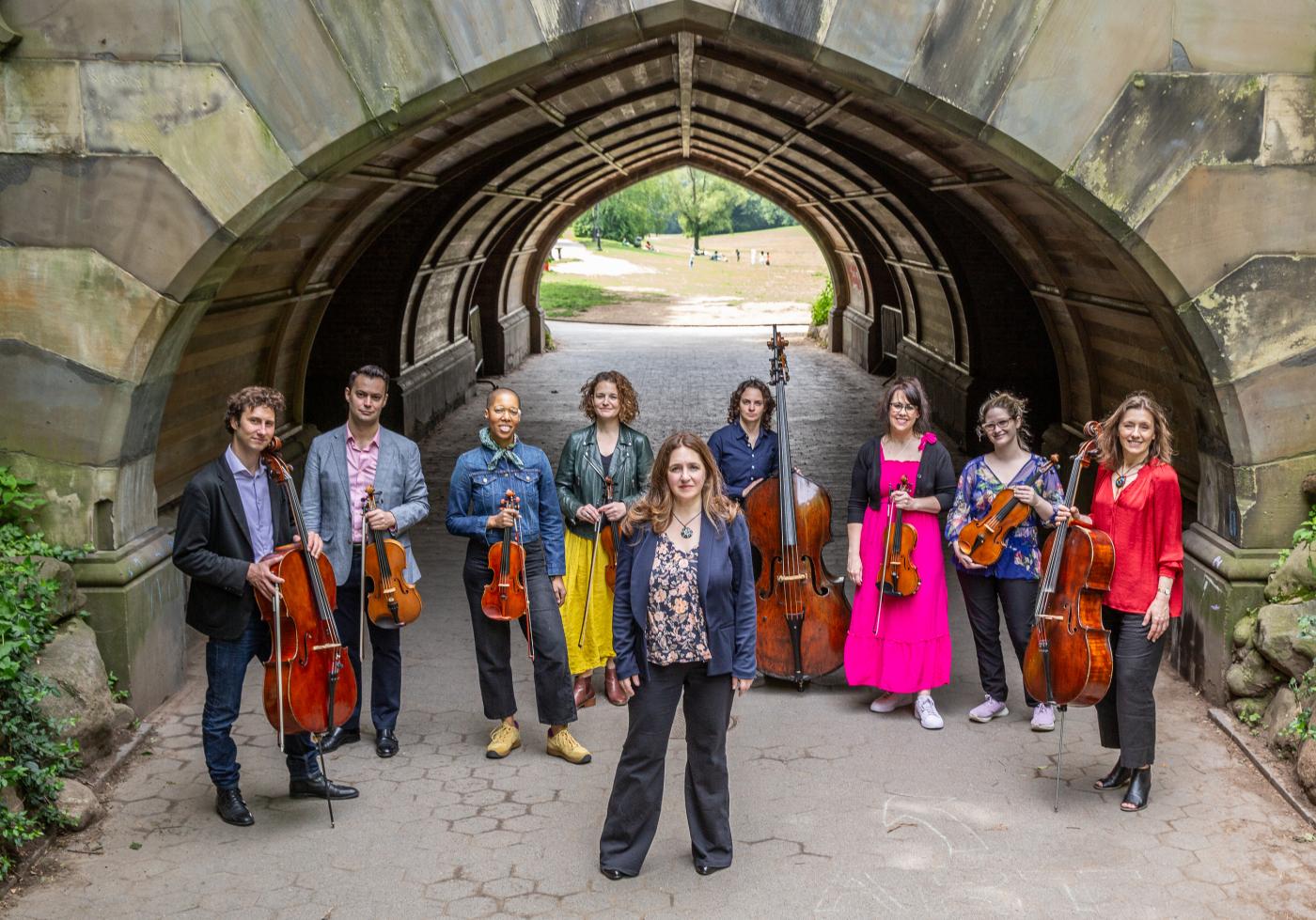
Pianist Simone Dinnerstein founded the string ensemble Baroklyn in 2017. Yes, that’s a portmanteau of “baroque” and “Brooklyn”, the latter being Dinnerstein’s home, and the former being the focus of the group when they first came into existence — specifically, they explored the music of J. S. Bach.
Earlier this year, they came out with a new album, playing music by living composer Philip Glass. Hourglass features performances of a suite from Glass’s score for the film The Hours (not to be confused with the opera by Kevin Puts) and his Tirol Concerto (a.k.a. Piano Concerto No. 1).
Dinnerstein and Glass have a years-long artistic partnership. He composed his Piano Concerto No. 3 for her; she gave its première in 2017 at New England Conservatory’s Jordan Hall with the chamber ensemble A Far Cry (they recorded it the following year).
Glass’s music is famously known for its repetitions. What I find fascinating is that these are not electronically generated loops. A group of people are playing these repetitions live. Every repetition is a reaction to the one before and an anticipation of one to come. We hear differently because our hearing changes with each note; we carry the whole unfolding of the music with us as we listen. We hear it as a constant becoming, not as a set of musical facts. This is exactly why I don’t hear Glass’s music as mechanical. It makes me think about the hourglass rather than the factory clock. A clock divides time into discrete, measured steps, in a way that in many parts of contemporary life feels natural. In music we can feel a vestige of the unnaturalness of that relentless pulse, an unhuman rigidity. Like our experience of time, music sometimes seems to move faster, sometimes slower, sometimes chaotically, sometimes evenly. The hourglass, with its unsubdivided and embodied flow, is how I think of this music.
– Simone Dinnerstein, from her liner notes for Hourglass
PBS PASSPORT
Stream tens of thousands of hours of your PBS and local favorites with WETA+ and PBS Passport whenever and wherever you want. Catch up on a single episode or binge-watch full seasons before they air on TV.