Violinist and Washington, DC native Benjamin Beilman will join cellist David Finckel and pianist Wu Han to play Franz Schubert’s two piano trios on Saturday, October 4 at Takoma Park Seventh-Day Adventist Church for the latest installment in the Anna H. Wang Concert Series.
In 2019, Wu Han was a guest on the second episode ever of WETA’s Classical Breakdown, now in its seventh season.
Featured in concerts all over the world, just a small sampling of the orchestras Beilman has played with include the Berlin Philharmonic, the Chicago Symphony, the Oslo Philharmonic, the Tokyo Metropolitan Symphony, the Philadelphia Orchestra, the London Philharmonic, the Taipei Symphony, the Tonhalle-Orchester Zürich, and the Sydney Symphony; Yannick Nézet-Séguin, Cristian Măcelaru, Lahav Shani, Krzysztof Urbański, Gemma New, Karina Canellakis, Jonathon Heyward, and Han-Na Chang are just a few of the conductors with whom he has performed. While mastering older repertoire, he is also a champion of newer and contemporary music, having played the Violin Concerto by Jennifer Higdon in several venues; composers Frederic Rzewski and Gabriella Smith have written works for him, and he was the soloist in the premiere of Chris Rogerson’s Violin Concerto (“The Little Prince”) in 2022.
He studied with Christian Tetzlaff at the Kronberg Academy, and with Ida Kavafian and Pamela Frank at the Curtis Institute, where he himself became a faculty member in 2022. I was glad to have the opportunity to connect with this extraordinary artist.
Evan Keely: This is going to be a remarkable concert of two monumental works Franz Schubert composed near the end of his life: the Piano Trios No. 1, Op. 99 and No. 2, Op. 100. You, Wu Han and David Finckel will also be giving this program in the Twin Cities and New Orleans right after your appearance in Takoma Park, and Schubert’s Trio No. 2 with Shostakovich’s Op. 67 next year. How did this collaboration between the three of you come about? Can we look forward to other performances of this trio of artists in addition to the aforementioned?
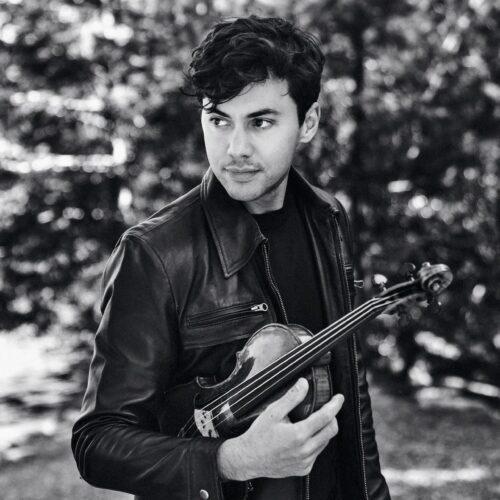
Benjamin Beilman: I’m pretty sure the first notes I ever played with David and Wu Han actually came from the Schubert B flat piano trio that opens our concert in Takoma Park. Almost 15 years ago, I auditioned for the Chamber Music Society of Lincoln Center’s young artist program (now called the Bowers Program) and I distinctly remember getting ready to play this mammoth piece as part of the audition. David and Wu Han wanted to get a feel for each applicant by playing some pieces alongside all the violinists in the audition. In those moments before starting, I remember preparing for a massive up bow while David was clearly telegraphing that he’d start down bow. Cautiously, I asked David if I should start down bow like him and, with a sly grin, he just said “you do whatever feels right.” Fortunately, I passed the audition and the rest is history.
In the years since, we’ve performed dozens of times together on three different continents, and made countless recordings (including a recent Beethoven “Archduke” piano trio recording that should hopefully come out in early 2026.) During the concert hiatus of the early days of Covid, David and Wu Han had the brilliant idea to transform their living room into a recording studio so that we could use that free time productively. After rigorous testing and safe isolation, we spent weeks diving into some of the most complex music (these piano trios.) This mini tour to Maryland, Minnesota, and New Orleans is the reward for that in depth rehearsal and recording experience.
EK: These two trios by Schubert are among the most often played of his chamber pieces. It seems like nearly every other movie or TV show includes the haunting, lyrical slow movement from the Op. 100. Maybe — maybe? — these trios are somehow more accessible than some other Schubert small-ensemble works — like, say, the immense Octet D. 803 or the searing, soaring String Quintet in C, D. 956 — but they’re still daunting, colossal, enigmatic in their own way. (I’m increasingly inclined to think that the epic scale of Schubert compositions like these paved the way for the titanic musical structures built by Wagner, Bruckner, Mahler et al.) These performances have got to be such a deep immersion into these two pieces for you and your two colleagues. What do you want audiences to know about your approach to this music, and what do you hope we’ll take away from your performance?
BB: These two piano trios were written in the last year of Schubert’s life, when his awareness of mortality seemed to spur him to a new plane of artistic enlightenment. It’s hard to put into words just how genius this era was for Schubert, but if I had to name one thing I enjoy most in these trios, it’s how he encapsulates the duality I think we all feel — how to reconcile our inner self with the outside world. Yes, the two works are extended in length, but I don’t think they’d be as sublime if they were shortened. The best things in life take patience, and these two pieces are worth it.
EK: You are playing a Guarneri del Gesù violin crafted in 1740 (the “Ysaÿe”), a loan from the Nippon Music Foundation, with a bow (the “ex-Balaković”) made by François Xavier Tourte around 1820. The history of these precious items must be amazing; what can you tell us about that? How long have you been playing with this violin and this bow? Do they present special challenges and opportunities when you’re playing music composed long after they were constructed?
BB: Oh yes — the violin has a very special history. I’ve been fortunate to play on this violin for the last 3 years and that places me as the most recent player in a very long line of greats. Eugene Ysaÿe (the great Belgian virtuoso, conductor, and composer) acquired the violin from a former student in the early 1900s and became so enamored with it that he had a luthier place a special label inside it that says in French, “this instrument was my faithful companion throughout my entire career.” After him, Yehudi Menuhin had a brief stint with the violin, then the conductor Charles Munch, and then (maybe most notably) Isaac Stern chose this violin as his main concert violin.
With such a storied violin, I couldn’t help myself but go back and research the significance of this violin, not just from a historic perspective but also how it affected the music written for it. Ysaÿe composed his famous 6 solo violin sonatas on this very violin, Cesar Franck’s violin and Piano sonata (written as a wedding gift for Ysaÿe) was championed on the instrument, and countless works commissioned by Isaac Stern were premiered on the violin. There’s a wealth of history to draw from, and I’ve even put together a violin and piano recital just to celebrate the history this very violin has created.
It’s an honor and an obligation to play the violin. When you can listen back to the recordings of the greats making incredible sounds using the same tools I have in my hands, it can only inspire me to play even better.
EK: You’ve played on most of the earth’s continents with some of the most renowned soloists, ensembles, orchestras and conductors; with your colleague Yekwon Sunwoo you’ve recorded Prokofiev Sonatas and put out an album of Schubert, Janáček, Stravinsky and Kreisler on Warner Classics. What’s ahead for you that you’re especially excited about? I hope you’ll be back in Washington soon and often.
BB: Certainly, exploring the Schubert Trios with David and Wu Han feels like a unique privilege, and I’m really looking forward to this violin recital I just mentioned. I’ll perform it on tour in November with pianist Gloria Chien, culminating in a big concert in New York at Alice Tully Hall. We’ll record that program in December, and (fingers crossed) we’ll have it ready to launch early next year.
PBS PASSPORT
Stream tens of thousands of hours of your PBS and local favorites with WETA+ and PBS Passport whenever and wherever you want. Catch up on a single episode or binge-watch full seasons before they air on TV.