The Washington Bach Consort has launched a new program this year: the Annual Celebrity Organ Recital. Its inaugural artist will be James O’Donnell, who was Organist and Master of the Choristers at Westminster Abbey from 2000 to 2022; since 2023, he has been Professor in the Practice of Organ and Sacred Music at the Yale Institute of Sacred Music.
In a concert on Friday, February 27, James O’Donnell will be playing the Clavier-Übung III by Johann Sebastian Bach at St. George’s Episcopal Church in Arlington, Virginia, on the church’s Pasi Opus 28 instrument: completed and dedicated in 2022, it was built by Martin Pasi and Associates, organ builders based in the Seattle area.
I recently spoke with James O’Donnell about Clavier-Übung III and the Washington Bach Consort’s Annual Celebrity Organ Recital. This interview is edited here for brevity and clarity.
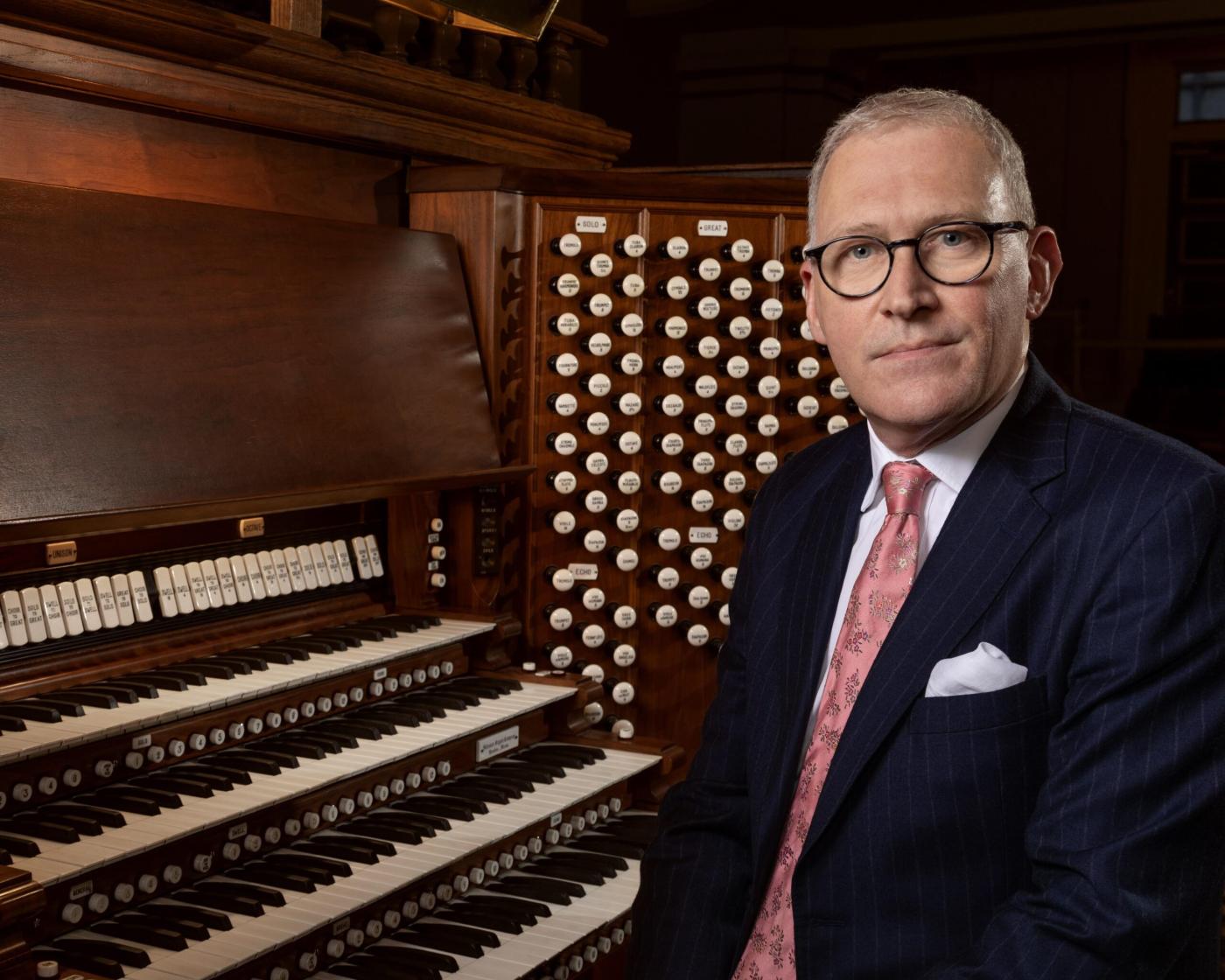
Evan Keely: Here’s this very intellectually demanding and really vast collection, two hours of music, the Third Part of the Clavier-Übung. Why this piece? What is it about this piece that made you want to select this, to choose this for the Washington audience? What does it mean for you to play it? What are your personal connections to it? What’s your perspective on it? Anything you want to share about your relationship with this work?
James O’Donnell: I should clarify that I’m not going to play the entire thing. I’m going to play what are called the pedaliter, or rather the large pedal settings. This is based on the Lutheran catechism hymns, which were used in Lutheran worship — and which sort of were a compendium, as it were, of Lutheran spiritual practice, a summary or a distillation of it.
This makes a superb unit of maybe an hour and a quarter of music. It’s very concentrated. It’s bookended by the great prelude and fugue in E flat.
EK: The “St. Anne”.
JO: Well, we call it “St. Anne”. Bach would not have — I don’t think — would have recognized that. It resembles the hymn tune, “St. Anne,” which is used for “O God, Our Help in Ages Past”; I think that’s just one of those musical coincidences, but it’s what we call that [fugue]. And even with the key of E flat major, we’re already into symbolism, because E flat major has a key signature of three flats — and the three symbolizes the Trinity, obviously. There are so many more aspects of the symbolization of the Trinity.
Bach was keen on numerology and symbolism, and a lot of scholars have had endless hours of amusement unravelling and theorizing on this. And some of this is undoubtedly right: Bach was very keen on connecting the structure of the music — not just the musical structure, but the formal structure of the collection — into the wider theological significance of numbers and relationships. So there’s a whole web or framework going on around this music, which I think adds to its fascination. You don’t really need to know about that stuff to enjoy either listening or playing it, but I think it does add a great deal of fascination and a great deal of depth to this.
The key signature is not the only triple symbolism here. There are three parts of the music in the prelude, and they have been taken, of course, rather obviously, to represent the Father — the rather grand, French-overture-style prelude, with its dotted rhythms in its swagger and grandeur; and the more expressive, manual-only music, which is taken to regard Christ, the supplicant on behalf of us sinners; and then the more rushing, toccata-like material, which is taken to represent the Holy Spirit. I think that seems likely to me, and it certainly adds that kind of theological structure.
And on the other hand, you have the fugue, which is in three distinct sections: the first, kind of old-fashioned, kind of what we might call the stile antico or the old style of music, which is polyphonic, a bit like a motet. Then there’s a more fleet and athletic and exuberant middle section — again, only on the manuals. And then finally, that kind of dance-like last section where the pedals reappear. So we’ve got the Trinity going on very strongly.
I think it’s a fascinating sequence of music, and it uses so many styles and so many sonorities — it showed so many facets of not just Bach, but of the music of the time, and what he did with it: it was a very strange amalgam of the old and the new. And when he used the new, he would introduce the old. So one of the famous movements is the Vater unser in Himmelreich, which is the Lord’s Prayer — a catechism hymn to which the Lutherans sung a version of the words of the Lord’s Prayer. And in this, there’s this very modern texture with lots of the kind of modish music elements of the day: what we call a back-dotting or Lombardic rhythms, which are short-long, short-long, and very elegant, very delicate. But within that is placed a chorale in canon. The piece is in five voices: there are sort of three voices which are modern, and two which are really quite old-fashioned and carrying this chorale which would have been very familiar to the listener.
There are lots of elements like that where you think you understand that Bach is kind of going down the very kind of well-worn, traditional route — sort of paying tribute, as it were, to his musical forebears, and showing his prowess in established musical styles — until you actually look at the music, or listen to the music, and you think: well, actually, this isn’t really what’s going on at all! There’s something really quite complicated and quite extraordinary going on here, and really quite daring as well. The Vater unser I mentioned: it’s an extremely complicated musical structure, and the music is quite weird in some ways — I mean, I think it’s weird and wonderful. We may be slightly inured to its modernity, but it’s really quite an extraordinary musical feat.
There’s another movement which I find quite extraordinary every time I play it, which is the setting of Aus tiefer Not: “Out of the depths, I cry to thee.” And this is marked as being pro organo pleno — for full organ. And it’s in six parts: four of the parts are in the hands, and two are in the pedals. That’s not itself unusual; Bach did write occasionally two pedal parts, and other composers have done that, too. But the chorale tune itself is consigned to the right foot and long notes: it’s what we call a cantus firmus, a tune which is presented unadorned at a slower musical rate than the surrounding music, and it stands out in the texture in the right foot. And above it — or around it, I should say — are four other voices in the manuals, and then below it is a bass part in the pedal, which relates more to the manuals than the cantus firmus in the right foot. And this is an absolutely extraordinary musical feat. Again, it feels like an old-fashioned texture — it’s quite imitative: it’s a bit like a polyphonic motet, or something like that from a bygone age — but the musical language is incredibly sophisticated and expressive and complex. And the sheer musical achievement of this almost defies belief, I think.
I hope that people will realize that in this sequence from the Clavier-Übung — even though I’m not playing the whole work, and the little works are amazing in themselves — but I think in concentrating just on the pedal pieces and this amazing sequence, and its integrity as a sequence, with its theological logic and its musical variety — I think there’s a very rich diet here. I think it would be a wonderful thing to just present it from movement to movement without interruption.
EK: And I’m mindful too, as you’re commenting, that this is late Bach: this is a work from the 1730s. And I’m mindful, too, that it’s often said the B Minor Mass is kind of a compendium of Bach’s life’s achievements, and we think of late works like the Musical Offering and the Art of the Fugue — you mentioned writing for six parts, and of course, we think of the ricercar in the Musical Offering. Do you feel like it’s worth thinking about the Third Part of the Clavier-Übung as also kind of a — maybe not a final testament of this great giant, but certainly at the height of his powers and sort of summarizing not only his own life, but the musical life of the generations before him? You mentioned the polyphonic writing in this prima pratica style, but also very daring, kind of more “modern” or wilder kinds of styles that we think of when we think of Bach.
JO: Yes, I think that’s exactly right. And I think there was a deliberate purpose here. In fact, he says so on the title page: it’s for what he calls Kennern or connoisseurs: experts who will appreciate the music.
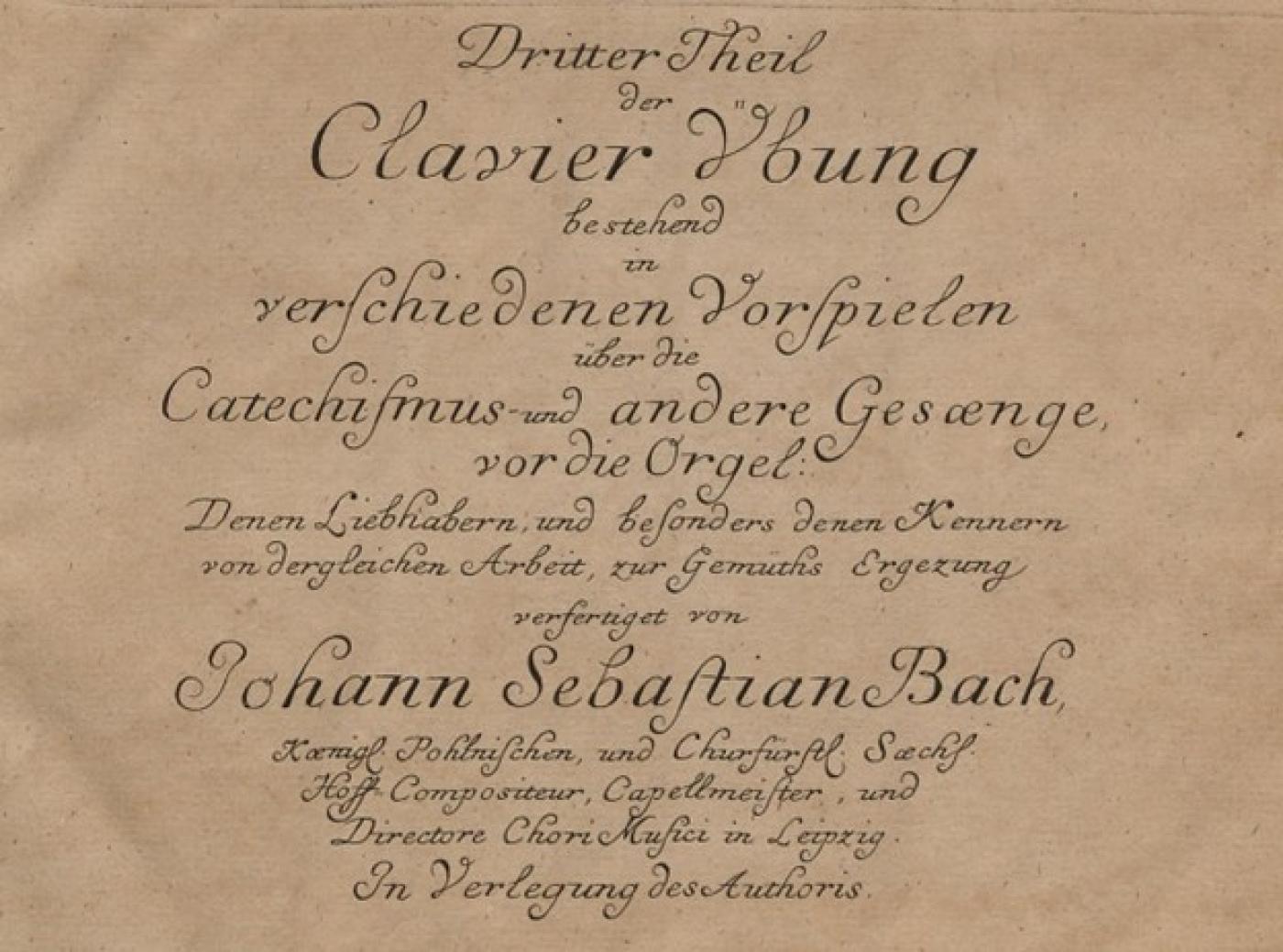
This is offered as a piece for those in the know, those who will get what he’s doing. And there’s a deliberate stated purpose there — in the way that Musical Offering was a deliberate, “This is what I can do with your theme” kind of thing. And as you say, the six-part ricercar [in the Musical Offering] is not quite the same kind of music as the six-part Aus tiefer Not, but the point is, you know, very valid, I think, that you made: there’s an assurance there with a complex polyphonic structure, a complex musical entity, but it belies the technical challenges of it and does something really quite remarkable with it. 1739 is when the third volume of the Clavier-Übung appeared; we’re in the last decade of Bach’s life here, and I think it is a fully mature work of a composer who is at the peak of his powers — and saying that Bach was at the peak of his powers is saying something.
To be invited by the Washington Bach Consort to give this recital — obviously there’s a very ready audience there for Bach, and with a good amount of background knowledge and a good amount of enthusiasm and understanding for this music. And so I offer it in the knowledge that it is going into a context where I think people will be able easily to appreciate it and to relate it to other music that they know of this period and other music by this composer. But even if I was playing it for another audience in another context, I wouldn’t have any hesitation to program this cycle, in the right circumstances. Because I think, despite its complexity and its musical daring and its musical inventiveness, it is eminently attractive and easy-to-follow music. It does require a certain amount of explanation, I think, to get the very most out of it. But I think you don’t have to be a connoisseur, even if Bach says you do. You can be a music lover, which is one of the other things he says, Liebhaber, a music lover, and you can enjoy this very much. And you can just relish the different textures and the different techniques the different sonorities that a beautiful organ can provide, the range of different styles and the fluidity with which Bach combines them or alternates them. All of these things — I think if one is, you know, ready for a fascinating musical experience, I think this is something that anybody can enjoy.
For me, this is a huge privilege. I mean, I don’t take it lightly that I have been invited to give this concert and to play this music. I was just thinking that if I only played this music every day for the rest of my life, I would still find it so fascinating, and I would never get tired of it — and I would always see something new and different in it. I’ve just come from a rehearsal session on this music, on one of the organs here at [the Yale] campus: and I was noticing new things all the time, thinking of things differently. And I’ve been playing this for so many years! I think that’s a mark of remarkable music. And I’m just so excited to have this opportunity to realize some of this music, and share my enthusiasm for it and my fascination with it, with the audience. And I’m delighted to be invited to give this concert. I’m really, really looking forward to it.
PBS PASSPORT
Stream tens of thousands of hours of your PBS and local favorites with WETA+ and PBS Passport whenever and wherever you want. Catch up on a single episode or binge-watch full seasons before they air on TV.