Recently I sat down with Matthew Roberston, founder and Artistic Director of The Thirteen, to talk with him about their October performances of Johannes Brahms’s Ein Deutsches Requiem, and Credo by American composer Margaret Bonds.
Few choral works have achieved the near-universal acclaim of the “German Requiem” Brahms completed in 1868. The Thirteen will present it in the composer’s own edition with piano four-hands; Eric Conway and Brian Ganz (who completed his monumental Chopin project earlier this year) will be the pianists.
Bonds’s Credo is not as well-known as it deserves to be, though that appears — felicitously — to be changing. It is a choral setting of a 1904 text by W. E. B. Du Bois. It’s première was here in Washington in 1967; another early performance was conducted by Zubin Mehta in Los Angeles in 1972, shortly after the composer’s death. I had occasion to become better acquainted with this work when I produced a program on Bonds for WETA Virtuoso for Black History Month this past February. I am not aware of another commercially available recording of this magnificent work other than the 2023 album by the Dessoff Choirs, which has been featured on WETA Classical’s Choral Showcase and on WETA VivaLaVoce.
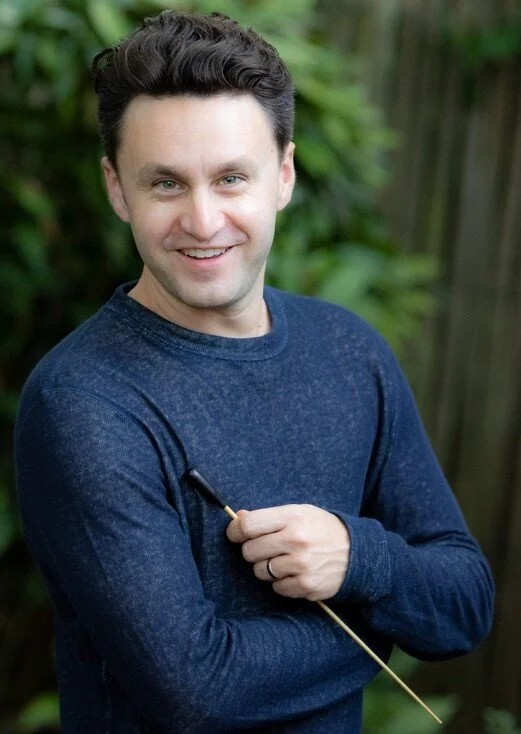
Matthew Robertson shared these reflections:
The first program of The Thirteen’s fifteenth season features Brahms’ Requiem and Margaret Bonds’ Credo. This season, In Our Time, asks how music remembers, how it changes over time, and how it speaks to us now.
There are few works with which I have had as long a relationship as with Brahms’ Requiem. Most recently, I led a memorized and staged production of the work in 2022, but my first interaction with it was long before: as a high schooler, when I sang it standing next to my dad, under the baton of Norman Scribner. The memory of my dad, who died at this time last year, is with me this weekend. Brahms wrote his Requiem for those who remain, setting “Blessed are they that mourn,” and “I will comfort you, as one whom a mother comforts” after the death of his own mother. And yet, it is humanity’s most enduring question—what happens to us when we die?—that the Catholic Requiem Mass answers conclusively and that Brahms refuses to address in his Requiem.
Instead, Brahms’ Requiem holds the Enlightenment’s promise of new birth. The nineteenth century saw an extraordinary expansion of participatory music-making through civic choral societies, part of a larger opening of public and cultural life. Brahms’ choice of vernacular scripture over the Latin Requiem Mass belongs to a world increasingly concerned with human dignity and widening participation. He concludes the work with the statement that
it is the dead who are blessed, for “their works follow after them,” set with cascading repetitions of the word “blessed.”
Margaret Bonds’ Credo is cut from the same cloth. Rather than setting the traditional Nicene Creed, Bonds sets W. E. B. Du Bois’ declaration of belief in the dignity of humankind and, especially, of Black Americans. Where Brahms touches the universal, Du Bois and Bonds insist that universal rights must necessarily include everyone. Bonds premiered her Credo in Washington, D.C. in 1967, at the height of the Civil Rights movement. She later refused publication when the publisher insisted that Du Bois’ words be altered; the score remained largely unperformed for decades. It is only this year, more than fifty years after Bonds’ death, that her grave has finally received a headstone.
Both works speak urgently to our time in that they ask us to look beyond ourselves. Brahms asks us to enter another’s grief and to imagine consolation as a communal act; Bonds asks us to recognize another’s dignity and to widen the circle of those included in our ideals. Both continue the Enlightenment’s unfinished work: they enlarge our understanding of our world and our place in it.
And through it all runs memory. While the Bonds is new to me, I hear my dad beside me as I approach the Brahms. Each audience member will bring their own memories to our performances, and perhaps leave with new ones.
The Thirteen performs these works with pianists Brian Ganz and Eric Conway, our spectacular singers, and our fall 2026 Vocal Fellows — early career singers who have experienced obstacles.
PBS PASSPORT
Stream tens of thousands of hours of your PBS and local favorites with WETA+ and PBS Passport whenever and wherever you want. Catch up on a single episode or binge-watch full seasons before they air on TV.