Roger Tréfousse has written a wide variety of music: film scores, operas and musicals, symphonic works, songs and chamber music. He has composed three operas, The Monkey Opera, premiered at the Brooklyn Academy of Music; Found Objects, commissioned by the Mannes College of Music; and Blue Margaritas, which premiered in New York at the Experimental Intermedia Foundation. Départ Malgache, the first section of a new group of short operas with libretto by Kenneth Koch, was featured on WNYC radio.
Tréfousse divides his time between Berlin and New York, currently living in Berlin, where he is at work on Berlin/Return, a large-scale vocal and orchestral project.
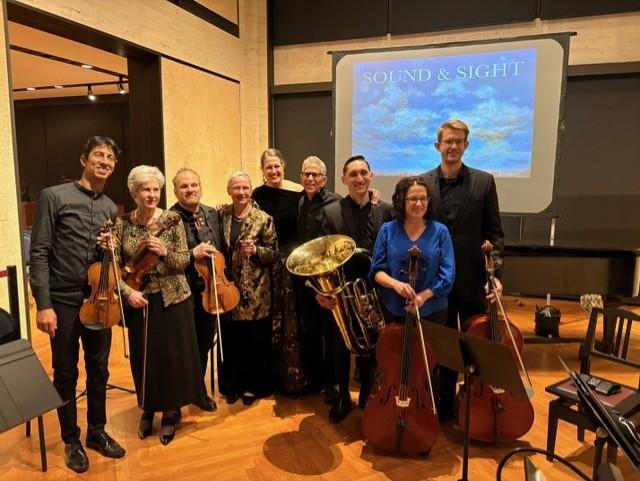
Faculty musicians from Appalachian State University
Catherine Garner (piano), Alicia Chapman (oboe), Sam Ambrose (tuba), Pedro Egeu Maia (violin), Nancy Bargerstock (violin), Eric Koontz (viola), Julie Goforth (cello) - and guest cellist Schuyler Slack.
Show Notes
Click here to view the corresponding paintings by Jack Boul while listening.
Program notes on the work by Roger Trefousse:
Sound and Sight: A Collaboration Jack Boul/Roger Tréfousse was born in a moment of chance and synchronicity.
The piece originated when Jack Boul’s paintings and drawings were being exhibited at the Salmagundi Arts Club in Greenwich Village, New York City. David Boul, the painter’s son, was overseeing the exhibit, and saw the program for a concert taking place there that week, featuring my music for the PBS film, Jackson Pollock: Portrait. Boul remembered me from Catawba, Vera Lachman’s legendary arts camp in western North Carolina--we had both been there as campers but had not seen each other since. This chance meeting led David, inspired by my music for the Pollock film, to ask if I’d be interested in writing music based on a group of his father’s paintings...
...In Sound and Sight: A Collaboration Jack Boul/Roger Tréfousse, my music is a study of tonality and vibration of color and line in painting translated into music. The musical soundscape for this Suite embodies my unique combination of elements: tonal, non-tonal, classical, jazz and free improvisation.
While Boul’s paintings are a realistic and often intimate depiction of places, people and events, they have an underlying, almost secretive connection to abstract color and line. Meditating on these paintings has led me to create music both constantly improvisatory and at the same time, highly structured. Quickly changing complex passions contrast with quieter thoughts that grow, diminish and change slowly in unexpected ways.
The Suite is scored for eight instruments: oboe, tuba, piano, two violins, viola and two cellos. In this orchestration, I’ve moved away from my usual chamber music combination of wind groups and one or two strings because the unexpected and ever-changing overlay of textures and colors that are an essential aspect of Boul’s palette called for something radically different. Multi-layered and sonically varied string writing seemed essential, juxtaposed and combined in unexpected interludes and dialogues with the piano and with the oboe and tuba in their full range of colors. There are eight pieces making up a whole, each based on a different painting in a developing and integrated sequence. The Suite begins with Catawba, a tonal piece for
solo piano in response to a lyrical painting looking down a hill at Camp Catawba and ends with a complex eight-instrument piece for Self Portrait. The sequence of the inner pieces, scored for all eight instruments, encompasses the major elements of Boul’s work: Museum Guard, a depiction of an intimate moment in time; Two Cows, a study of the animals he most loved to paint, in this case, with an understated but complex background; Canal, a shimmering, abstract landscape; Clouds, a classic and gorgeously lyrical modern study; Reflections, a complex journey of relations between people and place and Tango, a sensuous dance, both provocative and lighthearted.