Nikolaus Esterházy was a Hungarian prince who in 1766 began construction of one of the most elaborate European palaces that is still standing, located in northwestern Hungary near the Austrian border, which he named after his family, Esterhaza. Its magnificence has been compared to Versailles and Schönbrunn. It was a very full day's carriage ride from any urban area, a swampy piece of land in the middle of nowhere, and it soon became the prince’s official summer residence. It fulfilled Nikolaus's dream to live in an environment where he could enjoy listening to music far from the noise and stress of the city and his business and political concerns. And the music he was listening to was worthy of such attention, since his Kapellmeister, or court music director, was Joseph Haydn.
That music was central to the mission and culture of Eszterháza is evident from its design elements, with images of musical instruments everywhere you look. The grounds included a 400-seat opera house, a smaller marionette theater, an ornate music room, and a picture gallery that was also used as a performance space. Every summer these spaces were filled with music, theater and scholarly lectures, many of which were open to the public; people traveled far from the city every summer to listen to beautiful music in opulent settings.
This wasn't an ideal arrangement for Haydn and the musicians of his orchestra, who had no choice but to be subject to Nikolaus's whims; every year he stayed at Eszterháza longer and longer until finally in 1772 Haydn had had enough. He composed the "Farewell" symphony, in which the musicians leave the stage one by one at the end of the work, as a hint to Nikolaus that the musicians needed to get back to their families. He took the hint, and they left the next day. But aside from inspiring one of Haydn's most famous works, it also inspired an institution that continues to this day: the summer music festival.
The United States, formed just a few years after this incident, turned out to be surprisingly receptive to the Eszterháza model, and every summer many Americans travel far from their homes to beautiful rural settings where they can breathe clean air and spend all day attending performances of classical music.
Perhaps the earliest example of the American summer cultural festival was the Chautauqua movement that began in 1874 in upstate New York and gradually grew to sites around the country. Thousands of city dwellers would take the train to beautiful rural locations with their families to enjoy lectures on many different topics and a wide variety of entertainment options. Concert bands with plenty of light classics in their repertoire were a common feature. Serious classical music was introduced into the Chautauqua experience by the American Opera Company in 1926, presenting as many as five operas in a single week before going to the next stop on the circuit.
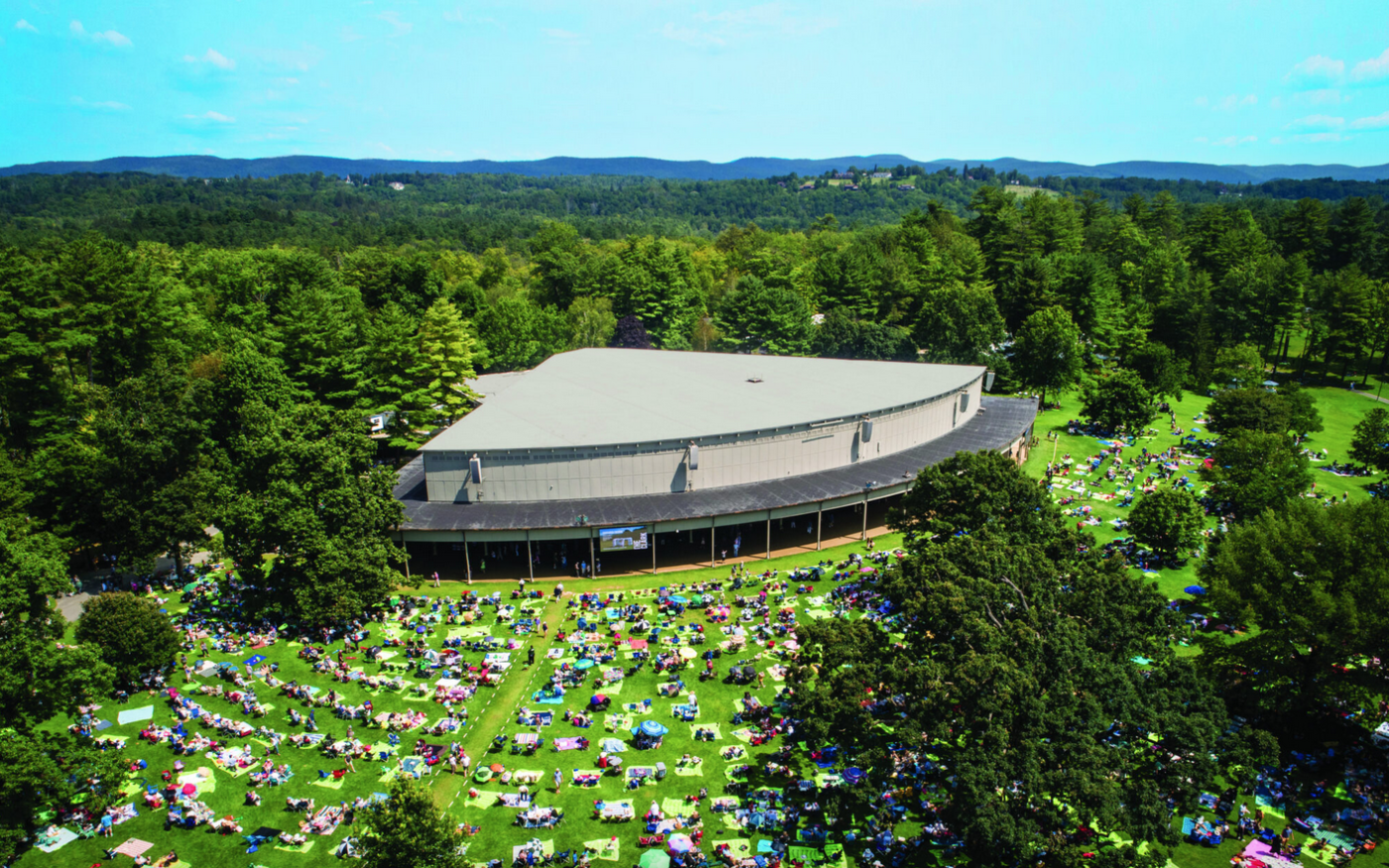
One of the first American summer music festivals exclusively devoted to classical music was Tanglewood, nestled among the Berkshires in western Massachusetts. It began as three concerts by the New York Philharmonic in late August 1934; by 1936 they were replaced by the Boston Symphony Orchestra under the direction of Serge Koussevitzky. 1938 saw the opening of what is now known as the Koussevitzky Music Shed, whichseats over 5.000 people protected from the elements but is open at the back, where thousands more can enjoy the music while picnicking on the grass.
Perhaps inhabited with the spirit of Prince Nikolaus, Koussevitsky quickly expanded his vision for Tanglewood, and by 1940 he established the Berkshire Music Center, described as an “academy for living and working in music”, intended to give conservatory students on track for a professional career an intensive experience of study and performance opportunities. By this time Tanglewood had built two other performance spaces on its grounds, then known simply as “The Theatre” and The Barn.” The faculty included Aaron Copland, Paul Hindemith and the principal players of the Boston Symphony, while the students for that inaugural season included Lukas Foss, Alexander Courage (the film and television composer best known for composing the theme music for the original Star Trek series), and Leonard Bernstein.
The success of Tanglewood helped inspire the development of other summer music festivals in other idyllic settings throughout the country, including Aspen, Ojai and Interlochen, and there are several other festivals in Tanglewood’s New England neighborhood; focusing on chamber music, there’s the Marlboro festival in Vermont (which also deserves the Hollywood treatment for the role it has played in the development of major classical artists), as well as Yellow Barn and Rockport; or you can enjoy innovative opera productions at Glimmerglass or take a deep dive into an individual composer’s life and work at the Bard Music Festival (this year’s, which just ended, was about Mozart; next year it’s Gershwin.)
And there are also a number of festivals that don’t require a major excursion but manage to approximate that Eszterháza-type experience closer to where people live and work, like Chicago’s Ravinia festival and our own Wolf Trap.
Shortly after the establishment of its Music Center, Tanglewood was forced to take a three-year hiatus during WWII, and there was also some curtailment of its schedule due to COVID. But it has proven to be remarkably resilient, and indeed summer festivals in general in the U.S. have thrived even during times when traditional subscription concerts during the rest of the year suffered a decline in attendance. Perhaps Nikolaus was on to something: while music is an essential source of beauty and sanity when we incorporate it into our daily lives (like listening to WETA Classical), we can forge an even deeper connection to it in an immersive environment in which we can actually live on the plane of beauty and order to which music aspires.
PBS PASSPORT
Stream tens of thousands of hours of your PBS and local favorites with WETA+ and PBS Passport whenever and wherever you want. Catch up on a single episode or binge-watch full seasons before they air on TV.