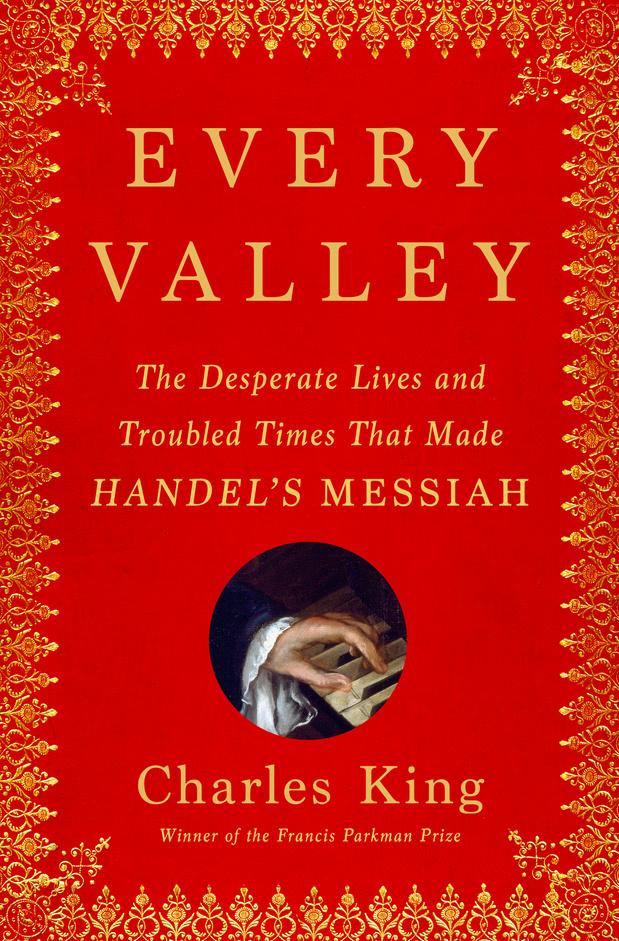
As we embark on Messiah season, I wanted to share my excitement about the book Every Valley: The Desperate Lives and Troubled Times That Made Handel's Messiah, published last year by Charles King, who very kindly agreed to come to WETA Classical to chat about the book.
When I ordered Every Valley, I expected a Handel biography and a dry analysis of Messiah. Instead, I was transported to the 18th Century and the Enlightenment—an epic journey with characters that feel as vivid and dramatic as those in fiction. It was like reading The Count of Monte Cristo or Dickens’ Bleak House.
Charles King is not a musicologist. He is a professor of international affairs and government at Georgetown University and completed his Master’s and Doctorate in Politics at Oxford. This background informs his deep understanding of the politics, philosophy and zeitgeist of Handel’s time, and writing the book, as he says, it gave him “a good excuse to travel the length and breadth of Britain because there are so many parts of the country that have a connection to the story-- and then of course going across to Ireland where the Messiah premiered at a small music hall in Dublin, so I wanted to see these places and sense the connection between place and context and the music.” Here is our conversation, edited for length.
Nicole Lacroix: You really bring us along. It’s like we’re walking on Fishamble Street in Dublin and Trinity College and St. Patrick’s right with you and Handel. You talk about the impetus to write the book, stuck at your home on Capitol Hill during the Pandemic and the aftermath of January 6th. As residents of the DMV, we can really associate with that experience.
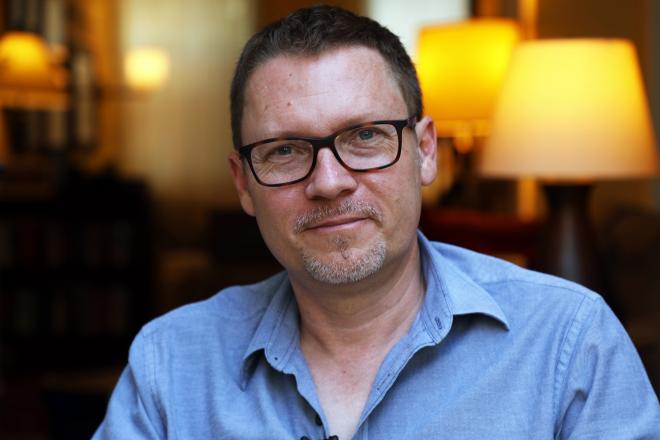
Charles King: My wife and I happened to put this music on at the height of Covid. We’ve both loved this piece of music for all our adult lives. And when we put it on and the overture and the first recitative came on, we both just burst into tears at the words “Comfort Ye” which are the first words every audience has heard since 1742. I wanted to follow that emotion, to sort of investigate why it is that people feel so connected to this work of art. And so, I wanted to go on this adventure to find the lives and the desperation and the pain that it took to make this monument to hope.
NL: The characters are so meticulously researched—proof that life is stranger than fiction! Tell us a little about this cast of characters and how they come together to create this incredible story.
CK: Well, there’s of course Handel himself who wrote Messiah famously in 24 days and because we are so connected to this work and the sacred themes, I think we desperately want there to be an angel on Handel’s shoulder! Who am I to say that there wasn’t? But it was not unusual for him to write at that speed.
He was writing Messiah at a kind of low point in his career. He had soared to the heights of fame in Georgian Britain, but by this stage, the late 1730s early 1740s, he was at the point where he would start doing a greatest hits tour. And Messiah was a very unusual piece of music unlike anything he had written before or would write after. Words that are drawn solely from the sacred scriptures but in the wrong order, using the musical conventions of the Italian opera or this newer form of oratorio, so it’s a very strange concoction, if you think about it, no plot line and only one named character at any point. Audiences at the very beginning didn’t know quite what to make of it. But Handel was relying on a text that he had kind of received in the mail from Charles Jennens, a kind of Handel superfan. He had the idea of rearranging excerpts from Scripture in an order that made sense to him for one very specific reason. He suffered from chronic depression or even bipolar disorder and the text he assembled for Messiah was his way of building a ladder out of the abyss that he found himself in. He put that all together in pages, shipped it off to Handel who sat on it, we think, for at least a year, maybe more. Finally, he sat down in August and September of 1741 to put it together to take it on tour to Dublin where it would premiere in the spring of 1742.
NL: Now, Susannah Cibber. She was the sister of Thomas Arne, the composer of Rule, Britannia and had the misfortune of marrying a despicable character who shamed and abused her so that when Handel hired her to sing in Messiah’s premiere, she was considered a scandalous “fallen woman.”
CK: So, when she stepped forward from the chorus to sing, “He was despised, rejected, a man of sorrows and acquainted with grief,” the audience, we know from eyewitness accounts, kind of fell silent because they could do the gender switch. She was “despised and acquainted with grief” and from that point her career kind of takes off. She returns to London to even greater fame and I think that one of the most amazing things of this connection is that now she and Handel are buried back-to-back if you will. He is of course in that magnificent monument in Westminster Abbey, and she is somewhere in the Cloisters, we don’t know exactly where.
NL: Susannah Cibber represents the historic plight of women. You tell the story of another “man of sorrows." Diallo was an educated Muslim prince who was captured in West Africa and sold at the Annapolis slave market. He escaped, then was liberated and brought to London where he was celebrated for his exotic learning and finally sent home.
CK: I thought it was very important in this book to have a character who represented what lay behind theater and music and performance in this period, which was of course the slave trade. Because the theaters that arise in the West End, the great families who are the patrons to Handel, the wealth, comes in large measure from the forced labor of human beings particularly in the Caribbean.
NL: Finally, the indefatigable entrepreneur Thomas Coram and founder of the Foundling Hospital sort of ties everything together.
CK: Yes, he does. He was one of those figures in the 18th century who had projects and schemes for things. You know the early 18th century was this great age of schemes-- of sort of civic awareness. They believed that you could solve problems in society with the application of reason. He had crossed the Atlantic many times; he had a wife from Boston, but the issue I think that spoke most directly to his heart was the plight of children in Britain. It was a time of vast disease and an astonishing 75% of infants would not live to the age of 5. It’s a number that’s almost impossible to believe, but it’s true, and those that did survive would often be left to fend for themselves. So, Coram financed this Foundling Hospital with many of the patrons who were also supporting Handel. But to raise money for the new chapel, the governors of the Hospital decided to call on Handel, the great figure whose career had been renewed through performances of Messiah in Dublin and London. It’s at the Foundling Hospital that most people come across this piece of music. It’s quite likely that it would have died in the 1740’s had it not been fused with this very famous charitable cause and become an annual feature at the Foundling Hospital.
NL: Besides the fascinating characters, you also weave in the zeitgeist of the time.
CK: We’re in the middle of the Enlightenment at this time, but I wanted to give a darker version of what the Enlightenment was because there is this ashen streak that runs through it. If we learned in our Western Civ. classes to think of the Enlightenment as being about reason, rationality and the triumph of science, that’s not at all how people experienced then. It was a time of war and hopelessness, of disease and of children dying before they could ever reach adulthood. If you think of the first performance of Messiah in 1742 and think of 6-700 people who are crowded into Neal’s Music Hall, all of those people would have experienced the death of a child, if they had children, it was quite likely that they would bury more children than they ever saw into adulthood. And if you look at the art, the music, the theater of the Enlightenment, it’s not about reason and rationality; it’s about how you manage to be hopeful in the midst of catastrophe. And that of course is one of the great themes of Messiah itself ...the technique is that you begin by imagining a better world...the “Comfort ye” at the top, and that is the thing that is going to carry you through the dark, the middle of the performance and triumph at the end.
For more of my interview with Charles King, listen to the live chat.
The book is Every Valley: The Desperate Lives and Troubled Times that Made Handel’s Messiah by Charles King, published by Doubleday. The audiobook is read by British actor Juliet Stevenson.