As we consider the 20th century musical movement that for better or worse is known as "minimalism" - a term that every composer labeled as such rejects (which was also the case with "impressionism" two generations earlier) - it should be noted that repetitive, trance-like music has been around for a long time. A very long time, in fact; Pérotin, who wrote music for services at Notre-Dame Cathedral in the late 12th and early 13th centuries, used repetitive polyphonic techniques remarkably similar to those used by modern minimalist composers, and Steve Reich in particular has named him as a major influence. Three centuries later you can also hear some pre-echoes of minimalism in the layered tapestries of choral sound woven by composers of the Franco-Flemish school such as Ockeghem and Josquin. During the late Renaissance and Baroque eras, from Byrd to Bach, there are hundreds of pieces written over a ground bass, a short harmonic progression that is incessantly repeated under seemingly infinite variations. (Back in my days as a working cellist, I remember having an epiphany as I played that famous eight-note phrase from Pachelbel's Canon for the zillionth time for my zillionth wedding gig: people like getting married to this piece because it represents infinity in music. Its structure suggests something that never really begins or ends, just flows. It symbolizes the hope that the couple's love will last forever. [Sigh.] And my cellist's perspective also helped me understand how brilliant it was for Purcell to set the famous lament at the end of Dido and Aeneas over a ground bass, because it makes the music easy to remember, which is exactly is what Dido is asking us to do as she sings, more than once of course: "Remember Me!") The development section of the first movement of Beethoven's Sixth Symphony ("Pastorale") is an early example of orchestral minimalism as we hear a five-note motif repeated over and over again undergoing subtle shifts in texture and tonality, like viewing it through a prism, or the way sunlight changes as it's filtered through the trees in the course of a day, appropriate for a piece about nature. Wagner begins his epic Ring Cycle with a prelude based on a single chord, symbolizing the churning of the river and time itself, foreshadowing the arc of the entire work, a hint that what belongs to the earth and the water will eventually return to it. Rachmaninoff's 1909 tone poem The Isle of the Dead uses a repeated churning motif in 5/8 time to represent the rowing of the oarsmen, the churning of the waves, and the souls' final breaths as they make their way to their destination. In 1939, John Cage began work on his Construction series in collaboration with Lou Harrison to create a new type of percussion ensemble, using found objects like automobile brake drums, whose hypnotic music evoked West African drumming and Indonesian Gamelan while pushing classical notation and percussion techniques into new realms of possibility.
In any event, composers have long understood that hypnosis is one of their superpowers and tools of their craft, wielded through the careful use of repetition. It's all in the timing. Listeners need a certain amount of repetition to serve as an anchor; once a theme or motif is established, we can follow it on its journey as it appears in different guises, and we know we're back home when we finally hear it in its original form. Great skill is required to make this work; one repetition too many or too few can make a piece boring, annoying or befuddling. You need exactly the right amount.
And then there's the kind of repetition that can take you through all those negative effects on its way toward something ultimately positive and satisfying. I remember when I first listened to classical Indian music: at first I was intrigued, and in the first few minutes I went through the stages of befuddlement, irritation and boredom before some kind of sensory dam broke and suddenly I felt I was living inside the music, never wanting it to end, and could happily keep listening to it for hours. (I went through a similar process when I first heard John Coltrane.)
And it was listening to Coltrane and Indian music that inspired the American musician Terry Riley, who was trained in classical music and the conventional jazz of the 1950s, to go off into a different direction, that would in turn change the direction of classical music, and American music in general.
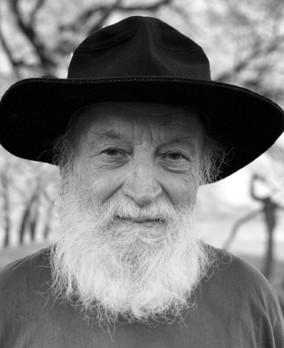
Riley was born in California in 1935 (and is still with us!) After completing his studies, with the skills and knowledge to become a professional pianist and composer, he had some choices to make. He could have taken an academic position and written the kind of rigorous, atonal, listener-unfriendly music that would have gotten him far inside the musical establishment. He could, like so many other American composers of that era, have gone to Paris to work with Nadia Boulanger and develop a neoclassical style that would still be respected by his contemporaries. He could have ditched classical music altogether and went all in on jazz. He could have gone to Hollywood to become a film composer, which would have given him the opportunity to explore a variety of styles. But each one of those options entailed a certain amount of conformity, and to someone in his mid-twenties at the dawn of the sixties, they all must have seemed like well-trodden paths that felt more like the past than the future. (And, like other young Bay Area artists of the time, one of his goals was a higher state of consciousness for himself and his audience.)
So Riley began his journey with electronic music, experimenting with tape manipulation during the day while playing in piano bars at night in order to support himself. He was one of several people at the time working with tape loops, a technique involving splicing pieces of pre-recorded magnetic tape to get a recurring pattern that one could then layer with other tape loops to get a collage effect. One of Steve Reich's first major works, It's Gonna Rain, used this technique to deconstruct a sermon about Noah's Ark by a San Francisco street preacher, turning it into a kind of audio tone poem that turned the preacher's own spoken words into apocalyptic music that effectively illustrated his powerful rhetoric.
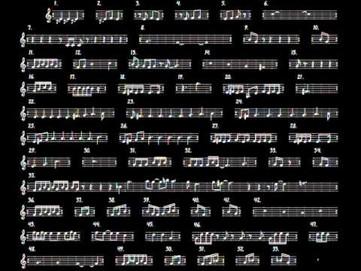
But what Terry Riley ended up doing for his first major work, In C, was unexpected. Instead of a tape collage, he wrote a piece of music for acoustic instruments that mimicked the phase shifting of tape loops - what happens when the same material is played back at different speeds on two different machines. Riley notated 53 short phrases, and instructed the musicians to play them in tempo, set by a constant pulse of high C's played on a piano or tuned percussion instrument, repeating each phrase as many times as they like before going on to the next one. The phrases are composed in such a way that the piece goes through gradual changes in tonality and texture.
The pulse, which is not part of the score, was the brainchild of Steve Reich (who participated in the premiere) as a way of keeping the ensemble together. Riley later emphasized that the pulse is optional, and shouldn't be too loud when used.
Premiered in 1964, In C was immediately recognized as groundbreaking, and while it was the product of a variety of influences from different genres of music - and its original recording, a bestseller, was championed by jazz and rock musicians - it eventually found its home in the classical section. This makes sense, because performing it relies on strict adherence to its notation and instructions, and its improvisatory elements – the players individually deciding when to go on to the next phrase, play loud or soft, take a rest or come back in, and when to stop playing at the end - are the kind of listening and ensemble skills classical musicians are trained to possess. And as it turns out, In C works beautifully as a piece for a standard symphony orchestra, or for a combination of acoustic and electric instruments, as well as non-Western instruments capable of playing all the notes Riley asks for in the same temperament as the ensemble.
The impact of Terry Riley's work cannot be, ahem, minimalized. He brought together musical influences spanning the globe and a millennium of musical development, leaning into their shared tradition of musical hypnotism, creating a template that many have followed. The classical establishment paid attention to In C's success (especially its appeal to younger listeners!) and as a result, composers like Steve Reich, Philip Glass and John Adams have enjoyed successful careers producing everything from string quartets to symphonies to operas to concertos for renowned soloists. Choreographers, working in both modern dance and ballet, love using minimalist music. Film directors love using minimalist music, especially for thrillers, science fiction and documentaries.
And popular music loves it too, ever since Pete Townshend named the song by The Who that everyone thinks is called Teenage Wasteland "Baba O'Riley", named for his spiritual guide Meher Baba and his musical guide Terry Riley - influenced both by In C and Riley's follow-up album A Rainbow in Curved Air, an overdubbed improvisation by Riley on electronic organ and synthesizer that was imitated by just about every progressive rock band of the 1970s (as well as Reich and Glass.) Riley paved the way for ambient music, jazz fusion, and perhaps most significantly in terms of its lasting impact, the quasi-psychedelic pulsating dance music that the kids started dancing to in the 1980s and they're still going.
Terry Riley was the primary developer of an extremely successful genre that helped sustain classical music, became tremendously influential throughout the world, and proved highly effective in collaboration with other art forms. And he also helped invent the modern DJ! It’s time to recognize that he has created one of America’s most significant musical exports and deserves to be considered among the giants of American culture. And at 91, he, like his music, is still going.
PBS PASSPORT
Stream tens of thousands of hours of your PBS and local favorites with WETA+ and PBS Passport whenever and wherever you want. Catch up on a single episode or binge-watch full seasons before they air on TV.