One of the reasons that I was drawn to a career in classical radio was not for my own musical interest or minimal talent, but because I am fascinated by men and women who have the passion to create something beautiful and to share it with us. These people make our world better—more awe-inspiring, more harmonious and more human. The violinist Midori is one of these exceptional artists. A child prodigy, debuting with the New York Philharmonic at age 11, she went on to earn a master’s degree in psychology at NYU while continuing her concert career. She now teaches at the Curtis Institute, Peabody and the USC’s Thornton School of Music among others. At 21, she founded Midori and Friends to bring tuition-free music education to underserved communities. And that was just the beginning of her humanitarian activities which now include Music Sharing, bringing both Western classical and traditional Japanese music to young people throughout Japan and Asia. Her Orchestra Residencies program supports youth orchestras and Partners in Performance, established with the money from her 2001 Avery Fisher Prize, helps to bring chamber music to smaller US communities. She serves as a United Nations Messenger of Peace and was named a Kennedy Center Honoree in 2021. And she’s still a young woman, with so much ahead of her.
Thanks to Washington Performing Arts, Midori will appear in recital with pianist Ieva Jokūbavičiūtė, Saturday, November 15, at 7:30 pm at Sixth & I.
The program presents a new work by Che Buford—Resonances of Spirit; Beethoven’s Violin Sonata No.5 in F Major, Op.24 “Spring”; Francis Poulenc’s Sonata for Violin and Piano;Clara Schumann’s 3 Romances, Op.22 and Robert Schumann’s 3 Romances, Op.94 as well as Franz Schubert’s Rondo in B minor, D.895.
Midori was kind enough to give us an overview of the recital. (The interview has been lightly edited for clarity)
Nicole Lacroix: How did you become interested in Che Buford's work? He describes the piece you commissioned, Resonances of Spirit as “exploring concepts of ancestral memory and the ways memory is embedded in nature. The piece contains sounds of water, wind, deep vibrating sine tones, electronic drones, whispers of Yoruba prayer, and my own humming and singing within the electronics. The violin blends with these elements, enhancing the atmosphere through exploration of texture and timbre, while remaining fragmented and lyrical.”
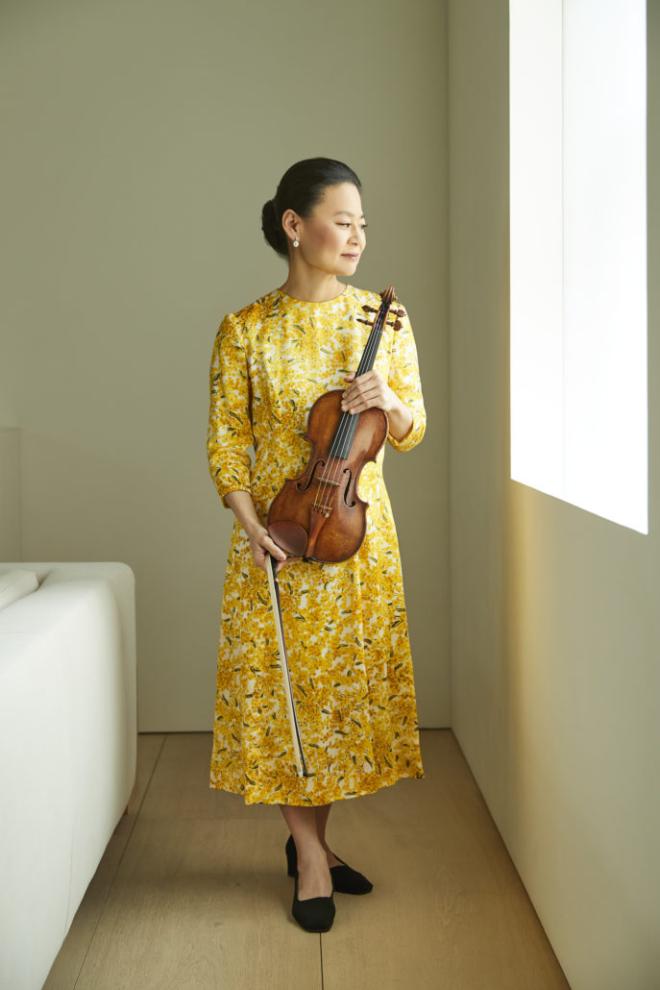
Midori: I was first introduced to Che's music and his sound world through a mutual colleague, and I got fascinated by his music. Music that really went in so many colors. And also the ideas–ideas for sound, ideas for the atmosphere that he creates through his music–was something that really got me very excited. Originally, this work was written to be premiered last season, but it will actually premiere this season, which changes things a little bit, because last season’s program was constructed with a theme of spirits and spirituals...it was inspired by one of the casidas (lyric poems) by Garcia Lorca. It had a theme of spirituals, of suffering, and Che’s was going to go into that program. The Poulenc Violin Sonata shares the theme (it was written in 1942-43 as a memorial to Garcia Lorca). What is so interesting for me is how Che creates this world that is almost half in this world and maybe the other half elsewhere. It has some magical moments and it has some spiritual moments. It has an atmosphere that is very hard to explain. It's an atmosphere that one enters perhaps rather than trying to describe. So yeah, I'm very much looking forward to playing this work by Che Buford. It is written for violin and electronics. The world of electronics within classical music has been expanding so rapidly and it is so diverse and so fascinating for me. Of course, there are works written and performed still today for violin and tape. Sometimes we have works for violin and synthesizers. We have works for live electronics and violin. We have so many different types of electronics now that we can talk about. And I do feel that for a composer to... write this element including electronics is a whole new added dimension which is absolutely mind-bogglingly interesting for me.
NL: Would you also be able to touch on the rest of your program?
M: So the current program includes the “Spring” Sonata by Beethoven, the Poulenc Violin Sonata, the set of Romances by Robert and Clara Schumann, then ending with the Rondo by Schubert. They all offer something different and unique, and yet they also inspire me to really go deep into the individual characteristics of each of these works. Of course, there's something lyrical in all of these works, something that really showcases the unique language of each of these composers. (Midori’s next album on the Pentatone label, due for release in Spring, is a recording with Festival Strings Lucerne of music by Robert and Clara Schumann-NL)
NL: And finally, I know you have a rich background, not only as a violinist, but as a humanist and educator, and you bring music to so many different communities around the world. Would you be able to speak on the importance of supporting live music performances and encouraging up-and-coming artists?
M: I think that there are so many different aspects of being involved with music education. I am really so fortunate to be able to engage myself in a few different areas, whether it's working with young artists who are interested in becoming professional musicians, or bringing music to those who may not otherwise have access to performances, or working with those that benefit from getting to know about the process of making music, and I think there's just so many different possibilities and opportunities. I'm so happy to be engaged and to be an advocate for music and for music education. I think we learned so much during the pandemic through Zoom and all these online platforms--they can do fantastic things; I think they're fascinating. They certainly helped us during the pandemic. And because of that, I think we also learned that live music has something that the online platforms don't. And that they can really work together very effectively. I can't imagine a world right now where we only have one or the other. I think together there's something that can be created, something perhaps even greater than the sum of the two platforms or by live versus online. So I think in this sense live music has become even more important than before we had all this access to online platforms.
NL: Thank you so much for speaking to us. I know our audience will be most appreciative of your insights.
Washington Performing Arts Presents Midori, violin and Ieva Jokūbavičiūtė, piano, Saturday, November 15, at 7:30 pm at Sixth & I.
More information at WashingtonPerformingArts.org
PBS PASSPORT
Stream tens of thousands of hours of your PBS and local favorites with WETA+ and PBS Passport whenever and wherever you want. Catch up on a single episode or binge-watch full seasons before they air on TV.