Full disclosure: I have been a fan of Leonard Bernstein my entire life, ever since I was a kid watching his Young People’s Concerts back in the 1960s. No one else does a better job explaining how music works. I believe his fundamental gift was teaching, and that he imparted insightful lessons even when he was conducting or composing, not only by delivering powerful music, but simultaneously demonstrating what makes it powerful.
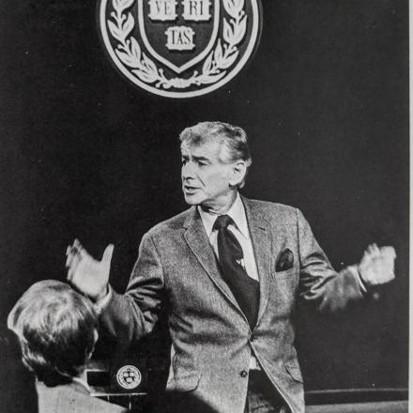
In 1973, Leonard Bernstein delivered six lectures at Harvard University. They're often referred to as the Norton Lectures, since they were given as part of his duties as the Charles Eliot Norton Professor of Poetry, a title given to a different artist or scholar every year. (In fact, this year marks their hundredth anniversary). Bernstein himself named his lectures after the Charles Ives composition The Unanswered Question, and the question that Bernstein thought demanded an answer was the future of tonality in music. In 2026, this question might seem abstract or moot, since most of today's composers continue to embrace tonality, but this was a serious and pressing question at the time, with real-world consequences. Some really excellent composers and extraordinarily talented musicians had their careers stalled or ended because the academic musical establishment and the major music critics were unrelenting in their insistence that tonality was regressive and reactionary and unacceptable.
Bernstein himself didn't need to worry about this. In 1973, he was at the peak of his conducting career; his iconic years at the New York Philharmonic now behind him, he was now receiving accolades conducting the Vienna Philharmonic, challenging Herbert von Karajan for the title of Europe’s Maestro (an especially gratifying position for a Jewish American to be in.) And if the critics were less kind to his composing career, they couldn’t do anything about the fact that West Side Story was now firmly established as an American classic constantly produced all over the world, the Candide overture was becoming as familiar as overtures by Mozart and Rossini, the Chichester Psalms was already becoming popular with choral societies less than a decade after it was written, and even his much-maligned MASS was a sellout whenever it was produced. As a result, if he wrote a piece, it was going to get played and recorded, no matter what the critics or anyone else thought.
But he wasn’t worried for himself (even if he did not-so-secretly long for validation by the establishment he sort-of rebelled against.) His concern was for the state of modern music, and the real threat that the stylistic debate posed to the future of classical music. It should be said that the anti-tonality faction had a couple of valid points: there was something self-indulgent and reactionary about the continued fascination with the unremitting lush sonorities and harmonies that Bernstein himself called “chromatic porridge” or “goulash”, and many prominent writers expressed the opinion that, in the wake of the horrors of World War II and ongoing brutality throughout the world, audiences didn't deserve pretty, comforting music, but sounds that would challenge us the way we are challenged by abstract art, experimental theater, and unflinching literature. But any idea that difficult, dissonant music was somehow more politically progressive than tonal, more listener-friendly music, had already been disproven a generation earlier by Aaron Copland, who embraced a populist aesthetic during the war to show that contemporary composers were in touch with the common man, and not just concocting complex scores that only their fellow composers and critics would appreciate.
By the 1960s, Bernstein was caught in the middle of this schism, dutifully championing new music in the tradition of his mentor Serge Koussevitzky while finding himself more interested in contemporary pop like The Beatles and Janis Ian, and in his mission to secure Gustav Mahler's place in the classical canon, than in most of the new scores being submitted to him. By 1970, he was determined to save classical music from itself. His first major manifesto was MASS, in which he drew upon a wide variety of musical styles, from blues and rock and Broadway to Beethoven and Schoenberg and Shostakovich, creating a score that makes an explicit connection between the crisis of tonality and the crisis of faith, which is how he framed the spiritual decline of the mid-20th century. (While “crisis of faith” might ring as hollow in 2026 as the tonality debate, it was also a very real concern at the time as families fell apart and dangerous quasi-religious cults were in their heyday.)
And then he went to Harvard to prepare for the Norton Lectures. He wanted these lectures to be accessible to a general audience who would be as excited about linguistics and intellectual adventure as about music in particular. So he knew he would have to give his listeners a crash course in basic music theory so they could understand his points about tonality and his claims that it contained the roots for a universal musical grammar, comparable to the concept of an innate grammatical competence as postulated by Noam Chomsky. He began by going to the piano to describe the overtone series and how our harmonic language is derived from it, and since the overtone series is a law of physics that doesn’t belong to any particular culture, he was on solid ground as he demonstrated how the first six overtones were assimilated into our musical language over the course of millennia.
But when he got to the seventh overtone, he admitted that he had a problem, since you can’t actually play it on the piano; the nearest you can do is approximate it by playing the “crack” between the major sixth and minor seventh of the scale. When played simultaneously they are familiar to us as the “blue note”, the dissonance as basic to jazz piano as bending the note to get what’s in between is to guitarists and singers.
Bernstein was clearly obsessed by this conundrum – that a note fundamental to universal harmony is not a part of Western musical language. There’s a reason for this, and Johann Sebastian Bach is partly to blame, since he championed the “well-tempered” keyboard tuning that sacrifices perfect intonation and fidelity to the overtone series for the ability to play the complex counterpoint that was his gift to humanity. I can’t argue that Bach fugues aren’t worth sacrificing quite a lot for – but they make it impossible to argue that Western music is a “universal language.”
The nearest approximation to that impossible, non-Western interval is a minor seventh, e.g. C to B flat. If you want to know what that sounds like, think of the first two notes of “Somewhere” from West Side Story (on the words “There’s a”.) That interval also shows up as a key thematic element in countless other Bernstein works, from Candide to MASS to the score for On The Waterfront.
I don’t think that’s a coincidence. It seems that Bernstein regarded the minor seventh – reaching upwards to the blue note, the note that symbolizes our shared sorrows and human foibles – as a way of expressing something just out of reach, a note that can’t actually be heard but only approximated, the impossible dream, the impassible boundaries between cultures that you have to keep trying to overcome. It certainly makes sense to use that interval to begin a song about a utopia (which, if you recall, literally means “no place”) of peace and quiet and open air where we can finally exist with our forbidden love.
And in that same musical he uses another interval to represent the opposite state, the reality of conflict and non-belonging: the tritone. It’s the interval of the first two notes/syllables of “Maria”, and it’s also the interval of “Boy-y, boy-y, crazy boy-y” in “Cool”, and can be heard throughout WSS in different guises, from the very beginning to the very end. The tritone is so called because it’s the distance of three whole tones, from C to F sharp, thus evenly bisecting the octave. In the Middle Ages it was called diabolus in musica, the devil’s music, and was forbidden for use in liturgical music, because it’s the most unstable of all the intervals. If you want to create a chord with tension, that the listener demands to be resolved, put in a tritone. It plays on our limbic system’s need for resolution – perfect for a story in which there is no resolution.
Playlist
| Name | Download |
|---|---|
| Playlist for America 250 Episode 12 |
Bernstein used both of these intervals as a way of illustrating in music the conflicts of real life: always seeking a cadence, a new way of living, while acknowledging our forever-unresolved reality. He seemed to share Pablo Casals’ belief that life should aspire to the beauty and order of music, and just as Casals felt that political activism and outspokenness was a natural and necessary aspect of his life as an artist (which is why a bust of Casals can be found in the foyer of the United Nations), so did Bernstein (which is why he was the natural choice to conduct an international orchestra in Beethoven’s Ninth near the site of the freshly demolished Berlin Wall.)
I recently had the great honor and privilege of speaking with Bernstein’s eldest child, Jamie Bernstein, who began the conversation by talking about her father’s idealism and activism – and the price he paid for it.

JB: I could go on a lot about this aspect of how my father used music to try and make the world a better place. It wasn't just entertainment to him or diversion or distraction. It was the opposite. It was a way of expressing what really mattered in humanity. And every chance he got, he would use his music in a literal way to make the world a better place: benefit concerts and supporting fellow artists who were doing activist things. And my father himself was such a big activist and never shied away from expressing what he thought was meaningful or what was heinous. And if there was an injustice in the world, he was going to go right there and speak about it and try to make it a better situation however he could. And that certainly got him into plenty of trouble over the years. He was being tracked by the FBI all the way back in the 1940s. He was barely out of college. And then in the 1950s, of course, the communist hysteria was off the charts. And so at that point, the tab keeping of the FBI only increased hundredfold. But over the decades, my dad was always giving the FBI something to keep track of. And by the time he was able to view his FBI file in the 1980s through the Freedom of Information Act, that was when he discovered, we all discovered, that it was 800 pages long! It was kind of a badge of honor, really, to have an 800-page FBI file, because he was always giving them something to fulminate about, wasn't he? You know, it's funny. Looking back on it, I think it's just amazing that my father was not subpoenaed to testify in front of the House Un-American Activities Committee. They did take away his passport for a while, and he had to go through a whole song and dance to get it renewed. He had to hire a lawyer who helped him create an affidavit where he swore up and down that he was not nor had ever been a communist, all that sort of thing. And he did finally get his passport in time to go to La Scala in Milan and conduct Maria Callas in La Sonnambula. And wouldn't it have been tragic if he hadn't made it on time to do that? But he got there.
(JJ: Since she brought up the House Un-American Activities Committee, I got up the gumption to ask her a potentially uncomfortable question, which is why Bernstein decided to work with Elia Kazan, who cooperated with the committee and named names, and not only that, but worked with him on the very film that is considered to be his justification for naming those names, On the Waterfront.)
JB: I think about it all the time. Elia Kazan had a lot going for him before he named names for the House Un-American Activities Committee, and he was a big hero in New York City in the theater world. And his films were incredible. So that's one thing. And then the other thing was that when Elia Kazan asked my father to write the music to On the Waterfront, he showed my father some of the footage. My father was so excited by the footage, and Marlon Brando was so incredible that I think he said somewhere that he could practically compose the music in his head as he was watching the footage. So I think he was really electrified. And so maybe that got him over the stumbling blocks. Maybe. I mean, I guess it did. But really, the whole film is a kind of apologia for naming names. Well, the day I realized this was a big day in my personal thinking life, you know, because no one had ever said that to me. But I suddenly realized it, and I thought, oh, my God. And even so, my dad was so infatuated with the whole project that he went along with it. It is kind of amazing.
JJ: Is the fact that he worked with Kazan, and later with Jerome Robbins who also named names in the McCarthy hearings, an indication that your father was someone capable of great forgiveness?
JB: It's a good question. It wasn't so much forgiveness as it was that he felt in all situations where there were these kinds of problems, like philosophical or political differences of opinion or whatever it was, I think my father felt like you could rise to a higher plane of discourse through music. And this came up in all sorts of other ways too. For example, conducting the Vienna Philharmonic, which back in the 1960s when he first did that, was still full of people who were Nazis during World War II. But he felt like they could all communicate on this higher plane through the music that they were making together.
I love talking about my father and his music, and I give a talk about him as often as I can to all kinds of people, young people, older people, people who know about music, people who don't know about music. And the talk that I most often give is, I called it Leonard Bernstein: Citizen Artist. And I like giving that talk because it gives me a chance to talk about him as an activist, not just as a composer and a conductor and an educator, which were the other three big ways that he expressed himself. But as an activist and humanitarian, that was equally important with the other three elements. And in fact, that sensibility informs everything else that he did. And today's young musicians are much more plugged into the idea of using their music making to reach out into their communities and to, you know, try to express themselves as citizen artists, people trying to be a part of the world and make the world a better place. And so because so many young musicians are that way now, Leonard Bernstein is really their perfect role model. He's sort of the granddaddy of today's citizen artists. So I love to point this out to young musicians if they haven't been exposed already to this aspect of Bernstein, then it's my great good fortune to do that for them.
JJ: Gustav Mahler, the composer that Bernstein did more to popularize than any other conductor, famously said “My time will come”. Bernstein could have said the same thing. One of the reasons I've always felt that his death in 1990 at age 72 was tragic is that he didn't live to see the way the culture eventually validated his compositions and his ideas.
JB: Yeah, it's true. As it were, he got the last laugh. It certainly happened in terms of his compositions and how much they are now valued. Whereas in his lifetime, he struggled all the time with the fact that, you know, if you wanted to be considered a so-called serious musician by the academic elite, you absolutely had to write 12-tone music and only 12-tone music. And my father just would not give up writing a good tune. And aren't we all so glad that he wouldn't give it up? And of course, he was perfectly capable of writing 12-tone music, and he wrote a lot of it. But it was just one color on his musical palette as opposed to the entire palette. And so as a result, you know, he never got a Pulitzer Prize and things like that. And it bugged him a lot. He really wanted to get the approval of the academic elite because he set such great store in all things academic. But in the end, he was just going to write the kind of music he felt like writing. And by now, you know, composers today in our contemporary world look to Bernstein as a real role model because he was so unafraid of writing in so many different flavors and was, you know, very flexible, very versatile in his way of composing. And today, that's considered an asset as opposed to a liability. So he got the last laugh there.
(JJ: Near the end of our interview, Jamie shared with me that one of her favorite pieces of her father's is the Serenade after Plato's Symposium. But then she had a confession to make:)
JB: Full disclosure, I have never read Plato's Symposium, even yet. Okay? But I maintain that you can totally adore this piece of music that my dad wrote without actually doing all the homework and reading Plato's Symposium. Because all I can tell you is I love Serenade so much. It's my favorite symphonic work of my dad's, even though I haven't done the homework. So there you go. Full disclosure.
PBS PASSPORT
Stream tens of thousands of hours of your PBS and local favorites with WETA+ and PBS Passport whenever and wherever you want. Catch up on a single episode or binge-watch full seasons before they air on TV.