Playlist
| Name | Download |
|---|---|
| Playlist for America 250 Episode 8 |
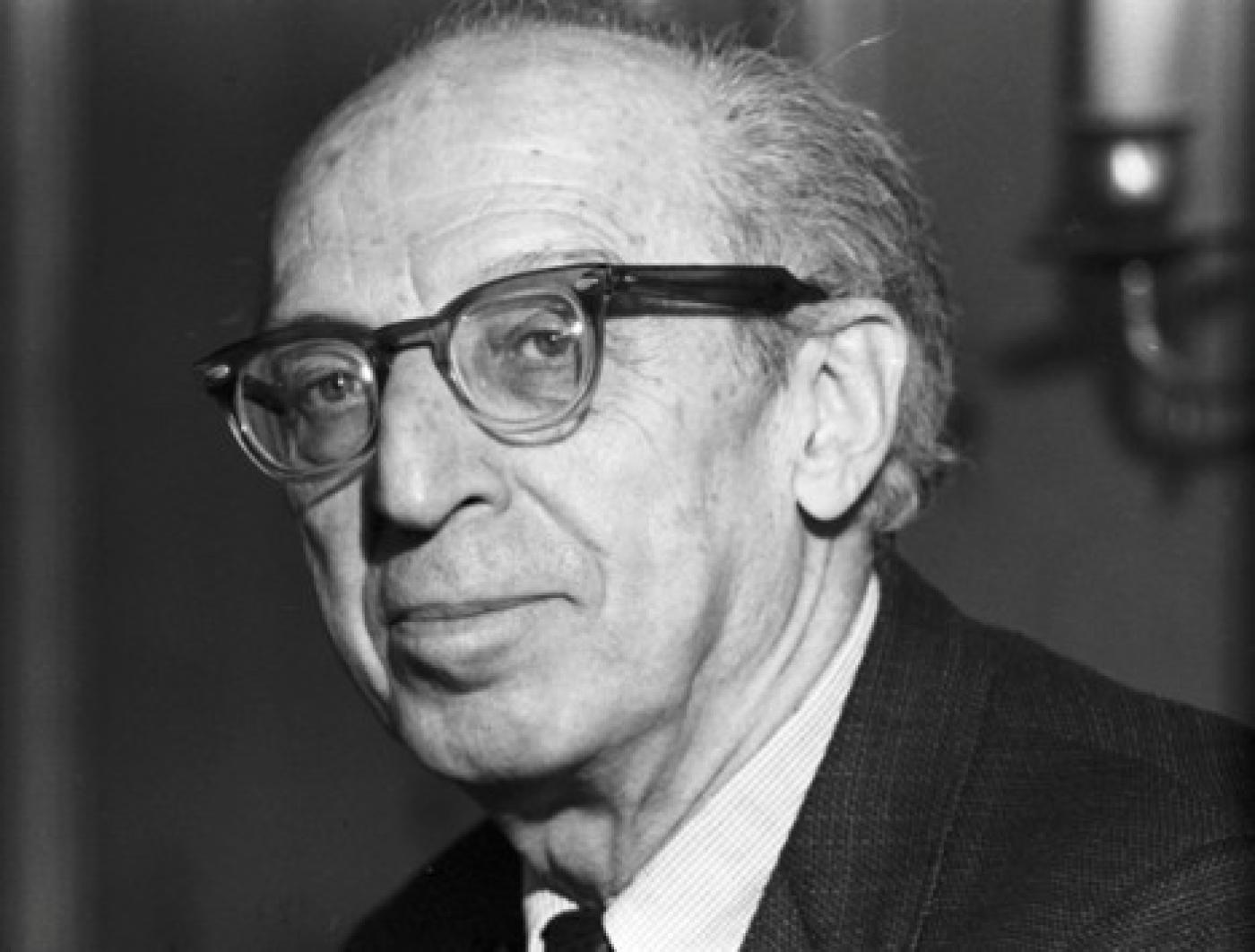
Aaron Copland was born in 1900 in Brooklyn, in what is now called the Prospect Heights neighborhood. His parents immigrated from what is now Lithuania, to escape the anti-Jewish pogroms. His father established a successful store that Copland described as "a kind of neighborhood Macy's" and the family lived in an apartment above the store. He was the youngest of five siblings, and his musical development began by absorbing the music of his surroundings: his mother and sister liked to sing and play piano, his brother played the violin, he heard lots of traditional Jewish music in the synagogue his family belonged to, he could hear the Blues coming out of nearby bars he regularly walked past and sometimes stopped to listen, and he occasionally attended concerts at the Brooklyn Academy of Music, where the New York Philharmonic would play several times each season. His sister taught him piano, and by age 15 he decided he would be a composer. After graduating from high school, instead of attending college, he played in dance bands and helped out in his father's store while taking private lessons in piano, theory and composition. When he was 20 he went to Paris for three years while studying with Nadia Boulanger and living the life of the expatriate intellectual in Europe, hanging out with some of the greatest writers and artists of the day. Most important for his future career, Boulanger introduced him to Serge Koussevitsky, the conductor of the Boston Symphony and a major champion of new music, who immediately agreed to conduct Copland's first major composition, a work for organ and orchestra featuring Boulanger as soloist. In 1925 he returned to the States where the work was played in New York and Boston. The reviews were mixed but Koussevitsky and Boulanger were delighted with the work, which led to a steady stream of fellowships and commissions, and so by age 25 Copland was firmly established as a major emerging American composer.
What is striking about Copland's story is that he belonged to the first generation of American composers for whom virtually every musical path seemed open. He could have played the jazz and dance music that was his American birthright, and perhaps gone on to Broadway; he could have followed in the steps of Arnold Schoenberg and composed highly dissonant music with complex rhythms that would have gained him some credibility among certain academics, critics, and fellow composers, even if most audiences resisted it; he could have gone in the more tonal, neoclassical direction encouraged by his teacher Boulanger and contemporary composers he admired such as Stravinsky, Ravel and Prokofiev; or he could have gone to one of the film studios in Queens or across the country in Hollywood and written movie scores. He could have gone down any of these paths and no one would have questioned his legitimacy, his right to play in any of those styles, or suggested that one path was more acceptable or respectable than another. It turns out that he didn't have to choose just one; he tried them all, because he could, and they all contributed to his own unique voice. Perhaps that is why his music is so often invoked to represent America: because it came out of a time when the choices and possibilities offered to Americans seemed infinite.
That work I mentioned for organ and orchestra turned out not to be a concerto but what Copland called an Organ Symphony, perhaps because in the piece the organ is more of an equal partner with the orchestra than a standout virtuoso, and that the form of the three movements (Prelude, Scherzo, and an expansive finale in sonata form) are associated more with symphonies than concertos. The Prelude is the most recognizably Copland-ish of the three movements, a languid dialogue between angular modal themes, with tension brewing beneath its placid surface. The scherzo is more eclectic, with moments of dissonant modernism, neoclassical elegance, some bluesy passages (that Copland attributed to his having been raised in Brooklyn), and a quasi-cinematic sense of color and event throughout; there are sections that sound like they could have been composed by a minimalist composer like John Adams over half a century after this was written. The finale is by far the longest movement and perhaps a bit unwieldy, but the strength of its ideas makes it compelling even if it’s not always clear where they’re going. But the work ends with a triumphant finale that ties it all together, the first of many times in his career he would pull that off.
In 1930, Copland would write one of his thorniest works, the Piano Variations. Leonard Bernstein loved this piece but also claimed that playing it is the quickest way to clear a room. It’s true that it’s uncompromisingly dissonant, a challenge for both the performer and listener. But Copland's ability to tell a story is evident even in this most abstract of pieces, and as always he does a lot with a very short, declarative theme. And, as a series of variations, there's always a theme to see if you can recognize as it keeps occurring in different guises. If you give it a chance, I think you’ll find that it’s more accessible than you might expect.
It’s hard in 2026 to appreciate just how original Copland’s Lincoln Portrait was in 1942.
While not the first work to combine spoken text with orchestra, it’s rare to find a work
that combines a serious public statement with a serious artistic statement, in which
ceremony, history and politics coexist with music.
The narrator doesn’t speak until the piece’s 15-minute duration is half over. Therefore
one should not regard the first seven and a half minutes as a mere prelude to the main
event. A story is being told from the very beginning of the piece, long before we hear any words, a story of both an individual life and of a nation. It’s also a story of diverse musical influences, a demonstration of the diverse musical strands that have come together to create an American music.
The beginning of Lincoln Portrait is typical Copland – woodwinds uttering soft three-note
mottoes in intervals of fourths and fifths, the most fundamental of all intervals, the first
overtones in the physical laws of sound, a way to signal that we're about to hear truths that go back to the beginning of time. One is reminded of Ives’s Unanswered Question – the discord between a stark, angular statement and its muddled response. This is not the only Ivesian moment in this work - about three minutes in, we are plunged without warning into a jaunty fantasia of American folk melodies, a juxtaposition of elements that are as diverse as they are united under the rubric “American.”
Just as we’ve almost forgotten about the impending speaker, he or she begins to speak. It’s too important, Copland seems to be saying, to hide behind the cloak of artistic license, of interpretation and ambiguity. No, the meaning of this music must be spelled out, and when we hear the words of Lincoln we know why. Copland has done us a service by providing a frame
in which we can ponder these words, which turn out to be as relevant to today’s struggles
as they were in the 1860s:
It is the eternal struggle between two principles, right and wrong, throughout the world. It is the same spirit that says 'you toil and work and earn bread, and I'll eat it.' No matter in what shape it comes, whether from the mouth of a king who seeks to bestride the people of his own nation, and live by the fruit of their labor, or from one race of men as an apology for enslaving another race, it is the same tyrannical principle. (From his debate with Stephen Douglas, October 15, 1858)
Lincoln and Copland seem to have had some things in common. Both took their role in the mainstream as a serious, important mission aimed at bringing wildly divergent philosophical camps together (in Copland’s case, that meant convincing his fellow composers that adopting a musical language more comprehensible by the average listener was a way composers could contribute to the war effort) which didn’t prevent both men from being criticized and branded as
sellouts or traitors. The historical significance of both men has been regularly subject
to cycles of reassessment that began during their own lifetimes. It’s sobering to think that Lincoln Portrait was composed and premiered in 1942 as a way of inspiring Americans during the darkest days of WWII with a reminder of our shared values, but then eleven years later it was blocked from being performed at Eisenhower's inauguration because of the grim irony that the composer of this most American of compositions was being investigated by the House Un-American Activities Committee. Fortunately, the message of both Lincoln and Copland is still available to us if we're ready to listen to it.
Later that same year Copland responded to another request to aid the war effort with Fanfare for the Common Man. In 1944, Copland began writing his Symphony no. 3, which is based on that famous fanfare, though its incorporation in the first three movements is subtle: fragments of it are presented and used as the basis for rumination and the creation of new melodies. The four movements of the symphony were composed as the war was coming to the end in stages.
The first movement was written in 1944, and you can hear in the music the uncertainty of that time: the beginning suggests a long-awaited peaceful dawn, green shoots coming up after a long winter, but a few minutes in we are reminded with the entrance of the brass and percussion that the war is not yet over. This conflict between the tenacious feelings of hope and the reality of ongoing violence finally succumbs to the latter about seven minutes in, and in the movement’s last few minutes the hope seems transformed into solemn remembrance and longing for peace. The second and third movements were written in 1945. The Scherzo starts out brash, like the sound of a victory on the battlefield, and we soon transition to a quieter section in which we hear the symphony’s first real melody, as those green shoots of hope we heard at the beginning start to grow and expand; but the end suggests that, while we’re winning the war, we’re still fighting. The third movement, which, like the others, consists of alternating episodes that vary in tempo and mood, feels like the long, dark, uncertain night before dawn reveals whether the war is finally over: you hear fear and hope, dread and giddiness. This leads directly into the finale, which begins with the famous Fanfare now in recognizable form, first uttered quietly by the woodwinds, then boldly by the brass. The finale was composed in 1946 when the war was officially in the past, and while the tone is mostly triumphant, including its celebratory coda, there is one moment, between nine and ten minutes in, that contains the most violent music in the whole work; one can imagine this as a depiction of the bombs dropped on Hiroshima and Nagasaki. While the work as a whole was presented in its 1946 premiere as a commemoration of the United States’ role in defeating global tyranny, Copland finds ways in all four movements to remind us of the human cost of that victory. Serge Koussevitsky, who conducted the premiere, called it the greatest American symphony.
Copland seems to be the last composer America can agree on. Lincoln Portrait survived its brief ban and has since been performed widely and narrated by figures from all over the ideological spectrum (a small sample: Charlton Heston, Maya Angelou, Norman Schwarzkopf, Margaret Thatcher, Bill Clinton, Barack Obama, Coretta Scott King, George McGovern, Neil Armstrong, George Takei, Gore Vidal, Justin Vivian Bond.) Thanks to its inclusion in the ballet Appalachian Spring, the Shaker tune “Simple Gifts” is now sung by people throughout the world, a true universal folk song. The ballet Rodeo also popularized a tune now synonymous with Americana, the Kentucky fiddle tune “Hoe-Down,” which has been used as the introductory walk-out music for politicians of both parties on the campaign trail, WWE wrestlers, and, at every stop on his “Never-Ending Tour”, Bob Dylan. And the film director Spike Lee, who is famously not shy about tackling subjects that divide America, has expressed his love and admiration for his fellow Brooklynite Aaron Copland, using his music as the basis for the soundtrack to one of his most moving films, He Got Game (1998).
While Copland’s gifts are certainly responsible for his popularity and success, he also benefited from excellent timing. His music embraced all of America when America seemed to embrace all of humanity. Listening to it now reminds us what a united America could sound like, as it will this summer when his music will inevitably be heard in all fifty states as the United States celebrates its 250th birthday.
PBS PASSPORT
Stream tens of thousands of hours of your PBS and local favorites with WETA+ and PBS Passport whenever and wherever you want. Catch up on a single episode or binge-watch full seasons before they air on TV.