Washington, DC native and composer, Jessica Krash, has recently released her next album, Krash: True Stories. In it, we find a wide variety of sounds and settings, from solo piano and spoken poetry, wind quintet, wind ensemble, and more. It’s an album that shows you different sides of music like a multifaceted gem, and she took time to answer my questions.
John Banther: Your album, Krash: True Stories, opens with What I Wish for You and features the big cello sound of Tanya Anisimova, with you at the piano. You write that this is a work about a "mother's wishes for her adult son's happiness," which sounds at once both endearing and also vulnerable.
The piano writing is thick and closed sounding, moving in rhythmic blocks as the music takes on blues aspects. What can you tell us about this?
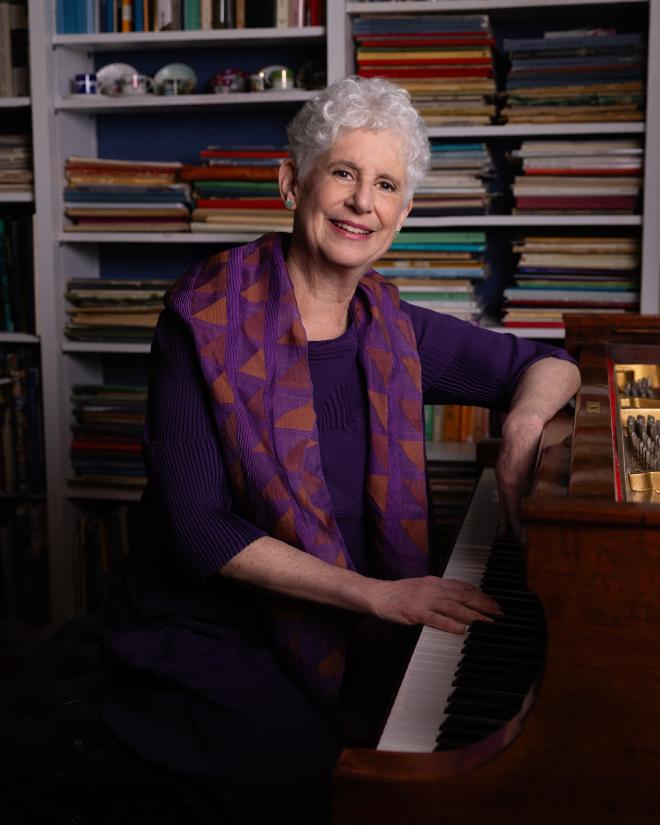
Jessica Krash: “What I Wish for You” has more of a pop, or 19th century-Romanticism sound than most of my other compositions. When I decided to start the album with it, I knew it was a risk, and would surprise people who usually listen to new music. They might feel this piece was either a little provocative, or a mistake. But vulnerability and intimacy can be a compelling artistic experience, a surprise invitation that draws you in.
My son asked me to write a piece for his walk up the aisle at his wedding. I wanted my piece to be a portrait of him, and at the same time, express my wishes for him. I find myself wondering whether Bach, Beethoven, and Brahms were also writing about things they knew from family and friends, or things they wish they had gotten from family and friends – only they called their pieces “sonata” or “symphony” while I named mine for my feelings about my son, or about what my great-great grandmother might have advised me (“The Imagined Wisdom of Bella Pavis”). Of course, most of the historic male composers weren’t mothers. But they knew mothers, and might have been writing about their hopes, in pieces called “Presto” or “Molto espressivo.”
The slightly up-in-the-air end of my piece could be interpreted as my handing matters over to the next generation.
As for jazz, I’ve never learned to play jazz, but I often write phrases in my pieces that have jazzy chords or other blues elements. Jazz musicians shouldn’t be the only ones who get to express those feelings and qualities of motion!
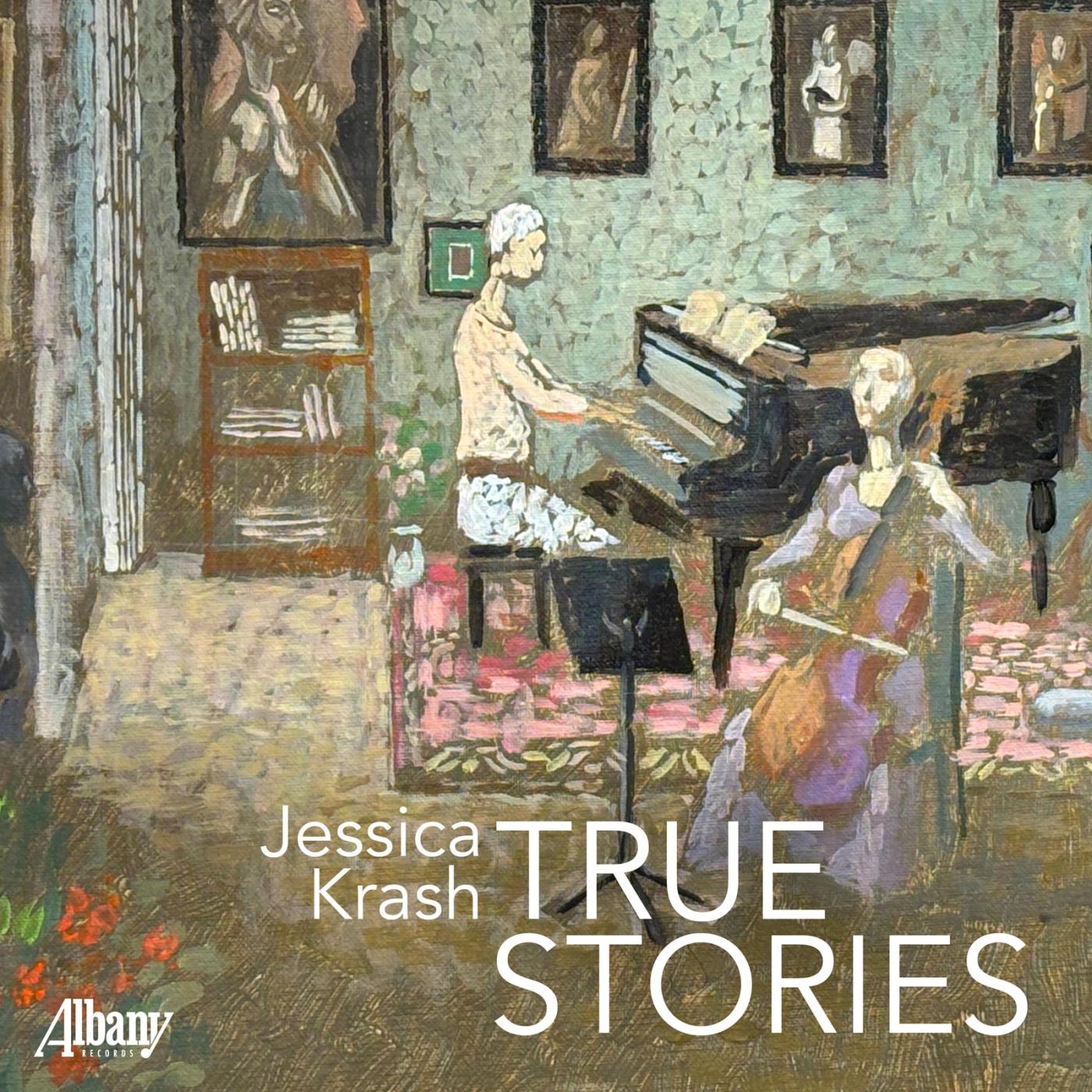
JB: True Stories is another work on the album for cello and piano, which you describe as "telling stories together in imagined spaces." Is this a conversation between instruments, and what does it mean to tell a true story in a place that is imagined?
JK: A lot of the music I write is built by putting short episodes in sequence, often with no thematic connection between the segments. For several hundred years, classical musicians were taught that the correct way to build a piece was to use just one or two themes, and vary or “develop” those themes in a sensible way, akin to a logical argument. In real life, though, people are often shifting quickly from one situation to another. By calling my piece “stories,” I hoped to help listeners reset when new material arrived, as if a new story was starting, with new characters and issues.
In my piece, sometimes the cello and piano parts are talking to each other, and sometimes they speak as one voice.
You’re right, it’s a paradox to have a true story in an imagined place! Maybe music lets me get away with that. Imagined spaces seem special, somewhere you’ve never been before. And then true stories seem special, because they really happened.
JB: There's even a moment it sounds a bit spooky, with the cellist, Tanya Anisimova, barely touching the strings and moving up and down the instrument. It reminds me of the ghostly sound in Prokofiev's first violin sonata, like wind in a graveyard. When writing music with extended technique (having the musician make sounds out of its traditional norm), do you have to experiment to see what works and doesn't with the musician?
JK: I love that part of that Prokofiev sonata! I performed that years ago with a terrific violinist, Kolja Blacher. I used to think about that passage often when I was composing. It is such a sad and extraordinarily moving moment.
Tanya and I have played together on and off for 30 years. We have a very honest collaboration, where we can criticize each other directly, because we each know the other is making her points only in order to make the music better. I’ve written a number of pieces for Tanya, and as she is looking at a first draft, she makes suggestions of what she would like to play in various passages, asking me what I prefer. Her playing is so expressive, passionate, and imaginative, and she is willing to step past the usual boundaries and rules. Tanya is so dedicated to sharing the power of music – I find her such an inspiration.
JB: I'll always believe poetry and music go together, and especially with solo piano. But, the work, Debussy chez moi, is a little different since it isn't a single poem but an interesting collection of poetic excerpts, lines, other quotes, even comedia del arte. It opens with two lines from the poem “Clair de Lune” by Paul Verlaine, which we also know as the title of a famous Debussy tune. We even have a quote from Debussy too and other French poets in this. I just want to know more about why you chose some of these quotes, and how they fit within the piano part.
JK: The piece starts with a quote from Verlaine that seemed so musical to me: not believing in your own happiness might be a frequent feeling in Debussy’s music, a kind of hesitation or distrust of an obvious feeling. It’s a wonderful philosophical and psychological space to inhabit, to be happy but not believe in it. It is almost paradoxical, and seemed like a good way to launch a piece, to toss a puzzle to the listeners. And then the end of the piece has us step back, letting Debussy float over us, as if his aesthetic was a breeze on a nice evening. For a middle section, I posed the uncomfortable challenge of Pierrot shaking his fist at the moon, and us possibly being like marionettes too. And then a soul dying from too much sun works as a focal point, kind of a statement of belief (“don’t air things out! Let them get complex and shadowy”) -- something to arrive at ¾ of the way through, where pieces often reach their high point.
The music and text come together through inhabiting some rather traditional aspects of Form (typical qualities of beginnings, middles, and ends). But what really makes the music and text come together is Cathy – her skill and sensibility. It’s amazing how she can play the piano and speak so expressively at the same time. She performs this live, and on the recording, you are hearing her speaking and playing at the same time – they are NOT separate tracks.
JB: You've written music based on or inspired by paintings, and in this album you have a work called Five Pieces About Women in the Sky, the first of which is based on paintings by Marc Chagall. What was the impetus or focus in writing this?
JK: My family came from Eastern European villages, like those in Chagall’s paintings. How wonderful it would have been to fly over those cottages! I started the piece, based on imagining the feeling of being able to fly (is it like swimming through air?), and then went back and looked at Chagall’s paintings. His flying women look severe and sometimes uncomfortable. I wanted these flying women to be happier, when they were in my music.
During the Covid pandemic, when vaccines first became available, people said the airplanes were filled with grandparents! What was on their minds? Of course they were yearning to see their children and grandchildren. But other things were on their minds too.
The piece about women pilots is based on the story of Tammie Jo Shults, who was flying a Southwest plane in 2018 when one of the engines failed, parts breaking off. Her passengers described being comforted hearing her voice from the cockpit as she brought the plane to a safe landing. I wanted to give the piano a voice like Nina Simone’s.
In October of 2019, astronauts Christina Koch (engineer) and Jessica Meir (marine biologist) accomplished the first all-woman spacewalk. Brave, intelligent scientists, they also seemed to enjoy their hair flying without gravity. In music, I tried to capture their seriousness and competence, and their fun. Six months earlier, two women astronauts were supposed to do a spacewalk, but the International Space Station only had one woman-sized spacesuit on board. They hadn’t planned to employ two capable women at the same time.
Flying can be a metaphor for freedom, transcendence, adventure, escape, being ungrounded, up in the air, and more. I wanted to set these images or experiences of women in the sky next to each other to see what other metaphors might emerge. The women in my piece inhabit the same space for about 12 minutes – would the Seven Sisters have liked to be astronauts? Would grandmothers today like to fly over cottage rooftops in Belarus, while singing with the comforting power, skill, and steadiness of Tammie Jo Shults, landing her plane with only one engine?
Originally, I was going to write this set of pieces for various chamber ensembles, and include a women’s chorus for the grandmothers on the plane. And then I decided to be more practical, and make all the movements for solo piano.
JB: A larger scale work on the album, What I Learned from You, is for wind band, and features the Lithuanian Symphonic Wind Orchestra. I think this is your only piece available for this type of ensemble, what were the challenges or even fun aspects of writing for band?
JK: Writing for band was very fun. The piece was written during the Covid quarantines, so I used zoom to work with the band director, Antanas Kučinskas, and with Karolis Variakojis, who conducted the recording, and Aleksandras Simelis, who conducted the premiere in Vilnius. They sent me a recording of their live concert, which I discussed with them in preparation for a recording session. I hope I will have more opportunities to work with them and other bands. There are so many colors and textures in a band! I have a tiny bit of band cred, as I played flute in junior high band every day for three years, where my position was like a concertmaster. 55 years later, I am still friends with three of the boys who played in the trumpet section of that band. When I started writing this piece, I asked my old friend David Lang if he knew anyone who could advise me on band orchestration, and he suggested a former student of his, Ryan Lindveit, saying Ryan was the “Band Guru.” This was during the quarantines and Ryan met with me a number of times on zoom. I learned so much from him. He is an unusually wise, imaginative, and expressive musician, and was very kind to work with me when I am so much older than he is.
One of the interesting issues of writing for band is that we have associations to certain instruments, they represent roles. For example, towards the end of my piece, there’s a shard of an old tune that fit well in the trumpet. When you hear a trumpeter play this section, it is heart-wrenching partly because it makes us think of taps at a funeral. Snare drums can evoke images of military bands in pre-20th century wars. Saxophones can make us think of jazz personalities.
When I write for orchestra, I usually treat the strings as the basic fabric or foundation. With band, I treated the groups of instruments equally, so there was not one group being the center to the overall sound. Each phrase called for a different sound. I enjoyed having the tunes and gestures overlap, as if they were shards found in an archeological site, combined with modern sounds, like diverse people coming together to make a better future – which is something that was on my mind during my several visits to Lithuania.
JB: The album concludes with Between Friends, a work for piano four hands which you describe as "two friends at the piano on a nonlinear romp between introspection and celebration."
How much of this is introspection and romp and is evident to the listener, because the titles make it sound to me like a lot of this is like a slang or inside jokes only friends know. We have 1. Between the Lines 2. Between Us and 3. Between Beats, and so I am wondering, does the album open with you pulling back the curtain and then shutting it at the end?
JK: I like very much your idea that the first piece on the album opens up an experience, and then the last piece is like a bookend to that beginning. I was touched and delighted that Betty asked me to write a duet for her and me to perform on a recital she was giving. Betty and I have known each other for a few decades, and I always feel happy after having coffee with Betty. The piece has its turbulent and wild moments, but maybe what you’re hearing most is the atmosphere of two friends having coffee.
PBS PASSPORT
Stream tens of thousands of hours of your PBS and local favorites with WETA+ and PBS Passport whenever and wherever you want. Catch up on a single episode or binge-watch full seasons before they air on TV.