"As a teenager in Portland, I used to listen to those wonderful broadcasts of chamber music from the Library of Congress, to think and dream...that would be the life for me"
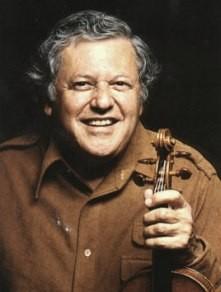
That was a quote from Robert Mann, violinist and founder of the Juilliard String Quartet, speaking of what inspired him to devote his life to chamber music. Not only did he fulfill his dream of being a chamber musician, leading one of America's leading chamber ensembles for over fifty years, but he ended up playing on that same series of radio broadcasts from that same institution, inspiring a new generation of musicians much as ensembles like the Budapest String Quartet inspired his own.
The Budapest began their 22-year-long residency at the Library of Congress in 1938 and ended 462 concerts later in 1962. The rationale for having a resident string quartet was that the Library needed world-class musicians to keep its collection of Stradivarius instruments that it acquired in 1935 in peak playing condition and to fulfill the vision of the person who donated them, Gertrude Clarke Whittall, to have them regularly heard by the public.
The Juilliard String Quartet played its first concert at the Library of Congress's Coolidge Auditorium in 1948, just two years after it had been founded. By 1962 it had become, in the words of several critics, "America's Quartet". They made the first complete recordings of the quartets of Bartók and Schoenberg, championing new music while also devoted to giving fresh, probing performances of the standard repertoire; Robert Mann often said that the Juilliard's strategy was to approach new music as if it were old and old music as if it were new. The quartet had already gained a foothold into the top tier of classical music culture within its first decade, and they collaborated with some of the most prominent musicians of their time, such as Aaron Copland, Glenn Gould and a skilled amateur violinist named Albert Einstein (who, from all reports, had excellent intonation.) The Coolidge was a regular and increasingly frequent stop on their annual tours throughout the 1950s as their reputation steadily increased, so by 1962 the passing of the torch from the Budapest to the Juilliard felt natural and inevitable.
This represented a significant cultural shift. For its first few decades since its establishment in 1925, the most prominent classical musicians to appear on the Coolidge stage were great musicians from Europe forced into exile by the war who found a welcome home in the United States. But by the sixties, there were enough world-class musicians trained in American conservatories that America's library could now feature American musicians with no diminishment in the quality or prestige of its offerings. Among the many musicians the Juilliard Quartet collaborated with were those from both generations, such as the French pianist Gaby Casadesus and the American Leonard Bernstein.
The Casadesus family of musicians was associated with the Coolidge from the very beginning. The family musical dynasty started with a French man of Catalan origin, Louis Casadesus, born in 1850 in Paris, who was a printer and accountant by trade but also a serious musician who published a guitar method. He had nine children over the course of 22 years, seven of whom became professional musicians, and three of them - Henri, Marius and Regina - along with Marius's wife Lucette, performed at the Coolidge in an early music festival in 1928! Regina played harpsichord while her brothers and sister-in-law played viols, early string instruments of various types. Another brother, Robert-Guillaume, became a successful actor and singer, and his son, Robert Casadesus, became the most famous member of the clan, one of the great pianists of the 20th century. His wife, Gabrielle or Gaby, was an equally renowned pianist; in her youth she worked with Gabriel Fauré and Maurice Ravel. She and her husband toured the world and recorded as a very successful piano duo. In 1972 tragedy struck when their son Jean, himself a very successful pianist, died in a car accident at the age of 44, and Robert died a few months afterwards. Gaby, however, kept going, and in 1975 she established a piano competition in her husband's name in Cleveland that remains one of the most important contests of its kind. That same year, at age 73, she played at the Coolidge with members of the Juilliard Quartet of a work by her mentor Fauré, the Piano Quartet no. 1.
Leonard Bernstein’s collaboration with the Juilliard Quartet, in a performance of Robert Schumann’s Piano Quintet, occurred 12 years earlier, in 1963. But his association with the Library of Congress began in 1954, when he started regularly sending the manuscripts of his compositions to them. His mentors Serge Koussevitsky and Aaron Copland had been heavily involved in developing the library's music program. While he only gave one performance at the Coolidge during his lifetime, Bernstein was in frequent contact with the Library while he was alive, knowing that it would take on a vital role in preserving his legacy.
The Juilliard Quartet ended its residency after its 40th season in 2003, when it was decided to spread the wealth of the Stradivarius Collection. When the Budapest Quartet began its residency, professional string quartets were rare, especially in the United States, but toward the end of the 20th century there were many exciting young American string quartets following in the wake of the Juilliard Quartet. So the Library of Congress decided to abandon its residency program and instead invite a different quartet every year to play the Strads in its annual Anniversary concert on December 18, the date Antonio Stradivarius died in 1737, and the date the Library’s Strads were first played on the Coolidge stage in 1937. (The Juilliard continues to play there occasionally, and their number of appearances at the Coolidge has blown past the Budapest’s number to over 500.) In this way the scope of Mrs. Whittall’s gift has been expanded.
In preparing this series I spoke extensively with Anne McLean, the Producer of Concerts and Special Projects for the Library’s Music Division, a position she has held for over forty years. One word that kept coming up in our discussions was “family.” In exploring the fascinating history of the Coolidge Auditorium, it becomes clear that perhaps the greatest achievement Elizabeth Sprague Coolidge made with her gift and her vision was to provide a home for artists and their art. She could not have known back in 1925 just how unstable the coming century would be, though she lived to see how vital the venue would be in providing a forum for artists displaced by global instability as well as those who faced discrimination or insufficient support in their own communities. Art has a way of creating community – and even in this digital age, it still needs a physical space in which to take shape and bring people physically together. In creating this auditorium 100 years ago, Mrs. Coolidge created a family that continues to grow.
PBS PASSPORT
Stream tens of thousands of hours of your PBS and local favorites with WETA+ and PBS Passport whenever and wherever you want. Catch up on a single episode or binge-watch full seasons before they air on TV.