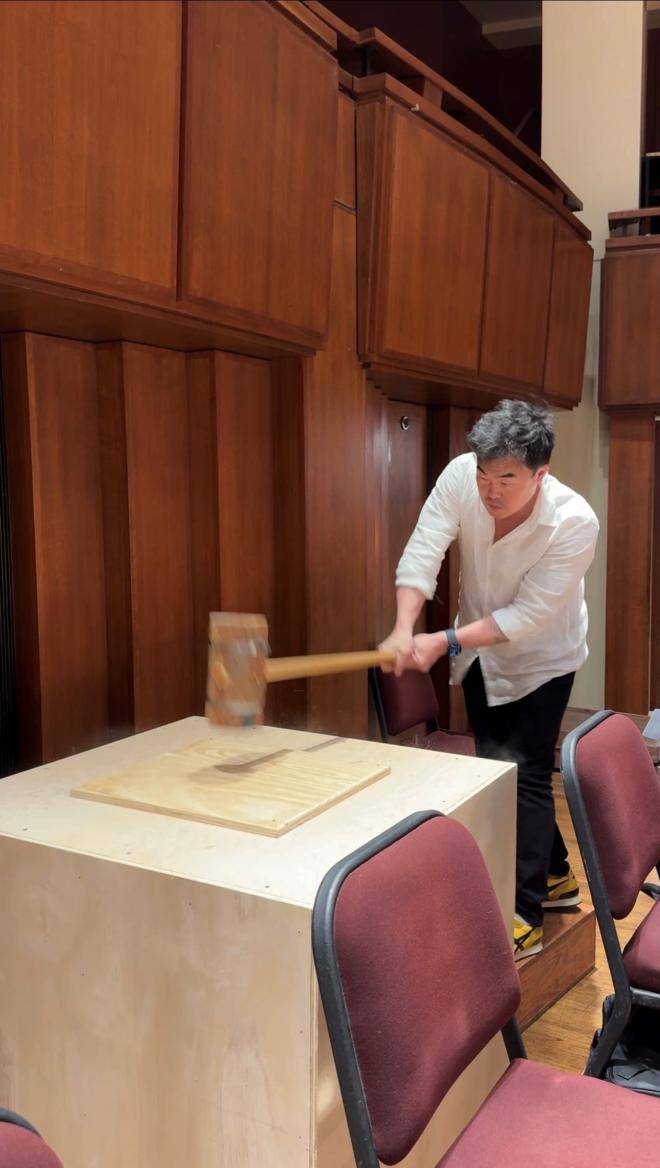
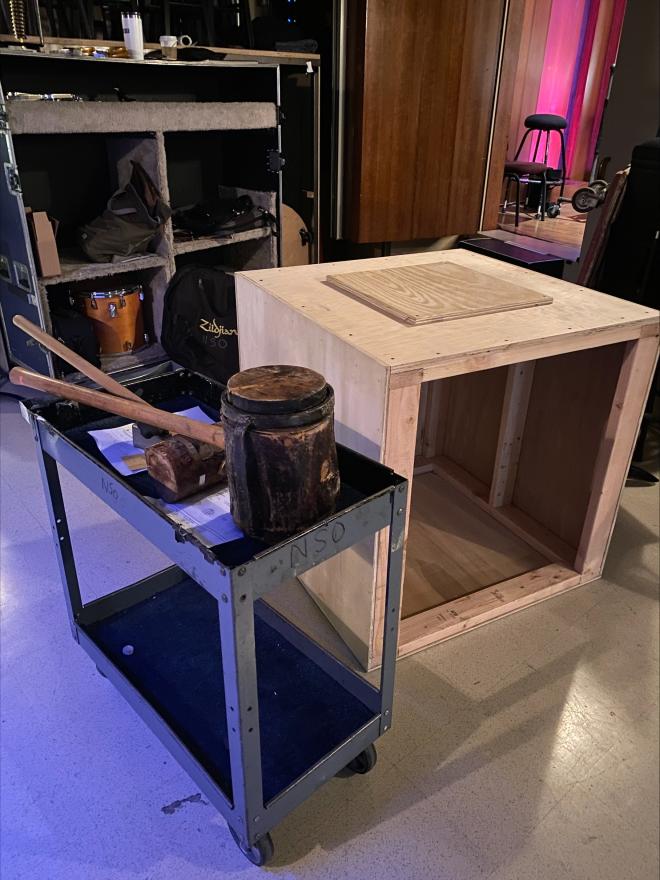
What is the weird contraption in these photos? And what’s it doing on the Kennedy Center Concert Hall Stage? Well, that’s principal percussionist Eric Shin getting ready to deliver the 3 fateful hammer blows that punctuate the final movement of Gustav Mahler’s Sixth Symphony in A Minor. This magnificent symphony was recorded by our own Charles Lawson in May of 2025 and will be the featured work on this month’s NSO Showcase.
If you look closely at the photos, you’ll see that the hammer is made from a tree trunk which is fitting, because according to Gustav’s wife, Alma, Mahler told her that the hero of the symphony, presumably Mahler himself is struck down by the “three blows of fate, the last of which fells him as a tree is felled.”
Why such violence in a classical symphony, you might ask?
Mahler wrote his Sixth Symphony during the summers of 1903-1904, at his idyllic family retreat in the Austrian Alps. Life was good: he had a prestigious job as head of the Vienna Court Opera; he had married the love of his life; and they had 2 little girls, the second of whom was born in the summer of 1904. As Alma put it, her husband was “young and unencumbered...often playing with the child, carrying her, dancing and singing...and every morning after swimming in the lake, he climbs the hill to his composing hut. He locks the door, and he writes music of annihilating darkness.” It seems that underneath the sunny skies, Mahler couldn’t help but ask himself, “will this happiness last?” Will fate torment me by taking it all away?
Tragically, he was right to worry. Three real life hammer blows nearly felled him 3 years later. His elder daughter Maria, the one had danced and sung with, died of scarlet fever at the age of 4; he was forced to resign his job; and he received a death sentence from his doctor.
Mahler poured all his anxiety into the titanic struggles of the Symphony—a mighty battle between light and dark, major and minor. The opening movement begins with a relentless, aggressive, nervous march, which gives way to the lovely theme Alma believed was her musical portrait. Offstage cowbells are supposed to “evoke the serene atmosphere of the Austrian alps.” They should, Mahler said, “produce a realistic impression of a grazing herd of cattle, coming from a distance.”
Mahler dithered about the order of the two middle movements. NSO Music director Gianandrea Noseda chose to play the Sherzo in second place. You could think this represents children darting about and playing, but even here, there’s darkness.
The Andante movement follows and quotes the first song of the Kindertotenlieder cycle (Songs on the Death of Children) on which Mahler was also working at the time.
In the massive Finale, the epic battle is joined with heavy brass. Lighthearted cowbells represent “the last earthly sounds heard from the valley below by the departing spirit on the mountain top.” The three hammer blows threaten the deceptive peace. Some performances feature just two blows, but Maestro Noseda insists on all three. We hear the cowbells one last time before the final hammer prostrates the hero. The symphony loses the battle between light and dark and ends on an A minor chord which fades away into the void.
This NSO performance honored retiring principal cellist Glenn Garlick who was hired by Mstislav Rostropovich in 1980 and performed a remarkable 6,600 concerts over his 45 years with the Orchestra.
One last note: Mahler’s 6th is a piece that rewards deep listening, and you can hear it as often as you like on demand throughout the month of July here. NSO Showcase airs July 1st at 9 p.m. on WETA Classical.
PBS PASSPORT
Stream tens of thousands of hours of your PBS and local favorites with WETA+ and PBS Passport whenever and wherever you want. Catch up on a single episode or binge-watch full seasons before they air on TV.