Censored Voices: Silent No More, is a chamber music concert featuring works of Russian composers who created music while struggling with the Soviet regime, presented by EGC Productions in partnership with the Baltimore Symphony Orchestra. It will include works by Rachmaninov, Prokofiev, Shostakovich, and Gubaidulina.
It will be presented on May 3rd at the National Presbyterian Church in Washington DC at 7pm.
Performers include BSO Acting Associate Concertmaster Boram Kang, BSO Principal Cellist Dariusz Skoraczewski, soprano Catherine Wethington, and Joseph Holt, piano
Washington concert goers will be familiar with Joseph Holt, from his years as collaborative pianist with the Army Chorus as well as his tenure as Associate Music Director of the Choral Arts Society of Washington before relocating to Florida where he served as the Artistic Director of the Choral Artists of Sarasota.
I corresponded with Joseph about how this concert came to be, his thoughts on the music itself, and his long-time association with soprano Catherine Wethington.
Scott Tucker: I am thrilled to see that you are coming to perform in DC! Even after your impressive 17-year tenure with the Choral Artists of Sarasota Florida, audiences here still feel a claim on you, from your many years with the Army Chorus and with the Choral Arts Society of Washington. How did this concert with EGC, the Baltimore Symphony players and Catherine Wethington come to be?
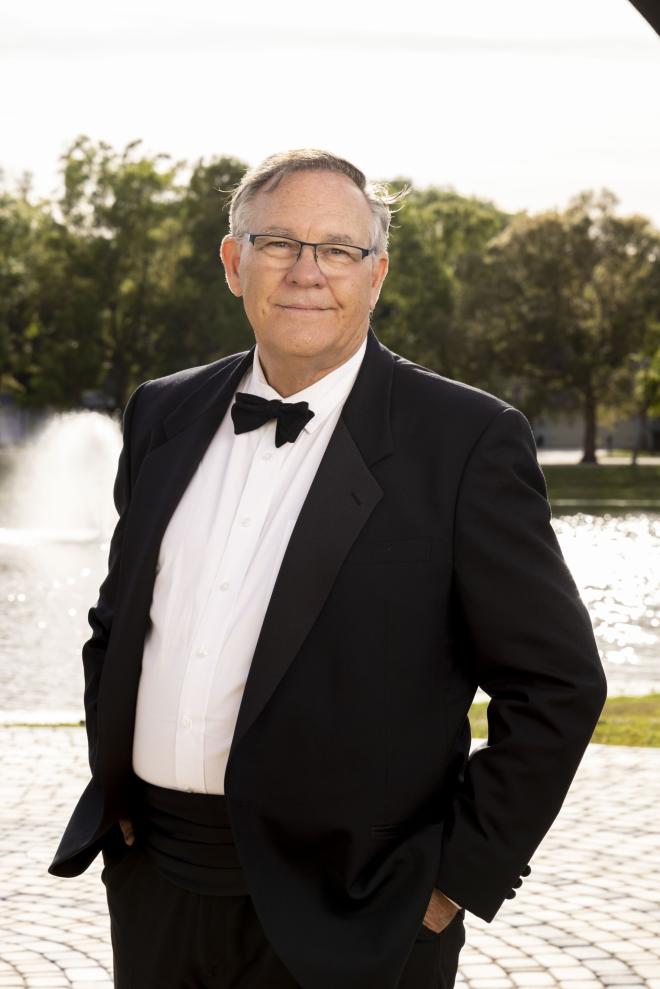
Joseph Holt: A year ago, it was announced that I was stepping down from my tenure as Artistic Director with the Choral Artists of Sarasota. Olin Wethington, co-founder and one of the managing directors of EGC Productions, called me that very same day inquiring whether or not it was true that I was ‘retiring’ from active musical life. His call was perfect timing as I was considering some future projects post-Choral Artists in Sarasota. He engaged me to be the chorus master for their first venture in the DC area – a musical tribute to Mother Teresa. During that performance, I mentioned that I was presenting a program in Sarasota later that Fall that ultimately became the genesis of the upcoming program at National Presbyterian Church. Both Olin and his wife Nadine, also co-founder and managing director of EGC, came to Sarasota and heard that performance. They were searching for a future program in DC that would engage both Baltimore Symphony musicians plus soprano Catherine Wethington and this program fit the bill and resonated with their mission statement for programs.
ST: Tell us a little about the music you will be performing. Many people are familiar with Rachmaninov and Prokofiev from their larger orchestral works. What is it like delving into their chamber and vocal repertoire? Are there insights to be gained there that one might not find by listening to Rachmaninov's piano concertos or Prokofiev's symphonies?
JH: Delving into the chamber works of a composer is a view into a more intimate and, perhaps, vulnerable aspect of their musical thought. In musical miniatures, the challenge is to create a musical experience that encapsulates an idea, an emotion or a short journey within a shorter framework. Regarding vocal repertoire, the poetry dictates the tenor of the experience as poems are not extended works typically. The delicacy of a phrase becomes the world in that moment, resulting in a universe of musical thought in just a few minutes of time. Stylistically, one can recognize the poignancy of Rachmaninoff in these works – his voice tends to remain true throughout his compositions. And, the sweeping romantic vision that one hears in the piano concertos and symphonies is thoroughly evident in these chamber works and songs. In the case of Prokofiev, the piquant and sarcastic nature of his personality is heard, particularly in the large-scale symphonies, concertos, operas and cantatas. They also ring true in his chamber works but the effect is different as his compositional style is more subdued and introspective. This is certainly true in the two works that are being presented on this concert. The opening set is almost impressionistic in flavor and the violin/piano melodies are almost hypnotic in approach. But, the harmonies that are a signature of Prokofiev do shine through on occasion and his ever-present sarcastic, biting humor can be heard in some passages.
ST: I see from the title, that you are featuring composers that suffered oppression in Soviet Russia. No doubt they dealt with that difficult situation in their own ways. Is there a message here for artists that you feel is apt for today?
JH: The original concept of the program was to highlight composers that have dealt with authoritarianism in their musical lives. The historical perspective informs us and aids in our understanding of their music. And, it provides us a view into a creative life that was frequently censored and/or rejected. In our era, we don’t suffer repression as these composers did in the Soviet Union, particularly under Joseph Stalin. However, there are signs in the world at large that a type of cultural repression has gained momentum and artists might be subjected to condemnation or censorship. The music we hear is a reflection of our time – the cultural conventions, established societal norms, and current events all contained within musical frameworks that have been established for centuries. Composers present us with their view of the world, whether that is a reflection of their own deeply felt beliefs or a reaction to beliefs that are being subjected imposed upon us. How do you remain true to your inner voice and muse if you are strangled by outside pressures that attempt to intimidate or require you to adhere to an acceptable norm that is in conflict with your own psyche?
I’m pleased that we also included a contemporary composer, Sofia Gubaidulina, who also faced censorship in her lifetime and moved to Germany as a result. Our research indicates that the performance of Gubaidulina’s Phaecelia will be a U.S. premiere.
ST: I know you have collaborated with soprano Catherine Wethington a few times now. Some musical partnerships grow and mature over time. Can you tell us about your musical collaborations together, and how you have influenced each other musically?
JH: It’s always a pleasure to work with artists on an ongoing basis and the relationship that I’ve had with Catherine has been developing over the years in wonderful ways. Having first heard her when she was a younger student, it’s been a distinct pleasure to hear her mature into the artist that she is today. While in DC, I had the opportunity to accompany her on occasion but our real artistic collaborations began after I had left DC for Sarasota. I engaged Catherine to sing the challenging soprano parts in Carmina Burana in a production that also featured the world premiere of choreography accompanying the work in Sarasota. The program was such a success that we had to present an additional set of performances a few years later. She was the vocal star of the performance! As I also produce and host a program in Sarasota, Music Mondays, that highlights the work of musicians throughout the country, I engaged her to be a part of that series, showcasing her artistry to an audience. She also made the trip to Southwest Florida to participate in some Gala events supporting Choral Artists. She is one of the most genuine artists that I know and I always look forward to being with her onstage.
PBS PASSPORT
Stream tens of thousands of hours of your PBS and local favorites with WETA+ and PBS Passport whenever and wherever you want. Catch up on a single episode or binge-watch full seasons before they air on TV.