Several composers are branded as "revolutionary," but it's hard to think of one more deserving of that word than Claudio Monteverdi. It's true that he didn't actually invent opera, but he's the one who revealed its potential for greatness in L'Orfeo (1607). It's no accident that two of the very earliest operas were about Orpheus, the musical demigod of Greek legend, because it provided composers with the opportunity to demonstrate the power of their art form, composing music so beautiful that one could imagine that it could tame wild beasts and melt the heart of the god of the underworld.
Those operas were by the intense rivals Jacopo Peri and Giulio Caccini in 1600 and 1602; they used the same libretto and were mostly focused on developing recitative, a declamatory style of speech-song that was meant to emulate how they imagined actors in ancient Greece delivered their classic texts, punctuated by choruses that commented on the action and sometimes engaged the soloists in a kind of responsory dialogue, all with minimal instrumental accompaniment. Monteverdi built upon this model but enhanced it in three ways: with highly florid, melismatic vocal lines, infused by a kind of primal, incantory power, possibly inspired by the Jewish cantors he could have heard in the Mantuan Ghetto and the calls to prayer by traveling Islamic merchants; a highly varied score that closely illustrates the action and the characters' emotions, from joyful wedding songs and dances to passionate pleas to heartbreaking laments, and which anticipated Wagner by 250 years with its use of leitmotifs; and the use of a large orchestra, with bowed strings emulating Orpheus' lyre, recorders standing in for shepherds' pipes, and the noble sound of cornetti and sackbuts (the ancestor of the orchestral brass section) representing the spirits of the underworld, all underpinned by the equally varied continuo section: harp, harpsichord, and different types of organs and lutes.
The work was the first operatic "hit", evidenced by the fact that its published score and libretto went through multiple printings, and there are some indications that it was performed in a few other cities during Monteverdi's lifetime. He followed this up in 1608 with L'Arianna, which was even more popular, though sadly the score is lost except for the "Lamento d'Arianna", the first operatic "hit tune." And all this time he was also composing madrigals, which were to Monteverdi what lieder were to Schubert, a stream of perfectly crafted miniature dramas on an intimate scale, which also served as a kind of creative laboratory.
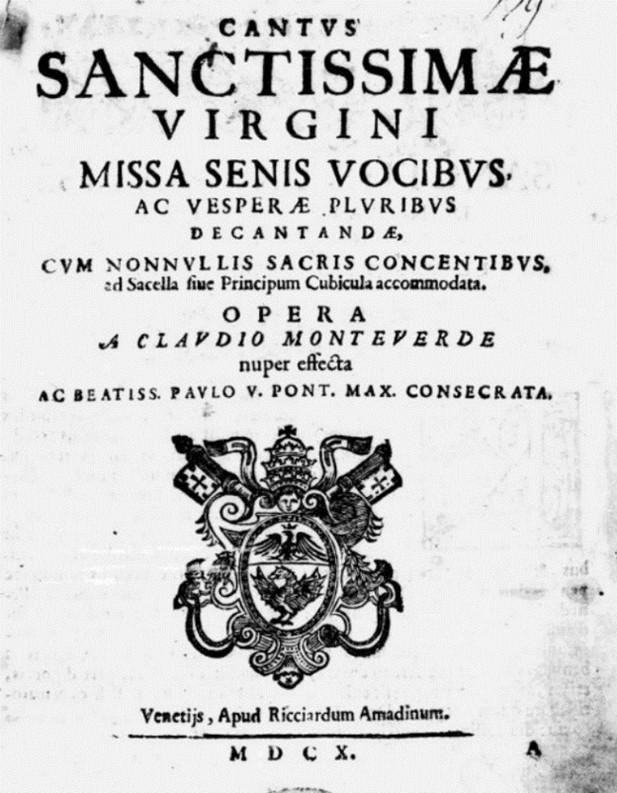
But it's what Monteverdi followed that with in 1610 that made him truly revolutionary: a volume of sacred music to which he applied all the expressive techniques he developed in his operas and madrigals. The volume begins with a setting of the Mass that he composed in "stile antico" (old style), also known as "prima pratica" (first practice), deliberately evocative of Palestrina and the more conservative 16th century, perhaps to show that he was capable of coloring within the lines before he burst all boundaries with the rest of the volume, devoted to an unusually complete Vespers service, Vespro della Beata Vergine (Vespers of the Blessed Virgin), which today is frequently referred to as the "1610 Vespers" to distinguish it from the Vespers music he wrote later in Venice. Monteverdi makes no secret of what he's doing here: the opening versicle, Deus in auditorium, is sung by the chorus in long tones while the orchestra blares out the opening toccata to Orfeo, made even more brilliant with the addition of an additional instrumental voice, creating one of the most iconic, spectacular openings in all of music. And what follows doesn't disappoint: each psalm setting has a completely different scoring and texture, with richly detailed word-painting that lets the listener ponder the text in a dynamic way that must have had the same effect on its original listeners as color film did for movie audiences of the 1930s. And interspersed among these standard Vespers settings are madrigal-like settings for solo voices of other Biblical texts, including the sensuous Song of Solomon. There are also passages featuring a solo tenor in dialogue with a distant "echo" tenor reminiscent of the last act of Orfeo when Orpheus' laments are answered by an echo that turns out to be his father Apollo. The effect is frankly operatic, and Monteverdi is entirely comfortable suggesting that the primal search of a son for his father is universal, transcending the distinction between belief systems.
The central question surrounding this work - is it a single composition or a collection of compositions? - is shared by another masterpiece written a century later, Johann Sebastian Bach's Mass in B minor (which will be performed by the Washington Bach Consort in April). Both composers published these works as compendiums, because they both lived at times when presenting them as unified concert works would have been unthinkable. But both composers seemed to envision a day when these works could be appreciated as more than just collections, since they were both crafted in a way that emphasizes their cohesion.
Much of Monteverdi's later sacred music is just as good as anything in this volume, but what makes the 1610 Vespers so powerful is its unified conception. Even though it was written centuries before works like Beethoven's Missa Solemnis and Verdi's Requiem made the concert hall a safe place for an evening-length liturgical work, the Monteverdi Vespers feels like a singular grand statement, and its connection to other genres and cultures at the dawn of what we consider to be "classical music" makes it feel eternally fresh. It's a daunting work to perform, and even though it's become familiar through recordings in the last 40-50 years that doesn't make a live performance any easier to pull off. Every performer must be not only a virtuoso but a specialist, whether it's in Monteverdi's unique vocal challenges or a mastery of instruments that are still not commonplace like the cornetto (a wooden instrument that's blown like a brass instrument, sounding like a distant and supple trumpet that can be beautiful and mesmerizing in the right hands) and chitarrone (a giant lute with two separate sets of strings). There are elements of improvisation in every performance, whether it's in the florid ornamentation or in the realization of the continuo, which responds to the singers in real time in a way that can't be mandated by a pulse or a conductor. And there is still no consensus on many details of performance: whether to interpolate plainchant to conform with a particular feast day, whether to have instruments (and to decide which ones) double the vocal lines in places they're not specifically called for, whether certain passages are sung by soloists or a choir, and in two substantial sections there's even a dispute over what key they should be performed in. Fortunately, many of these issues have been clarified through the work of musicologist Jeffery Kurtzman, who literally wrote the book on this piece and will be on hand to deliver a pre-concert lecture for the upcoming performance by the Washington Bach Consort.
Every performance of this work is a special event. No two performances are alike, and while all music is best experienced live, there are aspects of this piece that are really only fully revealed in person. So it was thrilling to be able to talk to Dana Marsh about the upcoming performance he's directing with the Washington Bach Consort.
The Washington Bach Concert, conducted by Dana Marsh, will perform Monteverdi’s Vespro della Beata Vergine at National Presbyterian Church on Sunday, March 22 at 4 pm.
PBS PASSPORT
Stream tens of thousands of hours of your PBS and local favorites with WETA+ and PBS Passport whenever and wherever you want. Catch up on a single episode or binge-watch full seasons before they air on TV.