The history of classical music instruments is full of technical and sonic experimentation, with each category of instrument (such as bowed strings, plucked strings, winds, brass, etc.) being host to a bewildering series of variations and permutations across the centuries. Just as in biological evolution by natural selection, most new experiments and mutations don't last very long and end up lost to the sands of time, while a few experiments result in such versatility and popularity that they become the dominant type of their instrument family for centuries.
But then, also as we see in biology, there are the niche specialists who thrive in their own small corners of the world because the attributes that they’re uniquely good at just found a perfect fit with their environment. The viola d’amore is that kind of instrument. It’s sort of a hybrid between a standard viola and a treble viol, with the additional feature of sympathetic strings that add a long, echoing resonance with a silvery tone to every note.
On March 6th and 7th, the Washington Bach Consort will host a concert featuring this very special instrument, played by viola d’amore virtuoso Dan McCarthy. He was kind enough to write to me about his approach to the viola d’amore and the music he’ll be performing in this concert program, “Metal and Gut: Two Violas of Love.”
MD: How did you first encounter the viola d’amore? What do you enjoy most about this unique instrument?
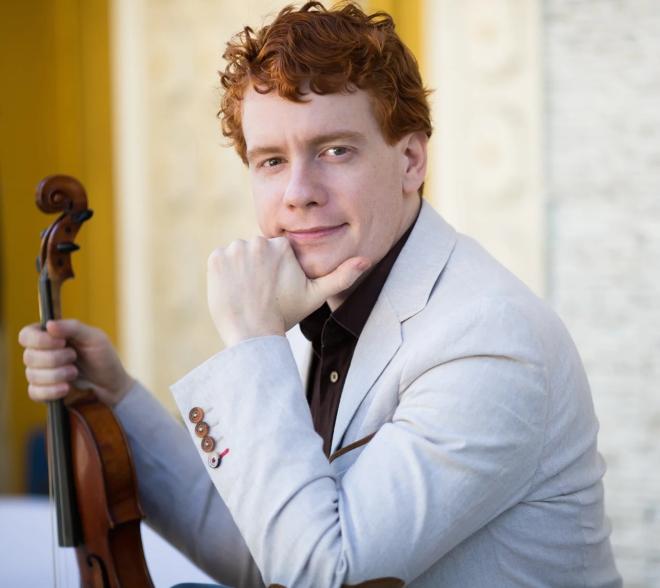
DM: For me, the Viola d’Amore has always been this exotic instrument that I’ve read about in music history classes and heard mentioned in lectures. However, I never encountered it in person, and sadly often violinists will just play viola d’amore parts on violin rather than take up and learn to play the viola d’amore. I decided to be the “change I wished to see in the world” and bought an instrument. Since then, I’ve gone out of my way to instigate a more historically informed approach to this instrument and the music it calls for in the various groups I play in.
What I enjoy most about the particular instrument I play are the various tunings, and how they’re employed by various composers. Vivaldi in particular is wonderful with writing these fun triads that aren’t possible to play on a violin or viol family instrument. The resonance it achieves is just delicious!
MD: Could you describe some of the challenges to playing the viola d’amore (as opposed to other viol or violin family instruments)?
DM: The type of viola d’amore with sympathetic strings is very cumbersome to play. Imagine something with a body the size of a viola with a neck that is thicker than a cello’s. In addition, the scroll extends for another 10-12 inches. Thus, you have an instrument with very odd proportions and an off-kilter balance that sits very awkwardly in the left hand. It can be quite taxing negotiating the often quite awkward fingerings I encounter on this instrument. Also, despite it being played like a violin on the shoulder, it is actually a member of the viola da gamba family. The way I bow the instrument requires a very different touch and approach. One must use more subtlety and articulation rather than brute force. There’s a reason why there was never a string section of d’amores in any orchestra!
MD: How do the different composers on this concert program handle the viola d’amore differently in their writing?
DM: Chiefly the d’amore is often used for its timbral effect. It’s an instrument that was played by specialists and rich dandies. In general, all forms of the d’amore have a sweet, silvery, ethereal sound. The two different ways of writing for d’amore that I can broadly categorize are: one where the instrument plays more chordal double and triple stops; and another where the instrument plays single line melodies. Bach’s treatment of the d’amore never calls for double and triple stops whereas Vivaldi employs them quite often. You will certainly hear them in the two Vivaldi pieces I’ll be playing.
MD: The concert program title refers to the two different types of viola d’amore, the “Metal and Gut,” do you have a favorite between the two types? How do you choose which one to use for the different pieces written for viola d’amore?
DM: In all honesty, I’ve never even seen the older style of viola d’amore strung in metal wires for the bowed strings and without sympathetic strings. I have only heard vaguely of one or two people in Canada that may play this form of the instrument. Next week in fact, I’m flying to Edinburgh to pick up such an instrument that I commissioned a year and a half ago from the Luthier Jonathan Hill. This concert will be the premier of this instrument!
The original form of the viola d’amore is an instrument resembling a treble viol but is strung in metal wires and does not have sympathetic strings. In fact, there are many many 17th century treble viols that seem to be misattributed d’amores. I believe the current thinking is that this instrument came about from trends in Elizabethan England to put metal strings on instruments, particularly plucked instruments. The earliest accounts of the d’amore do come from personal journals in mid 17th century England. As the instrument spread throughout continental Europe, it acquired sympathetic strings, and the bowed metal wire strings were exchanged for gut. There is an ambiguous overlap between these two forms of the instrument, but I think of Bach and older repertoire being played on the older d’amore. As I said before, there is probably an ambiguous overlap with a lot of d’amore music from German speaking lands. But for Vivaldi I feel very confident in saying that the “usual” viola d’amore should be used.
In the Washington Bach Consort’s upcoming concert, McCarthy will be joined by baroque flutist David Ross, harpsichordist Marc Bellassai, and soprano Julie Bosworth, for their program called “Metal and Gut: Two Violas of Love.” At 7pm on Friday, March 6th, at Live! At 10th & G; and Saturday, March 7th, at St. Paul’s Episcopal Church. Ticket information at Bach Consort dot org.
PBS PASSPORT
Stream tens of thousands of hours of your PBS and local favorites with WETA+ and PBS Passport whenever and wherever you want. Catch up on a single episode or binge-watch full seasons before they air on TV.