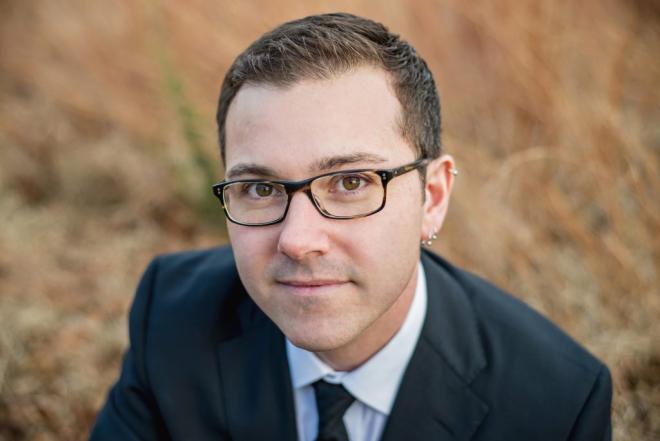
Harpsichordist and director Adam Pearl performs regularly throughout the United States as well as in Europe, South America and Asia as a soloist, and with ensembles including Washington Bach Consort, Tempesta di Mare, Baltimore Symphony, The Thirteen, Chatham Baroque, Folger Consort, American Bach Soloists, and many others. He has been a professor of harpsichord and historical performance at the Peabody Conservatory for over 18 years.
On Friday, April 10th and Saturday, April 11th, the Washington Bach Consort will be hosting Adam Pearl in a solo harpsichord recital called “Toccatas and Suites: Bach at the Summit;” and Dr. Pearl recently shared with me some of his great insights about the harpsichord and this exciting upcoming program:
MD: What first drew you to the harpsichord, and what do you love most about its unique sound and technique world?
AP: The first time I ever played a harpsichord was during my undergraduate years as a pianist. The first course in a four-semester keyboard literature sequence focused on baroque music and was taught on the harpsichord. We were required to learn pieces to perform in class, and I found myself captivated by this new and exotic (by which I mean old and long-established) repertoire, as well as a wholly new (to me) sound world. In my mind, the harpsichord had the reputation of being tinny and, because it lacked dynamic variation, incapable of being expressive. What I discovered, however, was an instrument with a large color palette, from sparkling and shimmering, to warm and lush, to dark and forceful. The technique and approach needed to draw expression from the harpsichord are obviously quite different from playing the piano. When pressing down a key, the player feels where the quill comes in contact with the string, and then plucks – almost as if we are plucking the strings directly with our fingers. Without dynamics, varied articulation and timing are of paramount importance. Since there is no sustain pedal, we frequently “overhold” notes to create a more sustained and resonant sound.
MD: Your upcoming concert, “Toccatas and Suites: Bach at the Summit,” highlights a progression of 17th-century composers writing music designed specifically for solo harpsichord. How would you describe the way these composers (whose music so influenced JS Bach) approached writing for the harpsichord, and what made their expressive language so successful and fascinating?
AP: The concept of this program, as you mention, arose from the desire to put some of J.S. Bach’s music in the context of his predecessors, whose music undoubtedly influenced the great master. I chose two genres of pieces: toccatas and suites. A suite is generally a collection of pieces including stylized dances; some also include preludes or other programmatic or character pieces. In France, dance music for the keyboard grew out of the lute repertoire of the early 17th century. While Froberger was German, his education and exposure to different musical styles included a heavy dose of Italianate forms (he studied with Frescobaldi in Rome for a few years) as well as acquaintance with the keyboard and lute styles of France (he also spent time in Paris around the middle of the century). Froberger was one of the first to organize keyboard dances into suites. The order he chose for the dances was consistent: Allemande, Gigue, Courante, Sarabande – not what one might expect considering that later composers, Bach included, chose to put the flashier Gigue as the final movement! Froberger’s compositional style is very unique, very personal, and extraordinarily expressive. This suite by d’Anglebert was published roughly forty years later than Froberger composed his. While also very expressive, d’Anglebert writes an astonishing profusion of ornamentation which is the epitome of the highly decorated tendencies of French Baroque music. On the toccata part of the program, I’ve chosen one from the undisputed master of early 17th c. Italian keyboard music, Frescobaldi. A keyboard virtuoso on both harpsichord and organ, Frescobaldi wrote his toccatas with elements of learned counterpoint and wild, fantastical, improvisation. While the harmonic language isn’t yet fully tonal, he is daring with his use of chromaticism and dissonant harmonies. Buxtehude, writing nearer to the end of the 17th c., continues the toccata tradition of mixing improvisatory and contrapuntal passages. Here however, the sections are larger, the harmonies are tonal, and the counterpoint is more strictly fugal. He also has a knack for contrasts, expression, and a clearer overarching structure.
MD: Is there anything that we in the audience at this concert should listen for that will help us hear the evolution of harpsichord playing and Bach’s synthesis of the Italian, German, and French styles in his music?
AP: While Bach was certainly influenced by the differing styles of Italy, Germany and France of the 17th c. as well as many of his contemporaries, he took these elements and folded them into his own, singular style of composition. I don’t think Bach was particularly concerned about preserving individual national styles or forms in his own works – there are Italian elements in the French Suites, and French elements in the Italian forms. Therefore, I didn’t program pieces with direct correlations, as in four of the exact same dance forms from each composer. And since there is such variety in the compositions of each of these composers, even within the same genre of pieces, my aim is to show merely a snapshot of each composer to illustrate some of the similarities and differences across time, nationality, and individual style within each genre.
With the suites, we can see many of the trademark characteristics of each dance type present in the music of each composer. The Allemandes are in a moderate duple meter, beginning with a pick-up note, using a mix of melody, style brisé, and a sort of casual counterpoint. (Style brisé refers to the “broken style” used by the French lutenists and later adopted and elaborated by harpsichordists – chords and harmonies are arpeggiated in explicit rhythms to sustain their sound longer on instruments whose tones decay rather quickly.) A general trend to listen for in the Allemandes is the increasing complexity of the counterpoint used and treatment of inner voices. The Sarabandes each display frequent emphases on the 2nd beat of the measure. However, the earlier Sarabandes are mostly chordal in their construction, with melody of secondary importance. Bach’s Sarabande is conceived more as melody and accompaniment. In the second section of the Sarabande, Bach introduces some rather Italianate ornamentation to the otherwise French decorations in the form of running triplet 16th notes. The Courantes are all in a lively triple meter – however while the earlier examples stick with the French manner of shifting the rhythms and accent patterns between 3/2 and 6/4 (this gives them their typical jaunty character), Bach’s version is more akin to the Italian Corrente, with its two contrapuntal voices and stable ¾ meter. The Gigues skip along in their typical compound meter. Both the Froberger and Bach Gigues utilize contrapuntal imitation at the start of each section – but where Froberger uses a melody of four notes to imitate, Bach’s melody is three full measures long and he treats each half of the dance as a mini-fugue, taking the strict use of counterpoint to its extreme. The d’Anglebert Gigue, on the other hand, doesn’t use contrapuntal imitation at all.
With the Toccatas, there is perhaps a clearer progression. Toccatas are typically characterized by their sectional mix of free, improvisatory styles and imitative, contrapuntal styles. The general trend here is that the various sections grow in size and complexity from the earlier to the later examples. The improvisatory sections of each toccata are flexible rhythmically, while the contrapuntal sections are more metered or regular. Frescobaldi’s contrapuntal sections are quite brief, utilizing short melodies or 4-5 notes as points of imitation. Half a century later, this has evolved into a longer, strict fugue in Buxtehude’s Toccata. Bach takes this a step further: he has two large sections which are fugues based on the same subject. The second fugue incorporates a countersubject (a second melody which overlays the original subject) and introduces 32nd notes to add to the excitement. One of the most interesting threads one can trace through all three Toccatas is the use of small sections which rely on a sort of “pedal point” – one note will stay constant through several measures while other voices change around this anchor note. This creates both a sense of stasis and repetition, while the voices which are changing create some of the most interesting, and sometimes poignant harmonies. And speaking of harmony, both Bach and Buxtehude use harmonic sequences which are extremely satisfying to the listener. After Buxtehude’s fugue is spent, it morphs directly into a similar texture of writing, but now with a repeated harmonic progression similar to Pachelbel’s Canon. Bach built a common progression into his fugue subject itself: the descending circle of fifths (think “I Will Survive”). Because it occurs in every iteration of the fugue subject, we get to indulge in this sonic treat throughout!
You can indulge in these 17th- and 18th-century sonic treats by seeing Adam Pearl perform “Toccatas and Suites: Bach at the Summit,” hosted by the Washington Bach Consort, Friday, April 10th, at 7:00pm, at Live! at 10th & G in Washington, D.C.; and Saturday, April 11th, at 7:00pm, at St. Paul’s Episcopal Church, in Alexandria, VA. Tickets at BachConsort.org.
PBS PASSPORT
Stream tens of thousands of hours of your PBS and local favorites with WETA+ and PBS Passport whenever and wherever you want. Catch up on a single episode or binge-watch full seasons before they air on TV.