Playlist
| Name | Download |
|---|---|
| Playlist for America 250 Episode 6 |

Charles Ives was born in Danbury, Connecticut in 1874. The Ives family had deep roots in that town, all the way back to its founding colonists.
Ives grew up with music. His father George was a US Army Bandleader during the Civil War, and since it ended he directed community and professional marching bands, choirs and orchestras, and taught several instruments and music theory. George Ives would amuse young Charles by having two bands playing two different songs in two different keys march onto the field from opposite ends until they met in the middle and created sonic chaos. So while we might associate chaotic, discordant wild music with violence and anxiety, for Charles it was associated with fun and the love of his father. But that's not to say that he didn't also see a deeper meaning in this exercise; in the wake of the Civil War, a massive influx of immigrants and the dawn of the Industrial Age, Ives was all too conscious of the deep divisions within the developing American culture. One of his favorite phrases was "take a dissonance like a man", and it's clear that he was referring not just to music, but that the inevitable cultural clashes that arose from this growing and conflicted nation should be leaned into instead of smoothed over; embracing dissonance is a way of embracing life and people as they are, and seeing it not as a problem to be avoided, but as its own kind of music, its own kind of societal harmony. There’s a remnant in him of the Puritan devotion to hard work and opposition to ostentation, a kind of distrust of too much comfort or shallow prettiness.
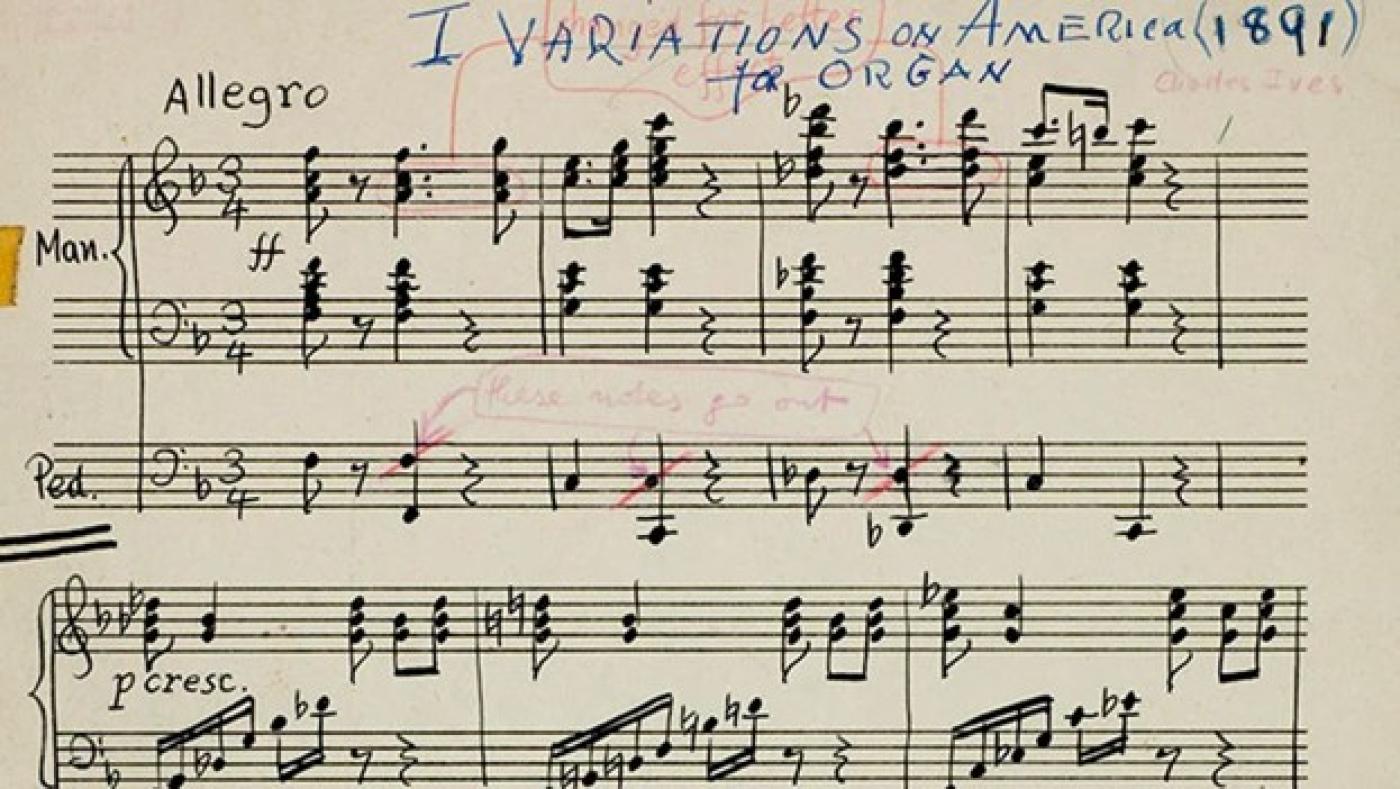
But the music Ives grew up with was not just his father's antiphonal band experiments. He studied classical music; he started playing organ for his church at age 14 and was fully steeped in the New England hymnody tradition; he knew the sentimental parlor songs of Stephen Foster and the like, and he knew the Saturday night fiddle tunes. He also knew the patriotic songs that would be sung in schools and the town square. The Star-Spangled Banner wasn't codified as the national anthem until 1931, so before then there were several de facto anthems, including the song called America that begins “My country, tis of thee”. This song was created by a Bostonian named Samuel Francis Smith in 1831 and was a revolution in action, because it took the melody of the British anthem to its monarchy and put lyrics to it celebrating liberty, democracy, the fight against tyranny and the majesty of the American landscape. By 1843 new lyrics were added making it into an abolitionist anthem. The 17-year-old Charles Ives was well aware of this history, and he wrote a series of variations on the melody for organ, which he performed the following year on July 4. Variations on America is a pretty wild ride for 1892, with the kind of dissonance and sudden changes in tempo and tonality one would associate with music written 20 years in the future, but the fact that it was deemed appropriate for a family holiday celebration is a testament to how well Ives knew his audience and how much he is the product of his hometown. Since this is an instrumental work, Samuel Smith's lyrics aren't available to provide its rebuke to the melody's British origins, so Ives takes on the job himself by treating the melody with a very American insouciance, even brattiness, an apt response to God Save the King on Independence Day.
He found many ways to transform his father’s clashing marching bands into sound collage. His works are full of a variety of familiar tunes in unfamiliar guises and juxtapositions, sometimes to make a joke or political point, sometimes to create an almost cinematic slice of life, and sometimes to reach for a mystical transcendence. He accomplished all three in his work “From Hanover Square North, At the End of a Tragic Day, the Voice of the People Again Arose”, about an incident he witnessed on his commute home from Manhattan.
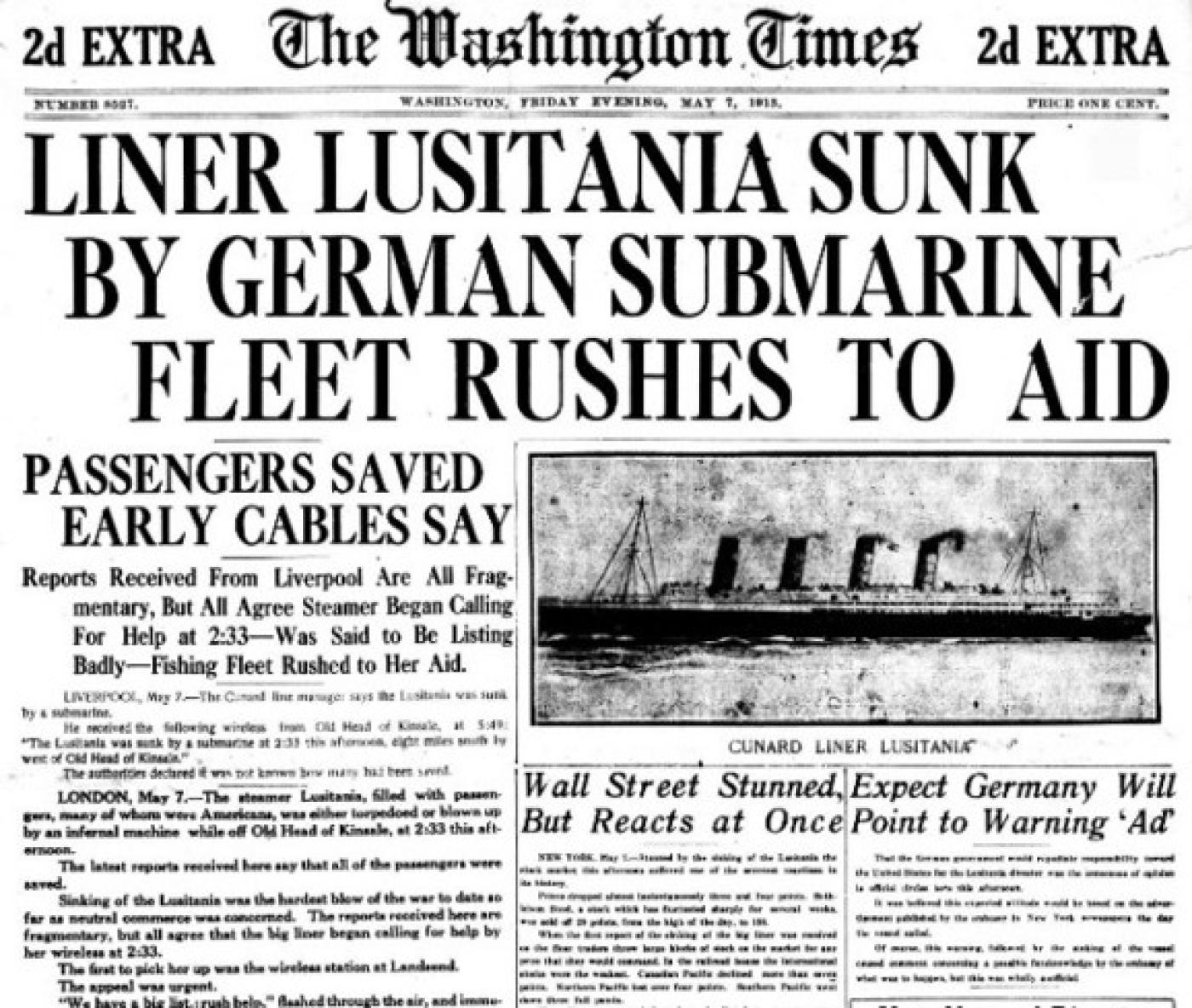
On Friday, May 7, 1915, at 9:30 AM EST, German U-boats torpedoed the American liner Lusitania, killing some 1,200 people and leaving the United States little choice but to join in the protracted, bloody conflict now known as World War I. Thanks to radio and wire services, most Americans knew about the tragedy by the time of their evening commute home from work, including Charles Ives, whose insurance firm, Ives & Myrick, had its offices at 38 Nassau Street. Ives wrote the following:
We were living in an apartment at 27 West 11th Street. The morning paper on the breakfast table gave the news of the sinking of the Lusitania. I remember, going downtown to business, the people on the streets and on the elevated train had something in their faces that was not the usual something. Everybody who came into the office, whether they spoke about the disaster or not, showed a realization of seriously experiencing something. (That it meant war is what the faces said, if the tongues didn't.) Leaving the office and going uptown about 6 o'clock, I took the Third Avenue "L" at the HanoverSquare Station [Stone and Pearl Streets, just south of Wall Street]. As I came on the platform, there was quite a crowd waiting for the trains, which had been blocked lower down, and while waiting there, a hand-organ, or hurdy gurdy was playing on a street below. Some workmen sitting on the side of the tracks began to whistle the tune, and others began to sing or hum the refrain. A workman with a shovel over his shoulder came on the platform and joined in the chorus, and the next man, a Wall Street banker with white spats and a cane, joined in it, and finally it seemed to me that everybody was singing this tune, and they didn't seem to be singing for fun, but as a natural outlet for what their feelings had been going through all day long. There was a feeling of dignity all through this. The hand-organ man seemed to sense this and wheeled the organ nearer the platform and kept it up fortissimo (and the chorus sounded out as though every man in New York must be joining in it). Then the first train came and everybody crowded in, and the song eventually died out, but the effect on the crowd still showed. Almost nobody talked-the people acted as though they might be coming out of a church service. In going uptown, occasionally little groups of would start singing or humming the tune.
Now what was the tune? It wasn't a Broadway hit, it wasn't a musical comedy air, it wasn't a waltz tune or a dance tune or an opera tune or a classical tune, or a tune that all of them probably knew. It was (only) the refrain of an old Gospel Hymn that had stirred many people of past generations. It was nothing but--"In the Sweet Bye and Bye." It wasn't a tune written to be sold, or written by a professor of music--but by a man who was but giving out an experience.
[From Hanover Square…] is based on this, fundamentally, and comes from that "L" station. It has secondary themes and rhythms, but widely related, and its general makeup would reflect the sense of many people living, working, and occasionally going through the same deep experience, together.
The movement graphically depicts this episode through an imaginative use of the orchestral palette. First one hears percussion and piano softly creating the clicks and clanks of commuter train tracks --never completely silent even when there's no train in the station. The woodwinds play the sound of faraway horns and squealing of brakes. Eventually the cellos enter with the tune, tentatively at first, and then the rest of the orchestra gradually comes in, building toward the climax, when we hear the wildly dissonant, cacophonic sound of the train rolling into the station, with the gospel hymn triumphantly blaring in the brass and timpani above it. The movement ends quietly, with the same noises with which it began, while a hurdy-gurdy softly plays the tune. Charles Ives graphically and lovingly painted this picture in music all in the space of ten minutes.
Of course, Ives didn’t invent the idea of a sound collage, or even the atonal juxtaposition of discrete tonal elements. But what he did do is to use those techniques to portray America and its spirit in a way no one else ever has.
PBS PASSPORT
Stream tens of thousands of hours of your PBS and local favorites with WETA+ and PBS Passport whenever and wherever you want. Catch up on a single episode or binge-watch full seasons before they air on TV.