I wonder if you know our situation here? We see that small countries are invaded from one day to another quite unexpectedly by the most terrible armies and subjected to tortures of every kind. As for my own country, now, instead of one dangerous neighbor, we have got two of them; nobody knows what will happen the next day. It may happen, if I leave my country for America, that I can’t return, can’t even have news from my family.
Béla Bartók wrote those words in 1939 in a letter to Harold Spivacke, the chief of the Music Division of the Library of Congress. Bartók had reason to believe that Spivacke could help him in his dilemma. The Library of Congress had achieved a reputation for being a place the greatest minds from all over the world could find a home for their work, where it would be preserved and disseminated for research and perusal by scholars and the general public. This was an invaluable service for those whose accomplishments were little appreciated where they lived or where their freedom of expression was in danger due to their countries' turn to authoritarianism. And in the dark years just prior to World War II, the Library of Congress became a place where the great musical artists of Europe found a safe haven which could not only preserve their work, but actually save their lives.
When the Library of Congress opened its Chamber Music Auditorium, now known as the Coolidge Auditorium, in 1925, due to the extraordinary generosity and superhuman efforts of Elizabeth Sprague Coolidge, it would have been impossible to predict just how tremendous its impact would be over the course of the next 100 years. But Ms. Coolidge might have had an inkling that its significance lay well beyond simply being a concert venue. in 1926 she wrote, referring to her own institution in the third person: "If the Elizabeth Sprague Coolidge Foundation might foster the interests of musicians, both creative and interpretative, by freeing them from the power of advertising middlemen such as manufacturers, managers, publishers and critics, I should consider it a service, rendered by a small corner of our Government, to Art, to America, and therefore to the idealism of the world." Not only did her foundation go on to fulfill that mission, but by creating a physical space where these efforts could be manifested, it helped overcome not only the commercial pressures musicians faced but political and even existential ones as well. By inviting the world's great musicians to come and play at Coolidge Auditorium, it created an entry into the United States, enabling those needing a way to escape the violence of the war gain a foothold into America and its culture. Once one has played the Coolidge, one has gained access to the American music community.
It was evident from the beginning that just because the auditorium was established as an American institution under the aegis of the Federal government, it did not mean it would confine itself to showcasing American artists - indeed, it was understood from the beginning that its identity as American obligated it to open its doors to the great artists of the world. Within a couple of years of its opening many of the greatest composers of the time appeared as performers in the Coolidge: Igor Stravinsky, Ernest Bloch, Ottorino Respighi, and Paul Hindemith, to name just a few. The great conductors of the day, including Leopold Stokowski and Serge Koussevitsky, came to conduct chamber orchestras, and another, George Szell, played piano in chamber music collaborations. The supremely influential teacher and conductor Nadia Boulanger conducted a repertoire spanning 300 years. And the greatest international soloists and ensembles played on the Coolidge stage, from Gregor Piatigorsky to the Budapest String Quartet to the great Hungarian violinist Joseph Szigeti.
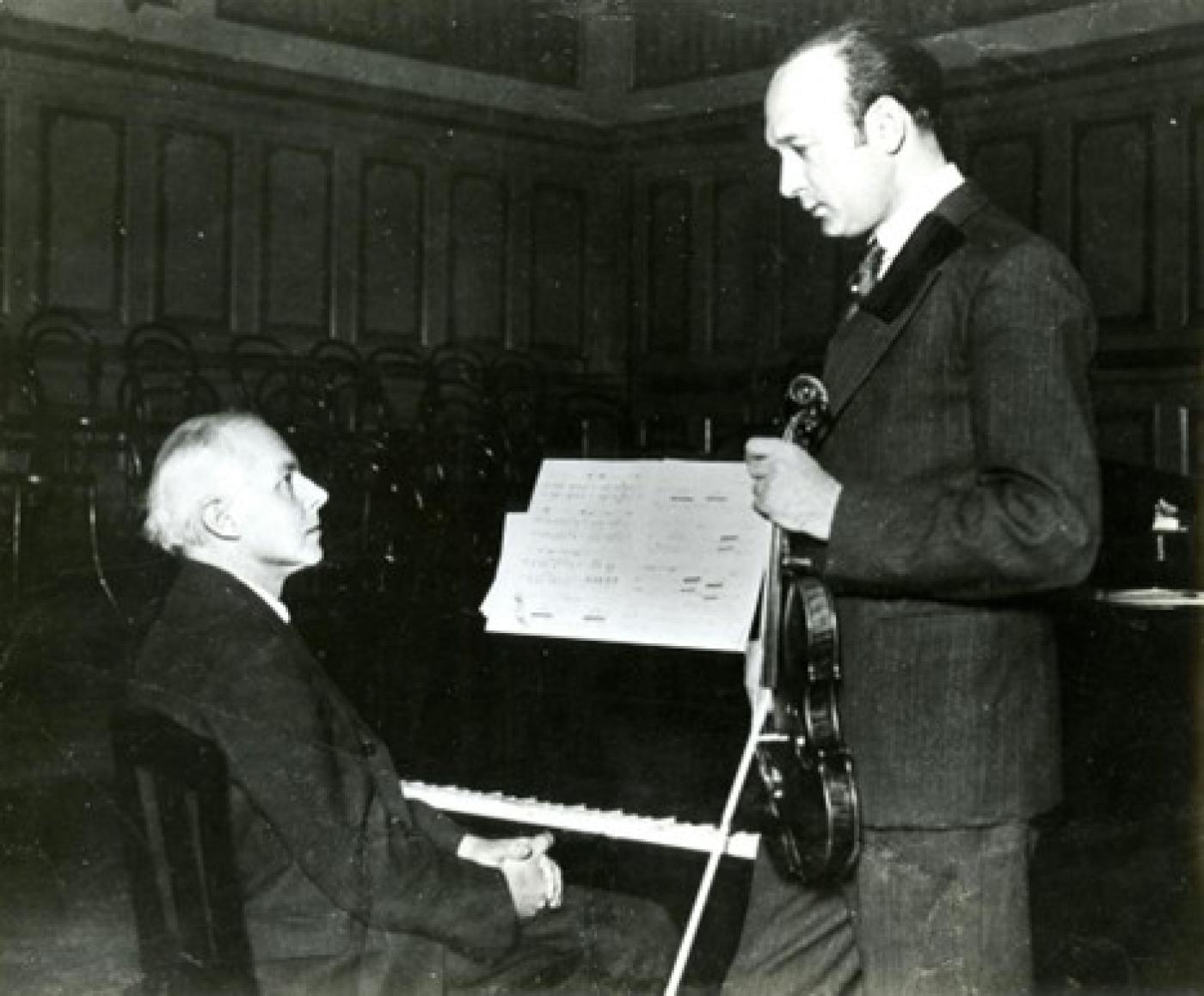
Joseph Szigeti made his first appearance at the Coolidge on the occasion of the hall's first anniversary, on October 30, 1926. The major work he performed on that occasion was Beethoven's Kreutzer Sonata with pianist Alfred Cortot. And it was that work that he played again on that same stage in 1940 with his countryman and longtime friend Béla Bartók.
Like Bartók, Szigeti was very concerned about the increasingly dangerous situation in Hungary, which took on added urgency because Szigeti was Jewish. He emigrated with his wife to California in 1939. Meanwhile, Bartók's situation was becoming increasingly precarious; as he told Harold Spivacke, he had, quote, "come into a really desperate state of mind." His music was being subjected to tests of ideological purity by the Third Reich, and in response he forbade his music to be broadcast in Germany or Italy. This virtually suspended his career in Europe, and he knew he and his family would be targeted when Hungary fell to the Nazis, which was looking increasingly inevitable. One of Bartók's major concerns was his mother, whose poor health prevented her from being able to move; but that impediment was sadly lifted in December 1939 when she died. He then quickly went to work to move himself and his wife to the United States.
Bartók's correspondence with Spivacke was intended to lay the groundwork for his emigration to the U.S., and this strategy paid off. In retrospect it's truly remarkable that he was able to set up a concert with Szigeti at the Coolidge for April 13, 1940, less than four months after his mother's death. And it's even more astonishing to us who are used to instant communication and air travel that he was able to make all the arrangements by mail, and travel to the U.S. by boat after traversing Europe during the first months of WWII. He arrived in New York Harbor on April 11, giving him two days to get to Washington, D.C. (remember there was no Acela back then), rehearse for the concert, and hopefully get some sleep. It should be noted that Bartok had just turned 59 and was himself in declining health; this was only five years before his death due to leukemia. So just in physical terms this was a remarkable act of stamina.
We don't know how much time they spent rehearsing or individually practicing. Both performers were past their prime in terms of their technical mastery of their respective instruments. They both still had the dust of the road on them, and the war and concern for their relatives in Europe were weighing heavily on their minds. Bartók had no idea how he was going to make a living. And they were all too aware that this concert was going to be recorded and broadcast and attended by powerful people who could decide both of their futures; despite the fact that both men were famous and in advanced middle age, in practical terms they were forced to seek sponsorship and reboot their careers to meet the tumultuous moment. This was not only due to the war, but to technological advances and changes in the American economy that were reshaping the music industry - a situation any 21st century musician is all too familiar with. In a letter dated April 2, 1940, Bartók referred to this concert then 11 days away as his "first and most important recital." Of course, this was far from his first recital, but this comment indicates his awareness that he was being forced to start over again; the stakes were high.
So we can only imagine how those two masters felt as they walked onto the stage on that unseasonably cool Saturday night in April: temperatures were in the thirties, and there was even a stray snowflake or two spotted earlier that day in the nation's capital. It was probably cold in the hall as well, though it helped that it was filled to capacity. Fortunately, we don't have to imagine how the concert actually sounded, since it was recorded and has become legendary as one of the landmark events in the history of the Coolidge. It was certainly not technically perfect; these were not pristine versions of Beethoven, Debussy, or even Bartók's own works. But it was genuine, electrifying music making from two musicians who knew these scores and one another inside out. The effect was similar to that of the field recordings Bartók made of Eastern European folk music. Technical considerations are beside the point, because you can tell that these performers owned this music.
The concert began with its longest work: Beethoven's Kreutzer sonata. There are interesting parallels between this iconic performance and the sonata itself. The piece had to be completed hastily to get it ready in time for its premiere performance on May 24, 1803, and there was no rehearsal at all; its original dedicatee, George Bridgetower, had to read the part, with its frequent tempo changes and concerto-like technical demands, at sight. Its three giant movements seem to occupy three different universes; the highly dramatic, almost symphonic first movement inspired Leo Tolstoy's highly dramatic novella The Kreutzer Sonata, which, like this piece, is small in scale but possesses a novelistic breadth. The second movement is, by contrast, a serene but probing set of variations, while the last movement was a last-minute repurposing of a finale discarded from an earlier violin sonata in A major. I suppose one could say that this sonata, like the performance we're about to hear of it, is a big unruly mess that shouldn't work, but not only does but is one of the greatest artistic achievements of all time.
The program also provided those fortunate enough to be in that audience that night a rare opportunity to hear a staple of the repertory played by its most ideal performers: the composer and the person for whom it was written and to whom it was dedicated. Bartók’s Rhapsody no. 1, based on melodies largely from the Transylvanian region that the composer collected during his youthful ethnomusicological endeavors, was composed in 1928 for Szigeti.
Also included on that program was Claude Debussy’s Sonata for Violin and Piano (the composer’s final major composition), and Bartók’s Violin Sonata no. 2 (1922).
By the way, five years and five days earlier on that same stage, on April 8, 1935, the Kolisch Quartet gave the world premiere performance of Bartok's String Quartet no. 5, and the original manuscript of that work lives at the Library of Congress.
PBS PASSPORT
Stream tens of thousands of hours of your PBS and local favorites with WETA+ and PBS Passport whenever and wherever you want. Catch up on a single episode or binge-watch full seasons before they air on TV.