Playlist
| Name | Download |
|---|---|
| Playlist for America 250 Episode 7 |
Henry Cowell was born in the San Francisco Bay Area in 1897. His parents divorced when he was 5, by which time he had already displayed an affinity for music, advanced language skills and a curiosity about different cultures. He was nine when the great earthquake of 1906 struck, and he and his mother lost everything in the ensuing fire. The two of them became penniless nomads for four years, traveling around the country staying with various friends and relatives, and when they returned to San Francisco, Henry immediately went to work at whatever job a 13-year-old could get to save up for a piano. Two years later he bought one, a used upright. He practiced hard, and after two more years, at age 17, with no formal education or musical training, he was accepted as a student at the University of California at Berkeley, to study composition with the renowned musicologist Charles Seeger (who five years later would have a son named Pete Seeger who became a famous folksinger but that's a story for another day). Anyway, after two years at Berkeley the now 19-year-old Henry Cowell presented his very first composition to professor Seeger: Dynamic Motion.
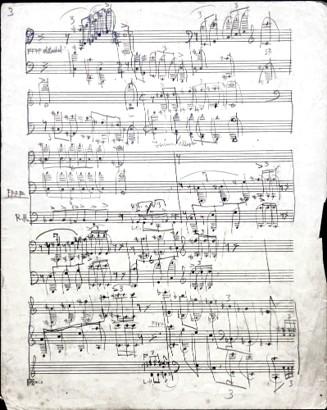
When he showed it to Professor Seeger, he gently replied that this might make audiences react with hostility, and he turned out to be correct. But it was enough to convince him that Henry was ready for a major conservatory, and so he recommended that he be accepted at the Institute for Musical Art in New York - which would eventually change its name to the Juilliard School. Henry Cowell went but ended up dropping out after three months, finding the atmosphere too stifling, but it was still a worthwhile trip because he made some contacts that would prove to be valuable. In any case school would have been interrupted anyway because there was a war on. Henry, now 20, knew that he had a better chance of avoiding combat if he enlisted instead of waiting to be drafted, so he spent the war training as a medic and helping direct the Army band. After he got out he returned to California, where one of his first projects was writing music for a play called The Building of Banba, based on ancient Irish mythology, The prelude he wrote for the production was called The Tides of Manaunaun. The deep sound you hear recurring throughout the piece is a tone cluster made with the left forearm, playing thirteen notes at once, but the effect is not noisy but deeply musical and pictorial, representing the primal rhythm of the ocean as the right hand plays stark modal chords, representing the different stages of the building of the universe. It became one of Cowell's best-known works: it was published twice as a piano roll, and in 1933 Edwin Hughes played it at the White House as part of the first cultural event of the Franklin D. Roosevelt administration.

Cowell continued to prolifically compose and develop his own extended techniques for the piano; when he was 22 he began writing a book about them called New Musical Resources, which he worked on for eleven years and when it was finally published in 1930 it was considered a sort of bible for many 20th century composers like John Cage, Lou Harrison, Conlon Nancarrow, and even George Gershwin, who was already famous and only a year younger than Cowell but looked up to him as a mentor. (Cowell also introduced his former professor Seeger to a student who would become his second wife and the mother of two more great folksingers , the composer Ruth Crawford.)
Another innovative way Cowell had of playing the piano was to actually go inside the instrument. To invoke the sound of the Banshee, a wailing spirit in Celtic mythology, Cowell has the pianist play the strings of the piano with their fingers, using one of twelve techniques he indicates involving both plucking and scraping with the fingernails, while a second player or a cinder block holds down the pedal.
By the mid-1920s Cowell was both famous and infamous: he went on a concert tour in Europe, and when he played in Leipzig, Germany, several members of the audience started a riot, loudly insulting the music, and it became so violent and disruptive that the police came and made 20 arrests. But when the great Hungarian composer Béla Bartók went to one of his concerts, he asked Cowell whether he could use those tone cluster techniques in his own compositions. Before he turned thirty Cowell was already the unofficial leader of the American avant-garde, and he used his influence to promote the music of others as well as his own. He began a journal called New Music Quarterly that would publish scores and essays by contemporary composers, and one of its major underwriters was none other than Charles Ives, who became one of Cowell's most prominent champions. Cowell soon expanded his journal's reach to promote Latin American music as well, and Cowell himself began focusing on ethnomusicology. As he approached his fortieth birthday it seemed like all was going well for Cowell - until he got arrested.
To make a long sordid story short, he was brought up on what they called a "morals" charge, which is how the U.S. government criminalized homosexuality at the time. He was sentenced to fifteen years in prison, and he went to San Quentin, at the time one of the roughest penitentiaries in the country. Several prominent composers rallied to defend him, including Aaron Copland, which probably helped him since he was paroled after serving four years, and he was fully pardoned by the governor of California two years after that. Those four years in prison were very traumatic for Cowell and he never fully recovered from them, but while he was in prison he never stopped working on music. He composed over sixty works while incarcerated, and he taught music to his fellow prisoners and organized them into ensembles that he coached. After his release, his style became much more conservative, and, like Copland, he became interested in American folk music and a more populist style, typified by his series of Hymn and Fuguing Tunes, inspired by the works of William Billings, and scored for a variety of instrumental combinations.
One of the many composers influenced by Henry Cowell was John Cage. Cage is most famous for what he would later refer to as his “silent piece”, 4’33, in which the performer sits idle and the audience listens to the ambient noise that occurs during that time as if it were a piece of music. It’s perhaps the most extreme illustration of his philosophy of music. (Tellingly, when he was fifteen years old, he delivered, as class valedictorian, a speech at Hollywood Bowl, proposing a day of quiet for all Americans.) But he did write many pieces that involved actual sound.

Cage was also the inventor of the prepared piano. While it was clearly inspired by Cowell’s extended techniques, it was also a practical solution to a problem he encountered while accompanying a dance class in a school with cramped facilities. They wanted to do a piece involving a percussion ensemble, but there was no room for them in the studio. So Cage attached various objects to the strings of the piano to create a variety of different percussive sounds.
He wrote more music for the prepared piano than for any other instrument, demonstrating that it was far more than a noisy gimmick: Cage’s prepared piano music contains some of his most personal expressions: sad, wistful, meditative, joyful, contemplative and energetic. He also wrote works for the toy piano, and, perhaps most radically of all, also wrote some beautiful, lyrical works for a non-prepared piano played in the conventional manner.
Another acolyte of Henry Cowell’s, who called him “the mentor of mentors”, was Lou Harrison. Like Cage, he was fascinated by percussion, and collaborated with him on several pieces for a percussion ensemble that included automobile brake drums. And, also like Cage, Harrison was particularly drawn to Asian music and culture. If you've heard a live performance of Indonesian Gamelan music in the United States, you have Lou Harrison to thank, since he's the reason many universities have established their own gamelans, many building their own instruments out of found materials that are meticulously tuned to the unique Indonesian pentatonic scale.

And, like Cowell and Cage, he couldn't leave the piano alone either; he was very fond of the tack piano, which is just an upright piano with thumbtacks pushed into the hammers to create a metallic sound when they hit the strings. Harrison didn’t invent the tack piano – it had been used for everything from ragtime music to a substitute for the harpsichord (Glenn Gould used one as a continuo instrument) – but Harrison used it in a way no one else had, as a way to emulate the Javanese zither that is played with gamelan orchestras. He employed the tack piano in what is perhaps his most monumental work, his Symphony no. 2 “Elegaic”, which was dedicated to another maverick composer, Harry Partch, who built instruments and devised new tuning systems.
American Mavericks have taught us new ways of listening to and relating to music. While they didn’t quite go in the direction Dvořák suggested, they had to deal with issues he hadn’t anticipated, like the rise in technology and global conflicts that made divorcing American music from its European models seem urgent. And the advent of recording played a role in American composers choosing to create music that was best experienced live for its unique resonance and sonic effects. This occurred at a time when there was a decisive schism within music: serious, popular, and “modern.” These composers knew they weren’t writing for the same audience that enjoyed jazz, symphonic music, or the performances by Charles Seeger’s children. The recording industry divided music and put in all in different boxes. The mavericks reminded us that the true, primal experience of music, expression through sound and time, transcends all attempts to categorize it.
PBS PASSPORT
Stream tens of thousands of hours of your PBS and local favorites with WETA+ and PBS Passport whenever and wherever you want. Catch up on a single episode or binge-watch full seasons before they air on TV.