The history of the cakewalk is fascinating and complex. It derives from African American culture of the 19th century both before and after emancipation, an elaborate mockery by slaves and former slaves of the supposed stateliness and dignity of plantation owners, dripping with irony and an encoded empowerment narrative that was completely lost on the white performers who appropriated it for themselves, who in turn used it in their blackface minstrel shows. In any case by the turn of the century it was enormously popular among both blacks and whites, rising in tandem with ragtime. A French vaudeville performer named Eugénie Fougère performed in New York in the 1890s and returned to Paris in 1900 with a cake walk performance that caused a sensation, resulting in the French adapting the cakewalk for themselves, so that by 1908 when Debussy wrote “Golliwog’s Cakewalk” for his suite Children’s Corner his audience would have caught that reference as readily as they caught the rather cheeky reference to Wagner's Tristan and Isolde that's also in that piece. And so it was that at the dawn of the 20th century, a form of music that originated in the United States was wholeheartedly embraced by the French. This was a significant milestone, since up to this point Americans were seen as consumers of European culture, and now the transaction was starting to go both ways as the Americans finally had a culture that could be exported and consumed in Europe.
Twelve years later, a world war came and went, and by now it was clear that those upstart Americans were on track to dominate the global culture. Jazz was everywhere. In 1922, a 30-year-old French composer named Darius Milhaud went to New York's Harlem neighborhood to absorb himself in American jazz. By this time Milhaud had already been to Brazil, and had composed pieces steeped in its popular music - but when he heard jazz, he realized that it was its own musical language that required its own study. He put that study to use when he was commissioned to write a ballet. He called it La Création du monde (The Creation of the World), and it drew on African folk mythology for its scenario. For its orchestra, he used an ensemble of eighteen musicians that drew on instruments that could be found in both a classical orchestra and a jazz band: 6 woodwinds, one saxophone, four brass, four solo strings, piano, and two very busy percussionists The form of the piece similarly straddled the two styles, using the structure of a Baroque prelude and fugue which, as the piece progresses and the newly created planet continues to develop, morphs into episodes of wild and complex Dixieland jazz.
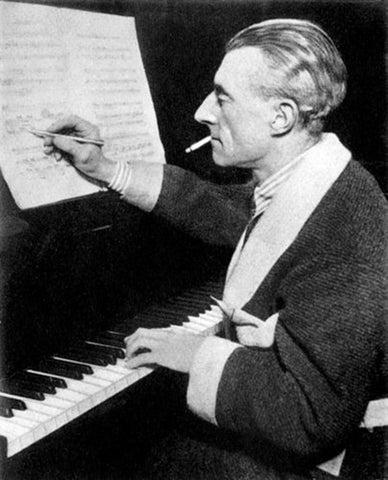
Perhaps Milhaud's most famous countryman and contemporary was Maurice Ravel, and he, too, fell under the spell of jazz. The second movement of his second sonata for violin and piano is subtitled “Blues”. It's not really a blues, but he knew that. As Ravel himself put it: “Fascinated as I am by this idiom, I cannot possibly feel it as I would if I were an American.”
Igor Stravinsky was Russian, not French, but it was in France that he established his career through his work with the Ballet Russes, a group of Russian artists who escaped the tumult of the Revolution by going to Paris where they did something they could no longer do in Russia itself: bring the distinct Russian creative voice into the modern era by freely engaging with other ethnicities and art forms. Stravinsky made his name with his three Russian ballets - The Firebird, Petrouchka and The Rite of Spring - each one of them based on Russian folk material. Throughout the three works their Russian-ness becomes refracted and deconstructed much the same way Pablo Picasso was doing at the same time in the same city with his Cubist approach to representational images. Shortly before WWI broke out and he was forced into exile in Switzerland, Stravinsky heard some of the first American jazz bands that made their way to Paris. When he set to work on a wartime chamber drama about a soldier's encounter with the devil, he used those same quasi-Cubist deconstruction techniques on those memories of his encounters with jazz, and the result was one of his most groundbreaking works, L'Histoire du soldat. The piece may not sound like jazz, exactly, but it could not have existed without jazz, and it created a two-way conversation, since some jazz musicians like Charlie Parker were influenced by Stravinsky to help create a new type of rhythmically arresting jazz called bebop.
Another 20th century Russian composer who was fascinated with jazz was Nikolai Kapustin. He was born in Ukraine, then under Soviet occupation, in 1937. He was a child prodigy who graduated from the Moscow Conservatory with honors at age 23, but what his professors didn't know is that he had been teaching himself jazz at the same time that he mastered classical piano, and it was jazz that he initially pursued, playing in a state-sponsored big band that played in the style of Count Basie. In the 1980s he decided to devote himself to composition. He has frequently been called the Russian Gershwin for the way he seamlessly incorporates the language of jazz into classical forms.
France and Russia have gone through many changes, but they continue to be big fans of jazz, which at this point is probably more popular in those countries than in its country of origin. But we Americans are glad you’re still listening to our music. You’re welcome.
PBS PASSPORT
Stream tens of thousands of hours of your PBS and local favorites with WETA+ and PBS Passport whenever and wherever you want. Catch up on a single episode or binge-watch full seasons before they air on TV.