Playlist
| Name | Download |
|---|---|
| Playlist for America 250 Episode 3 |
It seems fitting that the first major European work in the realms of both theatre and music to gain popularity in the United States would be revolutionary - but not in a noble way. We're not talking about a Shakespeare play or a Handel oratorio or a Mozart opera or a Beethoven symphony (though all those artists eventually proved to be tremendously influential in the development of American culture). No, the work that actually kickstarted performing arts in America was intended to be the antithesis of the very notion of a masterpiece and the whole idea of art as moral instruction or spiritual enrichment. Like the Boston Tea Party, this work was intended to be an insouciant response to the intransigence and corruption of British institutions and even specific politicians. And just as the Tea Party marked the point of no return in the conflict between the colonies and the crown (and helped cure Americans of their tea habit – they switched to coffee en masse as a gesture of patriotism) the work in question forever changed British culture and its relationship to one of its defining products: opera. I'm talking about The Beggar's Opera.
The work has an impressive provenance. The original idea of applying dramatic conventions used to tell stories of Greek gods interacting with nymphs and shepherds to a gritty story of contemporary London’s criminal underworld came from no less a figure than Jonathan Swift, who suggested it to Alexander Pope, who in turn suggested it to John Gay, a poet and playwright who wrote a three-volume narrative poem with the very cool name of Trivia, or the Art of Walking the Streets of London – which was published in 1716, though both its title and much of its content would have been perfectly at home in an early 1960s café – and, two years later, collaborated with George Frideric Handel on the latter’s first setting of an English text, Acis and Galatea, which became Handel’s most popular dramatic work during his lifetime. He manifested Swift and Pope’s vision with a blistering satire both of outdated operatic tropes (including his own work with Handel) and of the deep well of London’s corruption, an economy that relied on a delicate collusion between sophisticated crime syndicates and brazenly hypocritical government officials that could be undone at any moment by ego, ambition, greed, lust, or even a fleeting moment of moral clarity. The story concerns one particularly smooth criminal named Macheath, a highwayman robber with a long successful career, who has eloped with Polly, the daughter of Peachum, the head of a crime syndicate. Macheath’s downfall turns out to be the numerous women he has loved and abandoned before committing to Polly, and they betray him to the law. While he’s hardly admirable, Macheath’s love for Polly seems to be genuine, and he's far from the play's most morally challenged character. That could said to be someone who doesn’t actually appear in the play: Sir Robert Walpole, the notoriously corrupt statesman who is now recognized as Britain’s first prime minister. His depiction in Beggar’s Opera was so transparent to its first audiences that when Walpole attended a performance he was compelled to take a bow.
But perhaps Beggar’s Opera’s most radical element was its score: instead of original music, it’s a collection of 69 tunes from a wide swath of sources, including centuries-old folk songs, country dances, airs by British composers like Thomas Arne and Henry Purcell, and even a couple of melodies from Handel operas. John Gay selected the tunes and fit his words to them. His radical original vision was to have the actors sing a cappella, but at the last minute the producer John Rich insisted on using a small orchestra to accompany the singers, play an overture, and incorporate some dance music as well. (The task of composing and arranging all this fell to Johann Christoph Pepusch, who, like Handel, was a successful German expatriate composer in London.) While this somewhat undercut Gay’s conception of the piece as an anti-opera, it also ensured its success, since now it was like having one’s cake and eating it too: a work that satirized opera while also indulging some of its aesthetic excesses. The result was a smash hit.
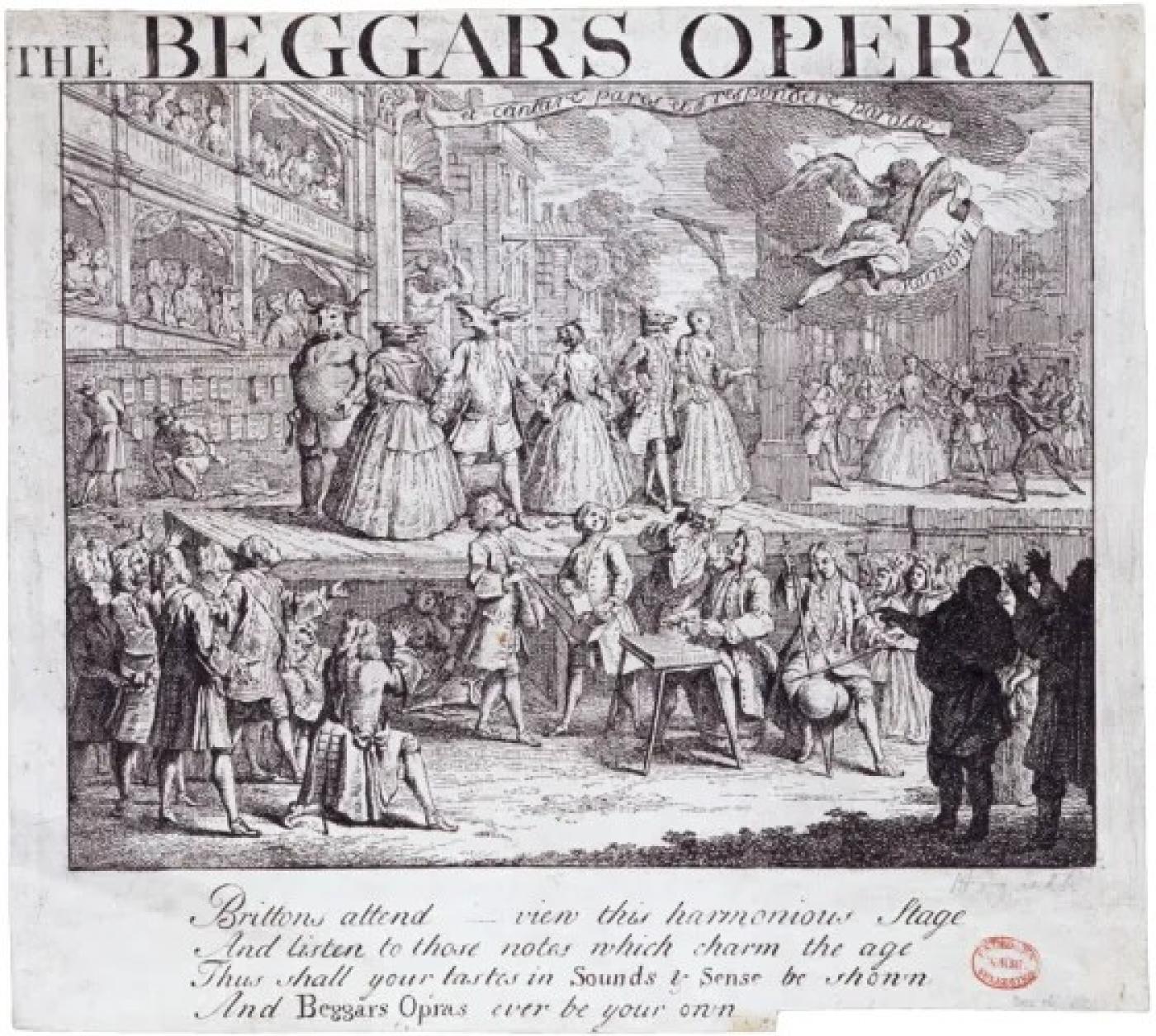
By the time of Beggar’s Opera’s premiere in January 1728, Handel had written many of his greatest operas and the improbably successful London opera culture – which entailed German composers writing works in Italian for an English-speaking audience – had reached its peak. While this enthusiasm was rooted in Handel’s justly exalted reputation, the thrill of hearing the almost otherworldly, superhuman abilities of the great Italian opera singers including the celebrated castrati, the spectacle of stagecraft onstage and the equally entertaining cross section of English society in the audience, there was also an undercurrent of the British inferiority complex about its own culture, reflexively assuming that anything from Italy or Germany was of course going to be better.
The Beggar’s Opera upended this narrative. The play demonstrated that the Brits were second to none when it came to combining social and political satire, memorable characters, and compelling storytelling, while its score was a veritable celebration of Britain’s musical heritage. It was premiered in London in 1728 and initially ran for a record 62 performances, with many more productions to follow. While the piece was seemingly made to be ephemeral, making jokes intended to be hilarious for a particular audience at a particular time and place, it proved to be remarkably resilient. It inspired fashion trends and a cottage of industry of merchandise, bearing likenesses of Macheath and Polly, and its libretto, which also included sheet music for its tunes, became a bestselling book. The Beggar’s Opera effectively killed the Italian opera craze, forcing Handel to switch to English oratorios to make a living. (Without itthere might have been no Messiah.)
And it even begot a new genre: “ballad opera”, because so many of its melodies were folk ballads. This new form became so popular so quickly that one of them, Flora, or Hob in the Well, by one John Hippisley, was published in 1732, made it across the Atlantic, and was performed in Charleston, South Carolina, in 1735, making it the first documented performance of any kind of opera or musical theatre in North America. The following year Flora was revived as the inaugural production of Charleston’s historic Dock Street Theater.
This is remarkable for many reasons; usually it took decades for an artistic trend in Europe to make its way to America, and it seems to defy logic that this brand-new art form made it here before any proper opera did.
PBS PASSPORT
Stream tens of thousands of hours of your PBS and local favorites with WETA+ and PBS Passport whenever and wherever you want. Catch up on a single episode or binge-watch full seasons before they air on TV.