Jamie Wilkes is currently playing Carl Philip Emanuel Bach in Oliver Cotton’s The Score, currently playing at STC Shakespeare Theatre Company starring Brian Cox as his character’s father Johann Sebastian Bach. He received his professional training at the London Academy of Music and Dramatic Arts – the same school where, half a century earlier, Mr. Cox received his training. This actually helped Wilkes get into character, because he was a long-time admirer of the elder actor’s work and looked up to him as a legend he hoped to emulate, much like CPE Bach’s relationship to JS Bach. That was just one of many fascinating observations he revealed to me in our interview (which you can listen to in the embedded audio). Jamie’s trajectory does in fact bear much resemblance to Brian’s: they have both worked at many of the same theatres and institutions, from the Edinburgh Fringe to the Royal Shakespeare Company, and Jamie has already accrued an impressive body of work in what Americans call “prestige television” and the Brits just call television, including a recurring role on His Dark Materials for HBO/BBC One.
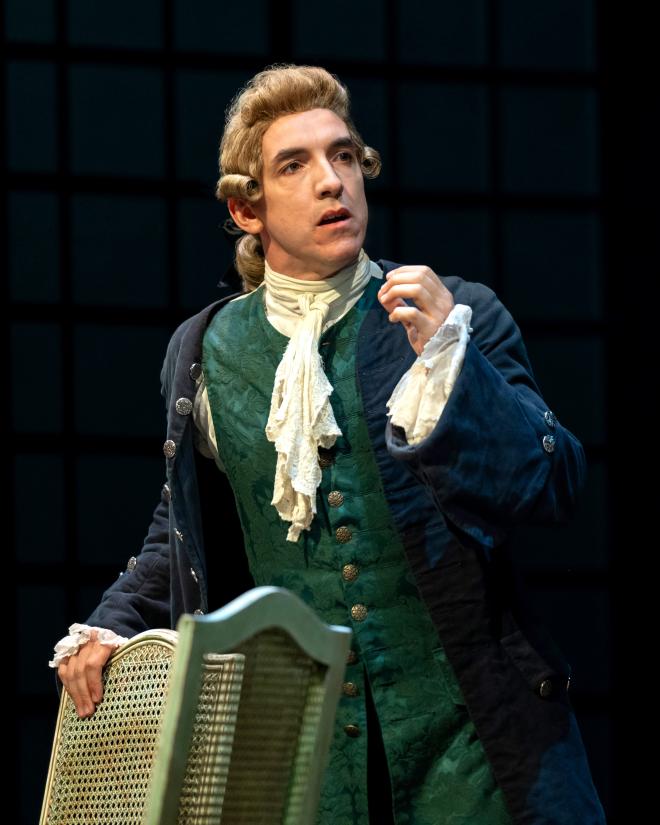
In addition to recommending that you listen to the interview, I’m also going to take this opportunity to recommend that you listen to more CPE Bach. He was a major musical figure in his own right who, more than any other single composer, led the transition from the harpsichord to the fortepiano and from the Baroque to the Classical eras. His real-life relationship to his father was, from all documented evidence, a bit frostier than is depicted in the play. JSB made no secret of the fact that he had a favorite son, and that was his eldest, Wilhelm Friedemann Bach. While WF was undeniably brilliant, talented and left behind some impressive works, it’s evident that he crumbled under the weight of his father’s expectations, never found stable employment, succumbed to alcoholism and died in poverty. Whereas CPE toiled away in his nominally prestigious but somewhat thankless position with Frederick the Great, produced what he was asked to without complaint, and organized his father’s papers to the extent that he could, though he noted that thoroughly cataloguing JSB’s compositions would be a full-time job that would leave him no time to compose his own.
A good place to start in exploring CPE’s output is in a trio of works that are in frequent rotation on WETA Classical: the concertos that he wrote in the early 1750s in the wake of his father’s death. Perhaps as a tribute to his father’s penchant for endlessly recycling and re-arranging his own music, CPE provided three different versions of each of these three concertos, so that the solo instrument could be flute, cello or harpsichord while the string accompaniment remains the same. The three concertos form a triptych that uses its temporal vantage point in the mid-18th century to sum up its musical trajectory. The first, in A minor, looks backward to the style of Vivaldi, but with a more spacious sense of development, so that each movement is the length of an entire Vivaldi concerto. The second, in B flat major, seems to be in the here and now of 1751, thoroughly steeped in the galant style favored by his employer the King. The third concerto in A major looks prophetically to the future, anticipating the Classical style of the 1770s and giving CPE an opportunity to shake off his taciturn impulses and produce one of his most freewheeling and deeply felt works.
And, finally, be sure to check out my guided tour of JS Bach’s Musical Offering, only available through the end of October.
PBS PASSPORT
Stream tens of thousands of hours of your PBS and local favorites with WETA+ and PBS Passport whenever and wherever you want. Catch up on a single episode or binge-watch full seasons before they air on TV.